

Stock-type laps that were selling briskly to retail investors after being pitched with 'target returns of 5–8%' are now exposed to loss risks. With the KOSPI falling more than 25% over the past three months, losses on target-conversion products remain unrecovered. The issue lies with KB Securities, which has seen a large influx of bank customers through its complex branches. Critics warn that this situation could repeat the Hong Kong H-Index ELS (equity-linked securities) crisis, given the high number of customers with low understanding of stock-type or target-conversion products.
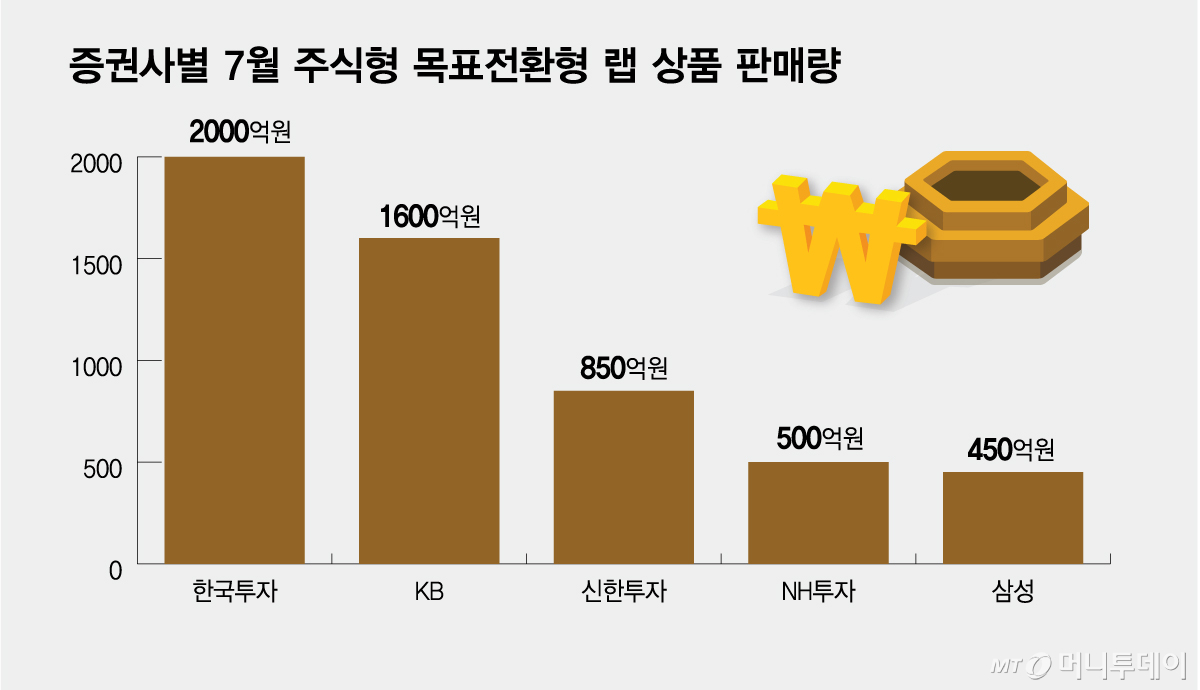
According to the financial investment industry on the 2nd, stock-type and target-conversion lap products were sold for at least hundreds of billions of won each by major firms even in July, just before stocks began to fall. Specifically, Korea Investment & Securities sold 2 trillion won worth of products in July alone; KB Securities sold 1.6 trillion won; Shinhan Investment Corp sold 850 billion won; NH Investment & Securities sold 500 billion won; and Samsung Securities sold 450 billion won. With the index failing to rebound after July, it is reported that losses on these products have not been recovered. The KOSPI's decline over the past three months stands at 25.44%. Portfolio stocks tracked by target-conversion lap products are also showing sluggish trends.
Target-conversion products are structured so that if the target return is achieved, the account is refunded and settled; otherwise, investors incur losses. While there is no fixed maturity date, invested funds can remain locked in accounts for extended periods. Analysts suggest that after the ELS crisis caused by a sharp drop in the Hong Kong H-Index led to investor losses and subsequently contracted bank operations, firms sought new avenues through similar products.
Target-conversion lap product sales for Korea Investment & Securities and KB Securities peaked in April when the KOSPI index continued to rise. In that month, Korea Investment & Securities sold 2.1 trillion won worth of products, while KB Securities sold 1.9 trillion won. As stock prices rose, existing target returns were achieved, leading to refunds, goal completion, and re-enrollment processes being repeated, which cumulatively increased sales volumes.
KB Securities has drawn attention due to its structure that allows bank customers to easily flow in through complex branches. The industry's common view is that bank customers are mostly deposit investors rather than professional investors, and word-of-mouth promotion is active. In fact, KB Securities saw its total assets under discretionary management contracts exceed 10 trillion won in the first half of this year at 10.7408 trillion won, while discretionary fees rose by 100 billion won year-on-year to 109.5 billion won, marking significant changes.
According to industry insiders from the lap and trust sectors, many customers visiting securities firms are aware of stock-type products and recognize the possibility of principal loss. Shinhan Investment Corp, a subsidiary of Shinhan Bank, is still grappling with issues related to the suspension of redemptions for Hong Kong Gentu Funds and the Lim Asset Management crisis, including claims for recourse, resulting in limited inter-affiliate transactions. NH Investment & Securities does not engage in any affiliated business at all. Korea Investment & Securities and Samsung Securities have no bank subsidiaries.
Notably, among products sold by KB Securities, some invest solely in single stocks. The advisory-type lap product for individual investors had assets composed only of single-stock equities such as SK Hynix and Samsung Electronics, along with cash. Single-stock equities accounted for an average weight of 29%.
A KB Securities official stated, "The proportion of bank-linked customers in stock-type laps is typically around 30%, so it is difficult to attribute the recent increase in enrollments solely to a large-scale inflow of bank customers." He added, "Target-conversion laps clearly inform customers that there is a possibility of principal loss and classify them as 'very high risk' products."
Meanwhile, retail sales operations at securities firms have contracted due to crises involving Lim Funds, Optimus, and ELS. Complaints were filed alleging that customers were not fully informed about the risks before purchasing products they did not fully understand, or that substandard corporate bond products were sold as normal ones, leading to massive compensation claims far exceeding the fees earned from such sales.

 in STOCK
