

While some BBB-rated companies struggled with unsold corporate bonds, securities firms received orders in the trillions of won, revealing a polarization phenomenon in the bond market. With rising market interest rates and credit events such as the Central Group default, institutional investors have been increasingly scrutinizing issuers' financial conditions and industries, according to assessments.
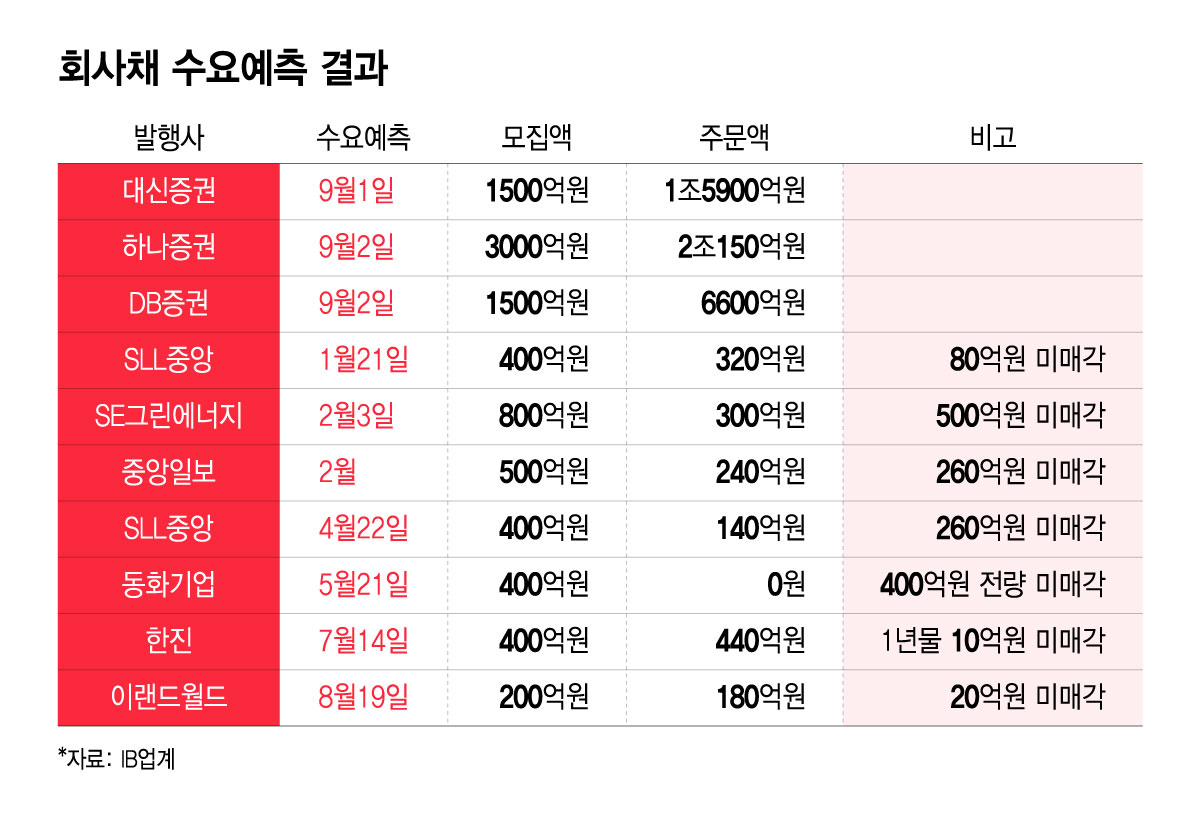
According to the IB (investment bank) industry on the 3rd, Daishin Securities received orders totaling 1.59 trillion won in a 150 billion won corporate bond demand forecast conducted on the 1st—more than ten times the offering amount. On the 2nd, Hana Securities secured orders of 2.15 trillion won for a 300 billion won offering, and DB Securities secured 660 billion won for a 150 billion won offering. These securities firms were approved to issue bonds at underpricing conditions, with individual minimum pricing rates 9 to 11 basis points (1bp=0.01 percentage point) below the market rate in certain maturity segments. It is interpreted that the issuance conditions for corporate bonds by securities firms have been relatively favorable due to expectations of improved securities industry performance.
In the BBB-rated category, Dongwha Enterprise, a construction materials company, received no orders at all in its 40 billion won demand forecast on May 21, resulting in a full unsold status. JoongAng Ilbo also managed to secure only 24 billion won out of a 50 billion won offering in February. SLL Central raised 40 billion won each on January 21 and April 22, but orders remained at 32 billion won and 14 billion won, respectively. Starting in June, the Central Group saw its affiliates sequentially enter corporate rehabilitation procedures following JTBC's declaration of default after failing to repay 20.6 billion won in securitized loans upon maturity. Last month on the 19th, iLand World also received orders totaling only 18 billion won out of a 20 billion won offering.
Following the unsold status, Dongwha Enterprise faced downward pressure on its credit rating. Korea Ratings maintained Dongwha Enterprise's unsecured corporate bond rating at BBB+ on the 1st but lowered its outlook from "stable" to "negative." Continuing operating losses from electrolyte solutions and overseas wood board subsidiaries led Dongwha Enterprise to report an operating loss last year, followed by a consolidated operating loss of 5.7 billion won in the first half of this year.
Market interest rate burdens have also increased. According to the Korea Financial Investment Association, the yield on AA- rated three-year corporate bonds closed at 4.567% annually today, rising 109.1 basis points compared to the end of last year. BBB- rated three-year bonds also rose by 106.3 basis points to 10.375%. The yield on three-year government bonds increased by 93.5 basis points to 3.888%.
Despite accepting higher interest rates, there is a possibility that corporate bond demand will revive again, centered on companies with strong business prospects and cash generation capabilities.
Lee Hwa-jin, a researcher at Hyundai Motor Securities, stated, "Recent issuances included many NPL (non-performing loan) companies, securities firms, construction companies, REITs, and new financial instruments. Relatively, the winning bid rates for securities firms were stronger on the lower side. Despite the JR REIT incident, group-affiliated REITs successfully issued bonds, and stocks with significant high-interest rate merits were relatively strongly awarded."

 in STOCK
