

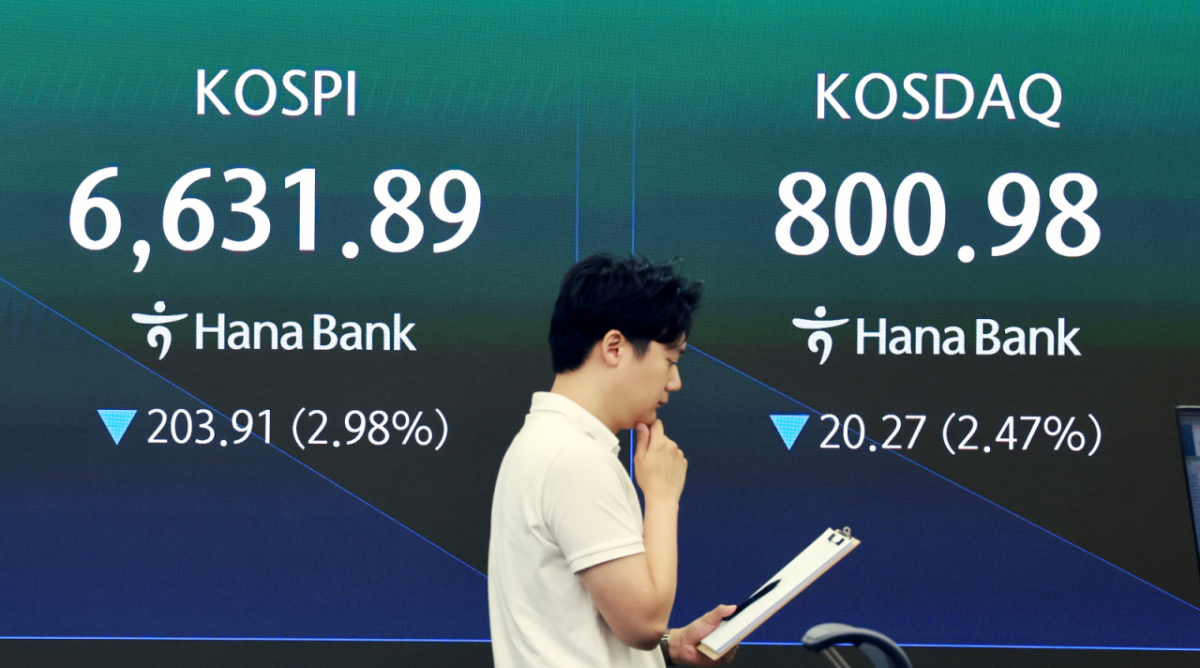
The KOSPI fell by over 3% in the early trading session on the 2nd, indicating that investor sentiment among market participants is contracting. As geopolitical tensions originating from the Middle East resurged, international oil prices surged by more than 5%, and global bond yields, including U.S. Treasury bonds, rose in tandem, placing pressure on the stock market. Amid a trend of persistent macroeconomic uncertainty, large-scale share buybacks by Samsung Electronics and SK Hynix are supporting the floor of the KOSPI index.
As of 11:28 a.m., the KOSPI was trading at 6,627.94, down 207.86 points (3.04%) from the previous trading session. This is due to the United States carrying out retaliatory military attacks on Iran for the second time in two days overnight, causing international oil prices and U.S. Treasury yields to rise together. The unstable macroeconomic environment appears to be limiting the KOSPI index's upward momentum.
On the 1st (local time), the yield on the 10th-year U.S. Treasury bond rose intraday to 4.798%, reaching its highest level since January of last year. The yield on Japan's 10-year government bond broke through 3% for the first time since 1996, and long-term yields in major countries such as the United Kingdom and Germany also surged to multi-year or even multi-decade highs, with global bond yields rising in tandem.
International oil prices also surged sharply due to anxiety over crude oil supply and demand. On this day, West Texas Intermediate (WTI) crude oil closed at $90.22 per barrel, up 5.2% from the previous session. Brent crude also closed up 4.6% at $94.65.
Lee Sang-yeon, a researcher at Shinhan Investment & Securities, said, "With an unstable macroeconomic environment and no events expected to provide strong momentum in the near term, a wait-and-see stance is likely to continue." He added, "It appears that market participants will move after confirming U.S. inflation data scheduled for release later next week."
Amid such macroeconomic uncertainty, foreign capital inflows are drying up. From the 26th of last month to the 1st of this month, over five consecutive trading days, the net purchase/sale volume by foreigners failed to reach the trillion-won level. Trading value during the same period also remained below 1 trillion won, indicating sluggish trading activity.
However, as the foreign selling pressure eases, other corporations, estimated to be conducting share buybacks for Samsung Electronics and SK Hynix, have begun net purchases since the 20th of last month, supporting the index's downward floor. There are also expectations that the KOSPI's decline at market close will be smaller than in the early session due to the effects of share buybacks.
Han Ji-young, a researcher at Kiwoom Securities, analyzed, "The fact that share buybacks are absorbing selling volumes and defending the index floor is a factor above neutral." She added, "Assuming the current pace of share buybacks continues, it is positive that there will be about a month of capital flow safety net until the third-quarter earnings season."
While the high-interest-rate environment poses a burden to the entire stock market, the banking and insurance sectors, which are expected to benefit, are showing strong performance. This is particularly evident as it coincides with a strengthening won. This is because most of their sales revenue occurs in won due to industry characteristics. Additionally, analysis suggests that interest in dividends and shareholder returns has further boosted buying pressure.
Lee Jun-young, a researcher at Eugene Investment & Securities, stated, "Foreign capital flows into sectors where the strong won does not impair earnings, so it is necessary to prioritize attention on banks and insurance." He explained, "This is because among the four sectors with won-denominated sales, these are sectors where interest rate sensitivity is positive."

 in STOCK
