

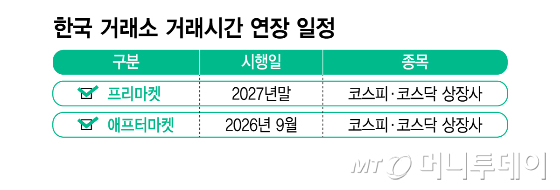
With the Korea Exchange (hereinafter referred to as the Exchange) Aftermarket opening in about two weeks, preparations by both the Exchange and brokerages are accelerating. The much-anticipated ETF (exchange-traded fund) trading has been omitted this time, reducing operational burdens for both the Exchange and brokerages.
According to sources at the Exchange and the securities industry on the 2nd, major domestic brokerages will provide customer guidance regarding the opening of the Exchange Aftermarket on the 7th. An implementation check test between the Exchange and brokerages is also scheduled for the 12th.
As part of the final execution checks in preparation for the Exchange Aftermarket launch scheduled for the 14th of this month, the Exchange has already completed relevant system preparations together with KOSCOM and the Korea Securities Depository.
Unlike NextTrade Aftermarket, which begins at 3:40 p.m., the Exchange Aftermarket operates from 4:00 p.m. The closing time is 8:00 p.m., same as NextTrade. From 3:40 p.m. to 4:00 p.m., after-hours trading continues with a single closing price. Once the Aftermarket opens at 4:00 p.m., trades are executed immediately when buy and sell orders match.
Most KOSPI and KOSDAQ listed stocks can be traded, but ETFs and ETNs (exchange-traded notes) cannot. The official closing price is not the Aftermarket closing price but the regular market closing price at 3:30 p.m.
To prepare for potential issues arising after regular trading hours, the Exchange has recalled employees on training or leave of absence back to relevant departments ahead of the Aftermarket launch and plans to hire new staff faster than in previous years. Additionally, internal personnel reallocation has been completed, including the establishment of a duty roster centered on the Prevention and Surveillance Department to monitor potential unfair trading activities within the Aftermarket.
Brokerages are also progressing smoothly with their preparations for the Exchange Aftermarket. Since NextTrade, an alternative trading system (ATS), has already operated the Aftermarket since last year, there is no significant difficulty in terms of personnel or systems.
Nevertheless, some brokerages are taking measures to respond to the Exchange Aftermarket launch, such as forming task force (TF) teams. Unlike NextTrade's market, which is limited to about 600 listed companies, the Exchange Aftermarket allows trading in all approximately 2,800 listed stocks, making management and systems somewhat more complex.
Specifically, NH Investment & Securities has established a collaborative framework between its business support division and IT-related departments and has completed updates to SOR (Smart Order Router), HTS (Home Trading System), and MTS (Mobile Trading System) in relation to the Exchange Aftermarket launch.
Hana Securities is also frequently conducting system development and testing, emphasizing that it has modified its trading systems to accommodate extended trading hours. Internally, the company is planning to recruit additional personnel as needed and intends to deploy appropriate staffing levels for each operating time slot by utilizing flexible work arrangements, after-hours work, and staggered commuting schedules.
In particular, brokerages view the omission of ETFs from this Exchange Aftermarket product as a factor that reduces potential human and material burdens that would have otherwise been required. Had ETFs been traded in the Aftermarket as originally planned, it would not have been easy for brokerages to establish LP (liquidity provider) working environments. LPs are market makers who continuously submit sell and buy orders to ensure smooth ETF trading in the market. While asset management companies handle ETF operations, securities firms contracted with them perform LP duties.
Currently, ETF LP contracts between asset management companies and brokerages are set for regular market hours from 9:00 a.m. to 3:30 p.m. If ETFs were traded in the Aftermarket, LP duties would extend accordingly, inevitably leading to increased workload for relevant departments and higher risk management costs. Negotiations between asset management companies and brokerages had been stalled due to difficulties in reaching an agreement.
However, the sale of ETFs through the Exchange Aftermarket was postponed following an incident after the launch of single-stock leverage ETFs in May, which caused increased market volatility. This decision also eliminated concerns among brokerages regarding LP-related personnel.
A securities industry official stated, "We plan to respond to the Exchange Aftermarket by monitoring future trends in trading volume, transaction amounts, workload, and the operation of related regulations," adding, "If necessary, we will consider additional staffing reinforcement."

 in STOCK
