

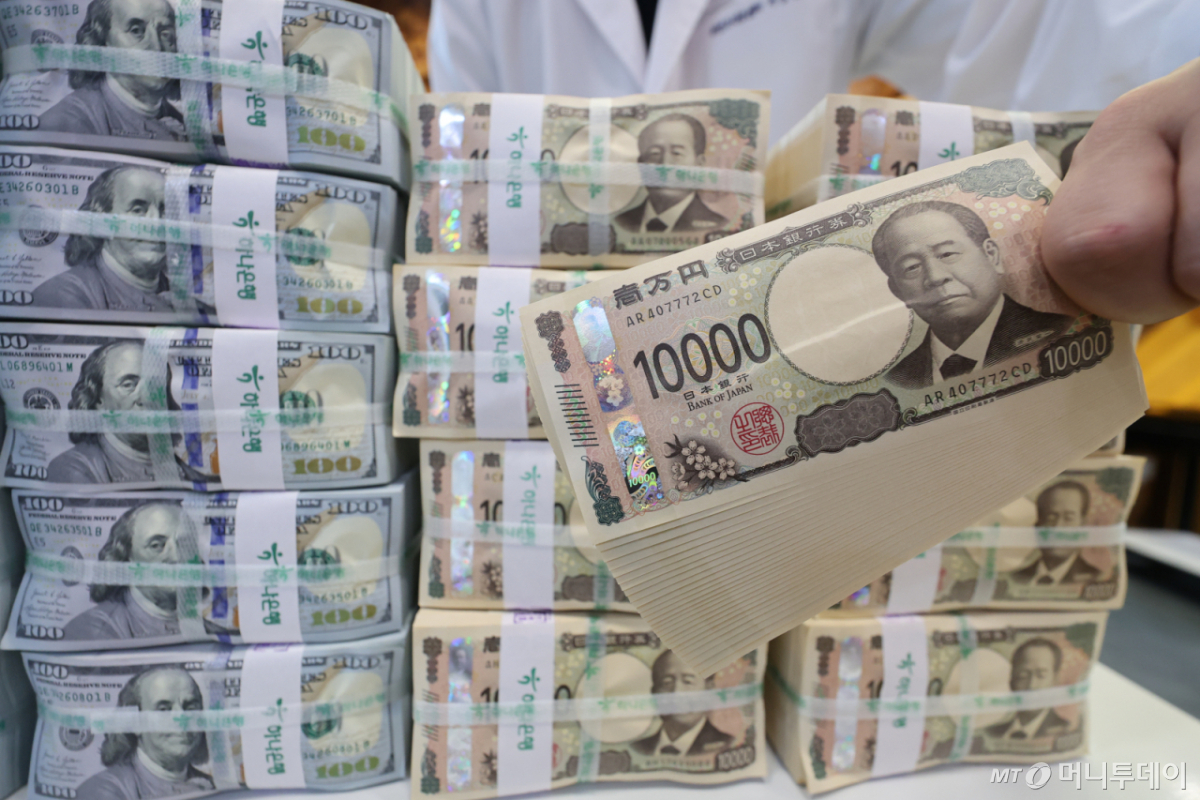
As the won/yen exchange rate continues to decline, returns on yen investments have hit rock bottom. Yen investment ETFs are on a downward trend, and ETFs with yen exposure are also struggling relatively. Despite record-low yen levels sparking increased interest in yen-related ETFs and Japanese stock investments, the attractiveness of the Japanese market remains low, and no significant movement has emerged due to risks of further yen depreciation.
According to Investing.com on the third, at 4 p.m., the won/yen exchange rate stood at 863.5 won per 100 yen, a 1% increase from the previous day. Earlier in trading, it had dropped as low as 854 won, marking the lowest level since November 2023. Over the past month, it has fallen by 5.9%. Compared to the end of the second quarter, it has declined by approximately 10%, showing a record-breaking downward trend.
The yen's weakness persists due to the interest rate gap between the U.S. and Japan, high energy prices, and market concerns over fiscal expansion. While the dollar/yen exchange rate continues its sharp rise and both the U.S. and Japanese governments have intervened in currency markets, no clear effects have been observed. Instead, the won has strengthened in tandem with the yen exchange rate, causing the won/yen rate to hit record lows.
The value of the yen has steadily declined since last year, leading to continued underperformance for "yen tech" (yen + financial management) investors. This is largely due to a 12% drop from its June peak, resulting in significant exchange losses. The TIGER Japan Yen Futures ETF, a representative yen investment ETF, fell by 5.6% over the past month.
Long-term bond ETFs linked to the yen, such as those investing in U.S. long-term bonds, are also showing weaker returns compared to similar types of long-term bond ETFs. RISE U.S. 30-Year Treasury Yen Exposure (Synthetic H) fell by 5.31% over the past month, while ACE U.S. 30-Year Treasury Yen Exposure Active (H) dropped by 5.18% during the same period. This decline was steeper than the roughly 4% drop seen in U.S. 30-year bond ETFs over the same timeframe.
While existing yen investment returns have been declining, signs of bargain buying are gradually emerging amid record-low yen levels. TIGER Japan Yen Futures saw an inflow of 8.8 billion won over the past month, showing the most active capital inflow among currency-related ETFs. Long-term bond ETFs with yen exposure have also turned toward capital inflows.
Individual investors, who had been net sellers in Japanese stocks throughout the second half of last year, have recently shifted to net buying. Over the past seven trading days, domestic investors purchased Japanese stocks worth 11.53 million dollars (15.6 billion won). This contrasts with net sales of 30.12 million dollars (4.09 billion won) in June and 101.42 million dollars (14.13 billion won) in July. However, concerns over recent weakness in the Japanese stock market have prevented a full-scale capital inflow.
Given that both bearish and bullish factors coexist regarding the yen, experts advise that investment timing is crucial. Woo Hye-young, a researcher at LS Securities, stated, "Concerns about the Takaiichi government's stance and fiscal direction are bearish factors for the yen, while the Bank of Japan's policy rate hike trend and a robust economic situation can be seen as bullish factors." She added, "However, given the extreme yen-low situation, it is highly likely that conditions will quickly return to typical low-yen levels after the second quarter of next year."

 in STOCK
