

While five active exchange-traded funds (ETFs) were delisted last month due to regulations requiring a minimum correlation coefficient, some ETFs have continued to fall below the threshold for over a certain period. Although the introduction of fully active ETFs without index-tracking requirements has been announced, discussions on their implementation remain stagnant, raising the possibility that more delisting cases may follow.
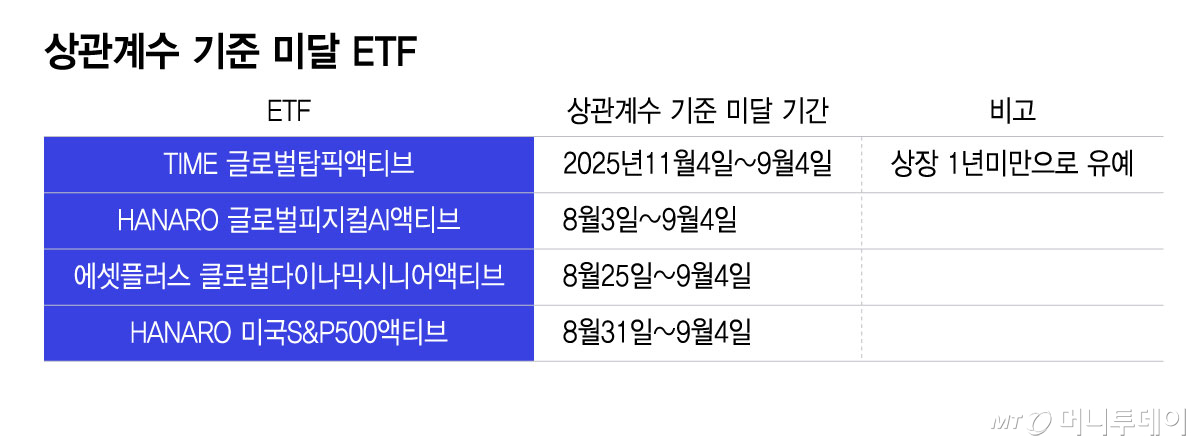
The Korea Exchange’s Stock Market Division recently issued an investment caution notice regarding HANARO Global Physical AI Active. This came after HANARO Global Physical AI Active failed to meet the 0.7 correlation coefficient threshold over the past month. If the fund fails to meet the standard for three consecutive months, it will enter the delisting process. In the case of HANARO Global Physical AI Active, if the situation continues, it could be delisted on November 4.
The correlation coefficient refers to the degree of linkage with a benchmark index. For passive ETFs, the correlation must remain at 0.9 or higher relative to the benchmark index, while active ETFs must maintain a correlation of at least 0.7. If an ETF fails to meet these standards for three consecutive months, it will be delisted.
The problem lies in the fact that the correlation coefficient is calculated based on cumulative data over the past year, making it difficult to recover within a short period. An industry official stated, “Even if an ETF attempts to align its operations with the index after failing to meet the correlation threshold, recovering the cumulative figures from the past year is not easy.” The official added, “This is why even with a three-month grace period, some funds still end up being delisted.”
Previously, five active ETFs were delisted last month due to failure to meet correlation coefficient standards: ACE TDF2030 Active Eligible, ACE TDF2050 Active Eligible, ACE TDF Long-Term Asset Allocation Active, ACE Apple Value Chain Active, and TIME U.S. Dividend Dow Jones Active. Although these funds recorded returns exceeding their benchmark indices, they were delisted due to low correlation coefficients, sparking controversy.
In addition to HANARO Global Physical AI Active, TIME Global Top Pick Active, AssetPlus Global Dynamic Senior Active, and HANARO U.S. S&P 500 Active are currently continuing to fail the correlation coefficient threshold. TIME Global Top Pick Active has been granted a temporary exemption from delisting as it has not yet completed one year since its listing. However, if it continues to fall below the standard for three months after completing one year of listing next month, it will proceed with delisting procedures. HANARO U.S. S&P 500 Active, which was listed last month, is also exempt from regulations for one year.
Although authorities are pushing to introduce fully active ETFs that are not subject to correlation coefficient regulations, progress remains stalled. Initially, the Financial Services Commission announced plans to amend the Capital Markets Act to enable the introduction of fully active ETFs, but no action has been taken. An industry official remarked, “When correlation coefficients widen, fund managers may face operational constraints in trying to align with benchmarks.” The official further noted, “We had expected the correlation coefficient regulations to be abolished by the end of this year, but it appears that priority was given to measures addressing single-stock leverage instead.”

 in STOCK
