

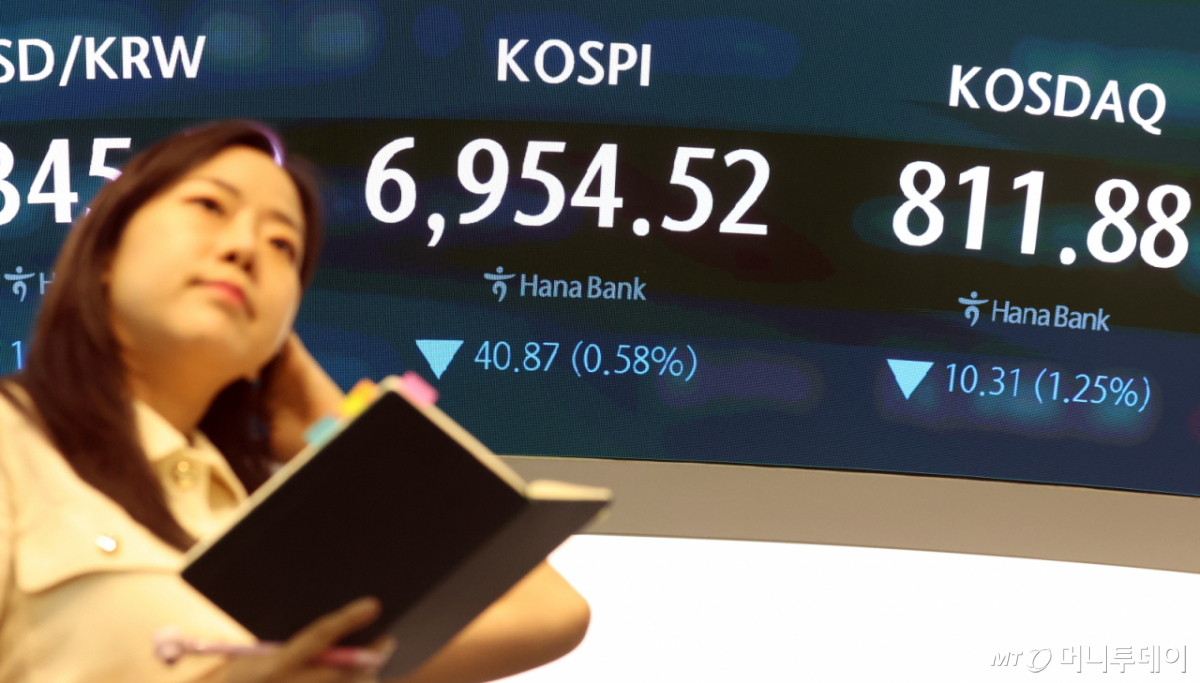
The KOSPI failed to secure a foothold above the 7,000-point level amid external variables such as rising international oil prices.
On the 8th, the KOSPI closed at 6,954.52, down 40.87 points (0.58%) from the previous day. The index opened above the 7,000-point mark and reclaimed that level intraday for the first time in 15 sessions. It then widened its gains to reach as high as 7,171.52 before reversing course downward toward the close.
The KOSPI initially rose on renewed investor sentiment toward semiconductor stocks following OpenAI's launch of GPT-6 Astra and expectations for U.S.-related investment projects. However, rising international oil prices and trade tensions between the United States and Canada pulled the index down in the final hours of trading.
Lee Sang-yeon, a researcher at Shinhan Securities, explained: "Semiconductor stocks rose in the U.S. market on the 4th (local time), and with the U.S. stock markets closed for Labor Day on the 7th, the KOSPI advanced primarily on semiconductor stocks. However, as international oil prices surged sharply and concerns grew over upcoming U.S. producer price index (PPI) and consumer price index (CPI) data releases this week, the KOSPI reversed downward just before the market close."
Saudi Aramco's refining facilities were attacked, causing international oil prices to spike sharply. During trading, WTI (West Texas Intermediate) crude oil futures and Brent crude futures each exceeded $93 and $97, respectively. The PPI and CPI data are scheduled for release on the 10th and 11th, respectively.
In the KOSPI market, retail investors sold net shares worth 3.3334 trillion won. Foreign investors turned to net buying during the session, purchasing stocks worth 648.3 billion won. Institutional investors also bought net shares worth 642.9 billion won.
Among KOSPI sectors, IT (information technology) fell 3.21%, and medical devices and precision equipment declined by 2.1%. Transportation equipment and parts, pharmaceuticals, logistics warehouses, insurance, telecommunications, and chemicals all dropped more than 1%. In contrast, electricity and gas companies and construction firms rose over 3%, while general services gained 1.74%.
Among the top market capitalization stocks on the KOSPI, Samsung Electric fell 5.78%. LG Energy Solution and Hyundai Motor slipped 3.86% and 2.04%, respectively. Samsung Electronics, which had shown an upward trend during trading, closed nearly flat, while SK Hynix and SK Square also ended with slight gains. Doosan Enerbility, which had surged more than 6% on expectations of benefiting from U.S.-related investment projects, managed only a 1.82% increase by the close.
The KOSDAQ recorded a decline of 10.31 points (1.25%) to close at 811.88 compared to the previous day. Although the index opened higher on this day, it ultimately closed lower.
In the KOSDAQ market, institutional investors sold net shares worth 217.9 billion won. Retail and foreign investors bought net shares worth 149.1 billion won and 60.8 billion won, respectively.
Among KOSDAQ sectors, general services, pharmaceuticals, textiles and apparel, machinery and equipment, chemicals, and manufacturing all fell more than 1%. Metals and entertainment/culture sectors closed nearly flat.
Among the top market capitalization stocks on the KOSDAQ, semiconductor materials, components, and equipment (MCE) stocks showed strength but narrowed their gains just before the close. Jungsung Engineering rose 3.95%, while Simtek and Padu gained 1.67% and 1.57%, respectively. In contrast, AlteoGen, RAINBOW Robotics, and HLB all fell more than 3%.
On this day, the won/dollar exchange rate closed the weekly trading session at 1,345.6 won, up 5.1 won from the previous day's closing price.

 in STOCK
