

The financial industry expressed concern over the ruling party's amendment to the Capital Market Act, which mandates that more than half of public offerings be allocated to parent company shareholders when a subsidiary is listed. With regulations and guidelines from Korea Exchange already in effect since the 3rd last month, adding legal restrictions could further contract the IPO market and hinder corporate fundraising efforts.
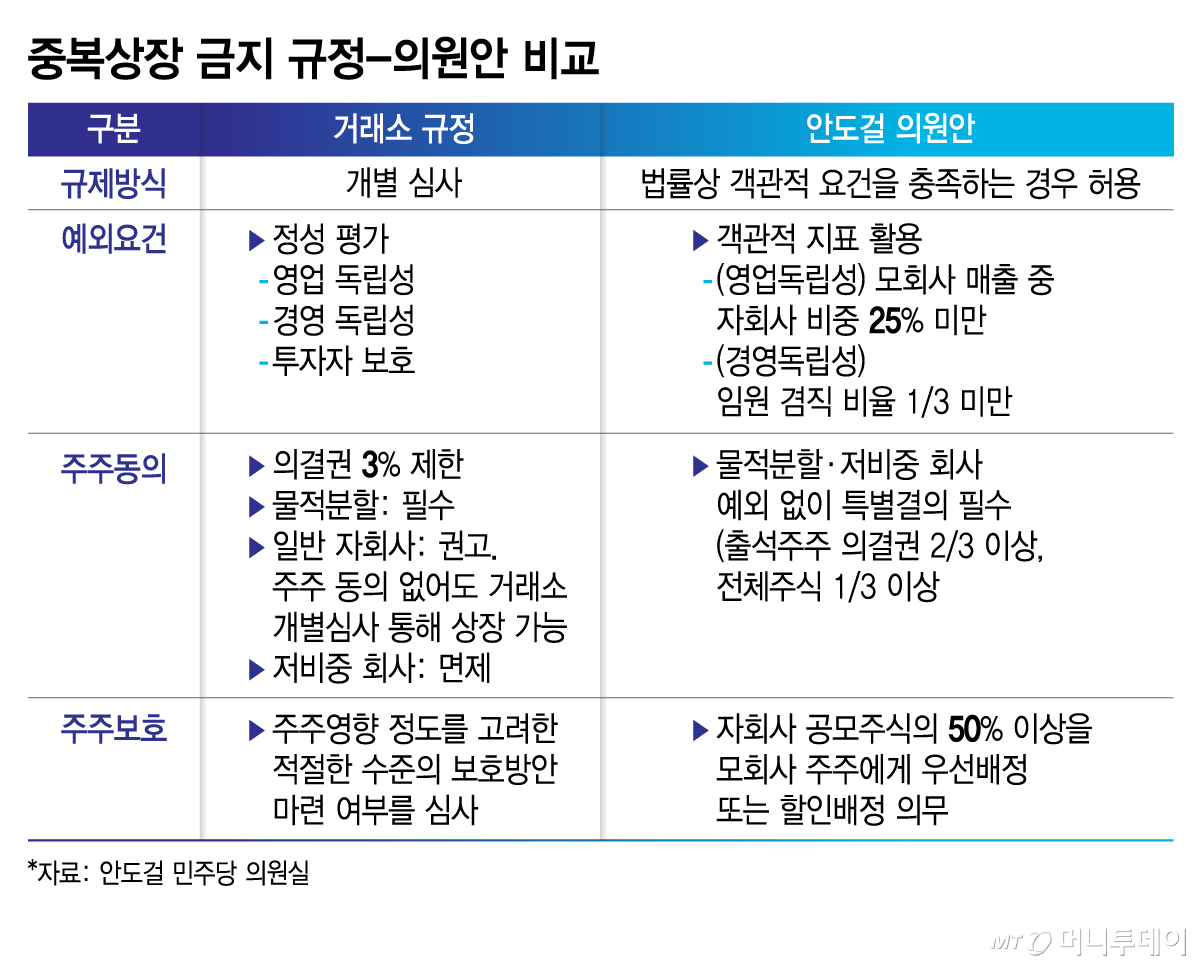
According to reports from the National Assembly and other sources on the 9th, Ahn Do-geol, a member of the National Assembly's Finance, Economy, and Planning Committee representing the Democratic Party of Korea, introduced an amendment to the Capital Market Act that would make dual listings more difficult than current exchange regulations. Notably, the bill requires parent companies to convene shareholder meetings and pass special resolutions (requiring approval from at least two-thirds of shareholders and one-third of total issued shares) not only in cases of asset spin-offs but also when listing low-weight subsidiaries.
The amendment also includes provisions mandating that over 50% of public offerings for newly listed companies be allocated first or at a discount to parent company shareholders. This is seen as raising the threshold for dual listings, as it currently allows such listings only when a subsidiary's sales account for less than 25% of the parent company's total sales and fewer than one-third of executives hold dual positions. Current regulations recognize exceptions to dual listing bans through qualitative assessments focusing on operational independence, management autonomy, and investor protection.
Securities firms worry that the ruling party's move to strengthen dual listing restrictions could further shrink the IPO market. Some argue that adding legal regulations to an already constrained public fundraising market—already burdened by extensive disclosure obligations and rigorous scrutiny from financial authorities—would exacerbate the situation.
While acknowledging the intent to better protect parent company shareholders, many in the financial industry expressed reservations about the overly uniform and additional regulatory approach. A financial industry representative stated, "If detailed exception criteria for dual listings are codified uniformly in law, it will be difficult to adequately reflect each company's business structure and market conditions." They added, "Unlike exchange regulations, this would prevent flexible adjustments in response to changing circumstances."
Concerns were also raised that strengthening regulations beyond existing exchange rules and guidelines could negatively impact corporate fundraising. Another industry representative explained, "We need to carefully assess the potential impact of additional regulations on the IPO market and corporate fundraising." They noted, "Applying the same procedures to all dual listing cases based solely on quantitative indicators could place a significant burden on the IPO market."
In particular, requiring that over half of public offerings for newly listed companies be allocated first to parent company shareholders places additional pressure on IPO structuring within the financial industry. An industry representative warned, "Mandatory allocation of more than 50% of public offerings could reduce demand from institutional investors and general housing subscription volumes, limiting our ability to forecast demand and determine offering prices." They added, "This burden will be especially pronounced in large-scale IPOs, where designing the offering structure becomes increasingly challenging."
Given that multiple amendments to the Capital Market Act related to dual listings are currently under consideration, the Korea Exchange plans to closely monitor the legislative process. Since exchange regulations and guidelines took effect on August 3 last year, the exchange intends to align its response with any resulting legal changes. As exchange rules and guidelines are subordinate to the Capital Market Act, any amendments to the law would necessitate corresponding revisions to these lower-level regulations.

 in STOCK
