

Bio ETF (exchange-traded fund) returns continue to underperform amid rising interest rates and a surge in semiconductor stocks. Compounding the issue, negative news from global pharmaceutical giant Novartis regarding clinical trial failures has further weighed on sentiment.
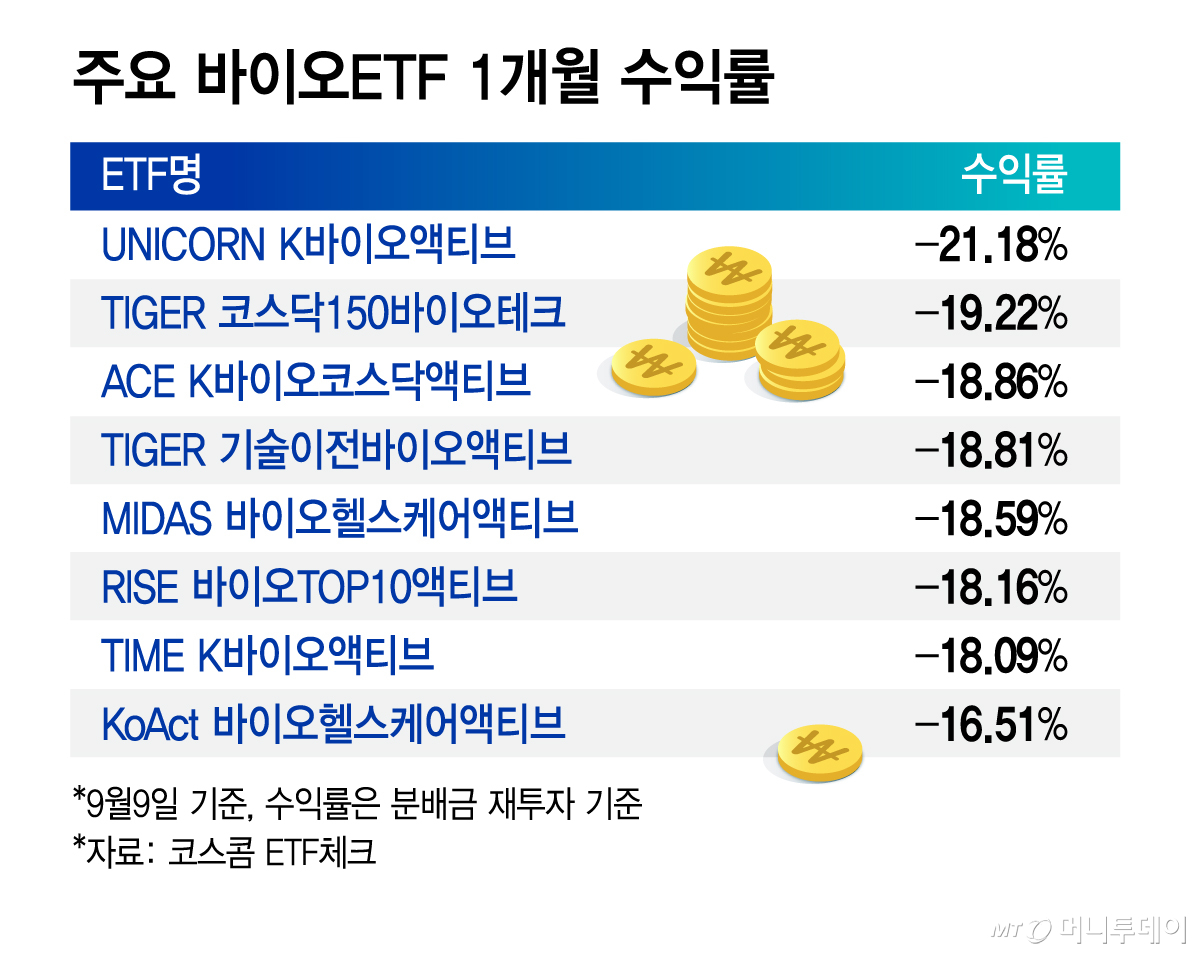
According to KOSCOM’s ETF Check report as of the previous day, the ETF with the lowest return (based on reinvested distributions) among all ETFs (excluding leveraged and inverse products) over the past month was 'UNICORN K-Bio Active,' down 21.18%.
Most bio ETFs recorded returns in the bottom tier. 'TIGER KOSDAQ150 Biotech' posted a return of -19.22%, ranking third lowest among all ETFs.
Other underperformers included: △ACE K-Bio KOSDAQ Active (-18.86%), △TIGER Technology Transfer Bio Active (-18.81%), △MIDAS Bio Healthcare Active (-18.59%), △RISE Bio TOP10 Active (-18.16%), △TIME K-Bio Active (-18.09%), and △KoAct Bio Healthcare Active (-16.51%).
The streak of negative returns for bio ETFs has continued since the beginning of the year. Year-to-date returns include: △'HANARO Bio Korea Active' (-34.92%), △RISE Bio TOP10 Active (-33.02%), △TIGER KOSDAQ150 Biotech (-29.31%), and △KoAct Bio Healthcare Active (-25.17%).
Experts point to rising interest rates and the market's focus on semiconductor stocks as key drivers of bio ETF underperformance. With growing expectations for a U.S. base rate hike, interest rates in major economies including the United States have risen. Typically, higher interest rates increase corporate borrowing costs, worsening investment sentiment toward growth-oriented sectors like biotechnology.
On the 9th (local time), the yield on the 10th-year U.S. Treasury bond stood at 4.8450%, while the 3rd-year Treasury yield was 4.5300%. Although the U.S. Treasury Department announced plans to increase its bond buyback program to a maximum of $6 billion in an effort to stabilize rates, yields remain elevated.
Adding to the pressure, recent announcements by OpenAI of new AI (artificial intelligence) models such as 'GPT-6 Astra' triggered a rebound in semiconductor stocks and drew significant capital inflows, causing bio stocks to once again face market neglect.
Novartis's announcement of three clinical trial failures within a week also negatively impacted investment sentiment toward bio stocks. The impact was particularly severe for Altheogen, Novartis's partner company. Shinhan Investment Corp lowered its target price for Altheogen from 540,000 won to 520,000 won, reflecting the failure of Phase 3 clinical trials for one antibody-oligo conjugate (AOC) drug candidate under development by Novartis.
An official in the financial investment industry stated, "Bio stocks are highly sensitive to interest rates," adding, "Unless interest rates decline, a rebound is unlikely."
However, some analysts note that individual bio companies continue to show growth momentum. Last month, Hanmi Pharmaceutical signed a technology transfer agreement for an obesity treatment drug, and SK Biopharm secured new drug candidates.
Kim Seung-min, a researcher at Mirae Asset Securities, said, "Recent developments in domestic healthcare companies—including market share expansion, large-scale technology exports, acquisition of new pipeline assets, and enhancements in production capacity and business portfolios—all represent fundamental shifts that can expand future cash flows." He added, "Unlike stock price corrections driven by external variables, the intrinsic value of these companies continues to strengthen."

 in STOCK
