

The Individual Comprehensive Asset Management Account (ISA) is on the verge of entering an era of 10 million accounts, yet competition among securities firms for customers is growing increasingly fierce. Firms are offering greater benefits not only to new subscribers but also to those who actually deposit funds or transfer ISAs from other companies. As the intermediary-type ISA has emerged as a key channel for securing investment clients and attracting assets, the competition has expanded from 'creating one more account' to 'bringing in accounts with money.'
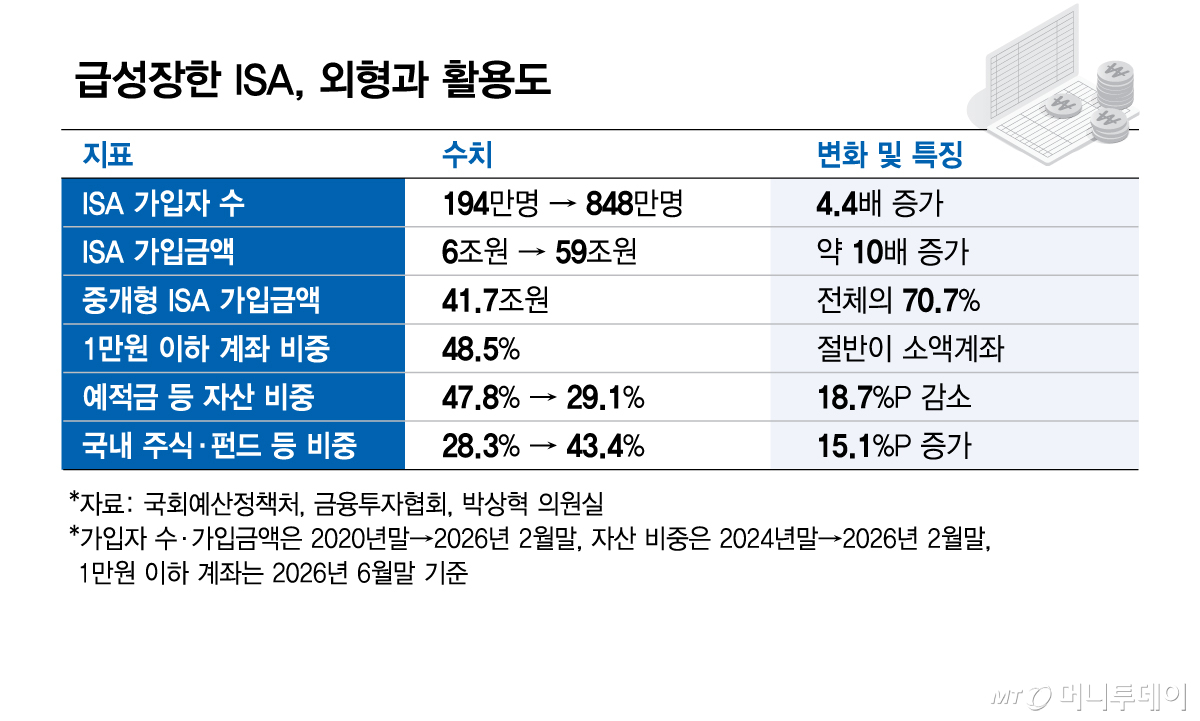
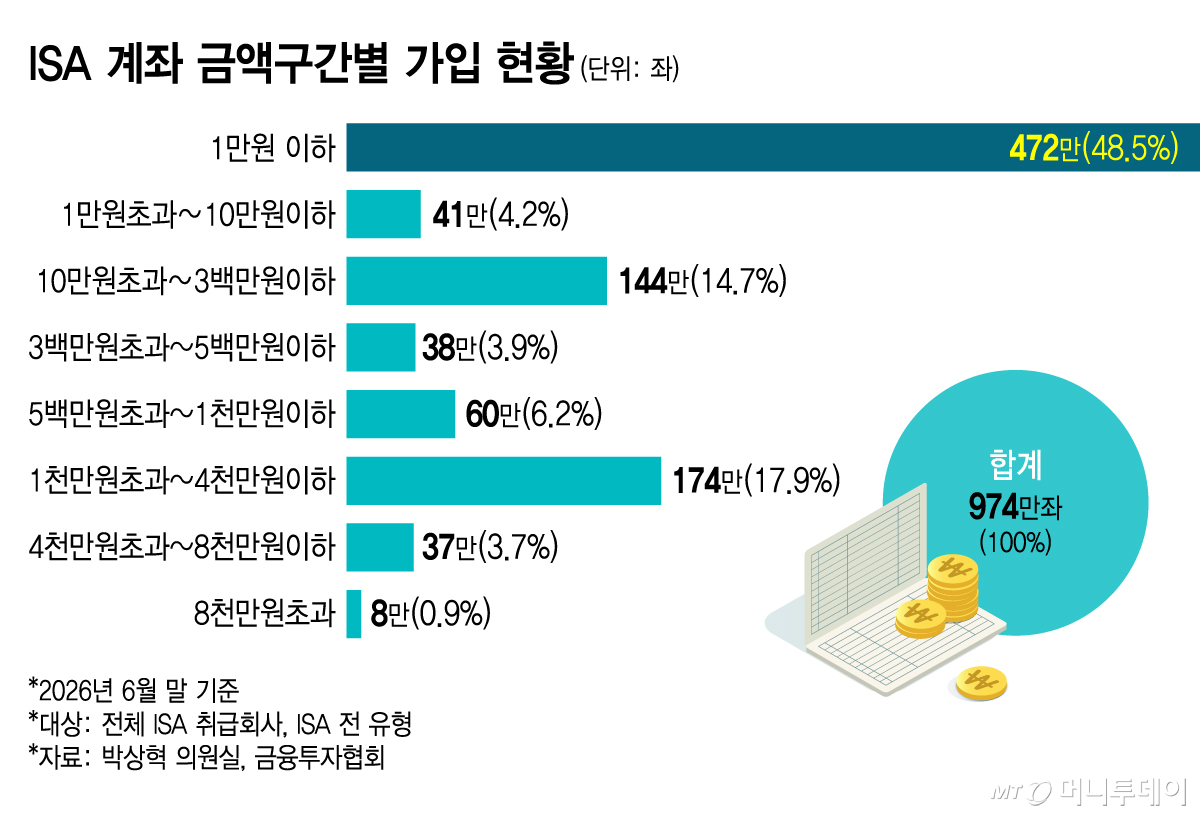
The issue is whether this fierce recruitment drive is leading to actual utilization of ISAs. Nearly half of all ISAs have balances of 10,000 won or less, revealing a significant gap between appearance and utilization. Critics warn that if the competition among securities firms to attract customers and assets through marketing costs does not translate into actual investment and long-term asset formation, the meaning of this outward growth—'10 million accounts'—could fade.
According to the financial investment industry on the 10th, major securities firms are offering various benefits such as cash and gift certificates for new sign-ups of intermediary-type ISAs, net deposits, transfers from other companies, and actual trading.
For example, Kiwoom Securities will pay 15,000 won in cash to customers who newly sign up, transfer accounts, or re-enroll upon maturity until the 30th, while running an event offering up to 5 million won for net deposits and transfers from other companies. This reflects a focus on providing benefits to customers who actually deposit funds or move ISAs from other financial institutions, rather than simply opening accounts.
The background behind the intensifying competition among securities firms is the rapid growth of intermediary-type ISAs. Introduced in 2021, the intermediary type allows investors to directly select and invest in domestically listed stocks, bonds, funds, and more. Previously, only trust-type and discretionary-type ISAs existed, making direct investment in domestically listed stocks through ISAs impossible.
According to the National Assembly Budget Policy Office, the total number of ISA subscribers rose from 1.94 million at the end of 2020, before the introduction of the intermediary type, to 8.48 million by the end of February this year—a 4.4-fold increase. The total subscribed amount grew approximately tenfold from 6 trillion won to 59 trillion won during the same period. The subscribed amount for intermediary-type ISAs alone reached 41.7 trillion won, accounting for over 70% of the total.
The assets held in ISAs have also changed. The share of deposits and time deposits within total assets fell from 47.8% at the end of 2024 to 29.1% by the end of February this year. Meanwhile, the share of domestic stocks and funds rose from 28.3% to 43.4% over the same period. This indicates a rapid shift in the focus of ISAs from savings to investment.
In particular, the overseas investment boom has also entered the ISA sphere. According to an analysis by the Korea Financial Investment Association of the top five securities firms by ISA balance, as of the end of June, 15 out of the top 20 holdings in intermediary-type ISAs were ETFs (exchange-traded funds), and nine of those were products based on U.S. markets. TIGER U.S. S&P 500 ranked third overall, while KODEX U.S. NASDAQ 100 and TIGER U.S. NASDAQ 100 took fourth and fifth places, respectively.
Under current ISA rules, investors cannot directly invest in U.S. stocks or ETFs listed on U.S. exchanges. Investors are instead meeting their demand for overseas investment through ETFs based on U.S. markets that are listed on domestic exchanges. Since the introduction of the intermediary type, the nature of ISAs has shifted from savings to investment, and investor interest is rapidly expanding beyond domestic assets to overseas markets.
ISAs allow only one account per person across all financial institutions. When securities firms secure intermediary-type ISA customers, they create touchpoints for forming long-term relationships with investment clients who trade stocks, ETFs, bonds, and more. Securities firms' move beyond new sign-ups to compete in net deposits and transfers from other companies is interpreted as a strategy to attract actual investment assets into their own ISAs, not just increase account numbers.
The competition among securities firms has positive aspects in that it has promoted the growth of the intermediary-type ISA market. As competition in investment convenience, products, and services has intensified, intermediary-type ISAs have rapidly grown into a primary investment account for retail investors. However, the gap between the market's outward growth and its actual utilization remains large.
In a situation where securities firms are competing through marketing to secure customers and assets, it is difficult to evaluate the performance of the ISA market solely by the increase in account numbers. In particular, competition for transfers from other companies differs in nature from new investment funds entering the ISA market. If existing ISA assets merely move between financial institutions, while individual securities firms may achieve results in securing customers and assets, the effect on expanding the overall asset formation scale of the entire ISA market is limited, critics point out.
Critics also argue that regulations have not kept pace with changes in investment markets. While ISAs allow investors to enjoy tax benefits by depositing and managing funds in accounts, there are insufficient mechanisms to encourage continuous deposits and long-term investment after signing up. Although the boom in retail investors overseas stocks has increased demand for overseas investment, direct investment in foreign stocks and foreign-listed ETFs remains impossible under ISAs. The National Assembly Budget Policy Office also noted the need to strengthen incentives for long-term investment in domestically listed stocks and funds during the expansion of ISAs.
Overseas, regulations are being revised to encourage long-term and systematic investments alongside expanded tax benefits. Japan's NISA (Nippon Individual Savings Account), a tax-advantaged account supporting individual asset formation similar to Korea's ISA, reformed its system in 2024 to allow simultaneous use of accumulation-type accounts for long-term systematic investment and growth-type accounts for investing in individual stocks, while also making the non-taxable period permanent. The United Kingdom also operates its ISA system to allow multiple types of ISAs within a single contribution limit.
Beyond expanding account numbers, the next challenge for ISAs is to reflect changing investment demands and drive 'qualitative growth' that leads to actual fund inflows and long-term investment.

 in STOCK

