

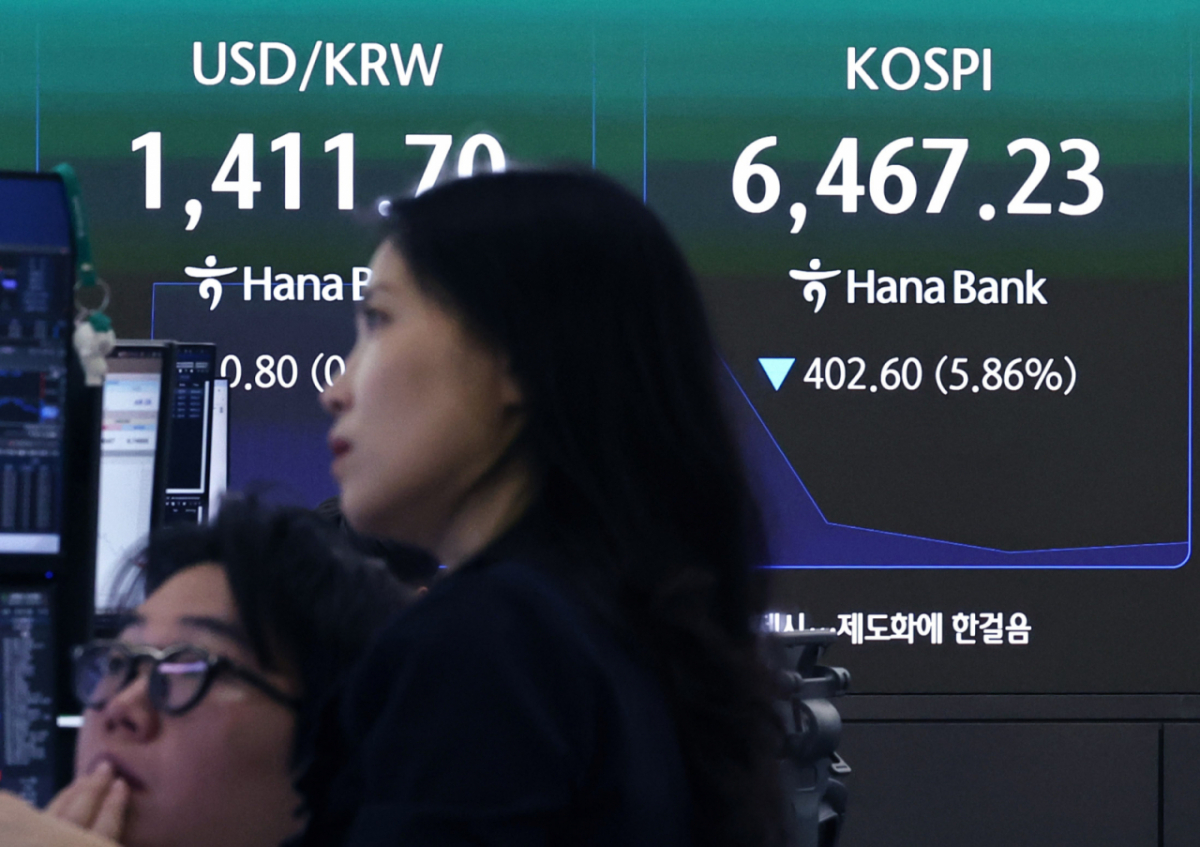
The KOSPI market closed down more than 5% on the 19th after triggering a sell-side sidecar (futures market circuit breaker), which temporarily suspends program sell orders, amid a sharp surge in U.S. long-term Treasury yields. Declines in top market capitalization semiconductor stocks added downward pressure to the index.
According to Korea Exchange, KOSPI closed at 6,471.17 points, down 398.66 points (5.80%) from the previous trading day. The index opened at 6,528.77 points, down 341.06 points (4.96%), and later fell as much as 469.02 points (6.83%) to 6,400.81 during the session. At 9:06 a.m., a sharp drop in KOSPI 200 futures prices triggered the sell-side sidecar (futures market circuit breaker), suspending program sell orders for five minutes. This marked the 48th time since the beginning of this year that the sidecar was activated on the KOSPI market, and the 25th instance in a downward direction.
Foreign investors and institutional investors sold net amounts of 3.4883 trillion won and 1.3244 trillion won, respectively, on the KOSPI market. Retail investors bought net 4.6368 trillion won.
Samsung Electronics closed down 7.82% at 247,500 won per share. SK Hynix closed down 9.75% at 1.5 million won per share.
Most of the top market capitalization stocks fell, including SK Square (-11.54%), Samsung Electronics Preferred (-7.75%), Hyundai Motor (-4.83%), Samsung Electro-Mechanics (-3.68%), and KB Financial Group (-1.25%).
On the 18th (local time), the Dow Jones Industrial Average closed at 53,343.40 points, down 116.38 points (0.22%) from the previous session. The S&P 500 Index closed at 7,691.76 points, down 53.30 points (0.69%), and the NASDAQ Composite closed at 26,289.71 points, down 355.20 points (1.33%).
The decline was attributed to the collapse of an extension agreement for a ceasefire between the United States and Iran, which pushed up international oil prices and increased inflationary pressure. Amid concerns over rising prices, U.S. 30-year Treasury yields climbed intraday to as high as 5.33% annually, reaching their highest level in nearly 19 years since 2007. Under the burden of higher interest rates, semiconductor stocks such as Micron Technology, SanDisk, and Western Digital fell by at least 7%, and the Philadelphia Semiconductor Index dropped 4.98%.
Han Ji-young, a researcher at Kiwoom Securities, said, "The issuance of government bonds to cover fiscal deficits in major countries and corporate bond financing for AI (artificial intelligence) investments by big tech companies are increasing, while long-term funding demand from central banks and insurance companies is failing to keep pace with the rate of supply growth. As a result, the market is demanding higher interest rates."
The researcher added, "Given that we have only recently emerged from the July crash driven by concerns over AI profitability and leveraged liquidations, it is true that market fatigue has increased due to exposure to macroeconomic uncertainty."
The KOSDAQ Index closed at 824.46 points, down 9.74 points (1.17%). The index opened at 810.08 points, down 24.12 points (2.89%), fell as much as 30.18 points (3.62%) to 804.02 during the session, briefly recovered and turned positive, but ultimately closed in negative territory.
On the KOSDAQ market, foreign investors and institutional investors bought net amounts of 14.8 billion won and 49.9 billion won, respectively. Retail investors sold net 71.6 billion won. Among top market capitalization stocks, RAINBOW Robotics (-1.60%), HLB (-2.43%), and Juseong Engineering (-4.29%) declined.

 in STOCK
