

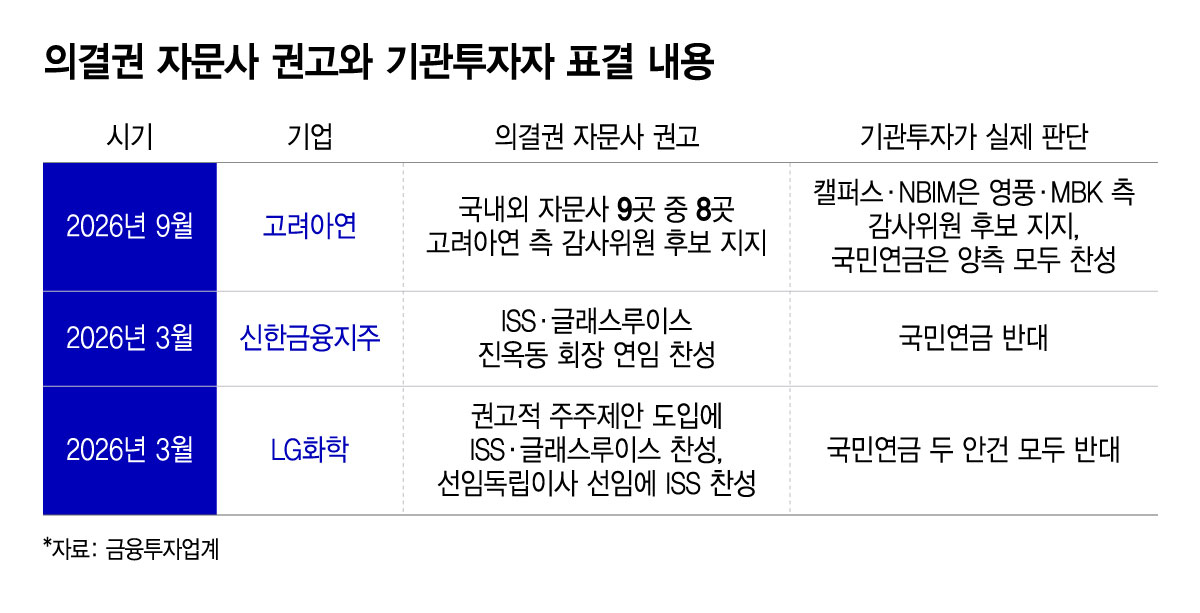
Cases are increasingly occurring where the pro/con recommendations of proxy advisory firms at corporate shareholder meetings diverge from the actual votes cast by major institutional investors. This phenomenon differs from the common perception that advisory firm recommendations effectively dictate the behavior of institutional investors.
According to the financial investment industry on the 10th, at the extraordinary general meeting of Korea Zinc held on the 9th, eight out of nine domestic and foreign advisory firms, including ISS (institutional investor services), the world's largest proxy advisory firm, and Glass Lewis, supported the company-side candidate for auditor, Baek In-gyu.
However, CalPERS (California Public Employees' Retirement System) in California, U.S., and NBIM (Norwegian Government Pension Fund Global) of Norway's central bank investment management agency cast their votes for candidates from Youngpoong and MBK Partners. The National Pension Service voted in favor of both candidates. Thus, the majority opinion of advisory firms and the actual choices made by major pension funds did not align in one direction.
Last March, ISS and Glass Lewis recommended approval for the re-election of Shinhan Financial Group Chairman Jin Ok-dong, but the largest shareholder, the National Pension Service, voted against it.
The National Pension Service stated that it found it difficult to approve the recommendation due to past records of corporate valuation impairment or infringement of shareholder rights related to Jin (Chairman). Jin (Chairman) received a 'cautionary warning' as a disciplinary measure from financial authorities in connection with the Lime Fund incident.
In the same month at LG Chem, ISS and Glass Lewis supported the advisory shareholder proposal introduced by activist fund Palisade Capital, and ISS also supported the appointment of a senior independent director. However, the National Pension Service voted against both proposals.
Institutional investors can cast votes different from those of advisory firms because the authority to exercise voting rights is, in principle, vested in each institutional investor. Advisory firms express their pro/con opinions on shareholder meeting agenda items such as director appointments and shareholder proposals, while institutional investors make final decisions after reviewing their own voting criteria and internal deliberation procedures. Judgment criteria such as whether corporate valuation has been impaired or the eligibility of directors also vary by institutional investor.
![[Seoul=NEWSIS] Reporter Kim Sun-woong = Park Ki-deok, Ko Ryeo-a-yeon (CEO), attended the 53rd extraordinary general meeting held at Mondrian Hotel in Yongsan, Seoul on the 9th and announced the opening of the meeting. (Joint reporting) 2026.09.09. photo@newsis.com /Photo=](https://thumb.mt.co.kr/cdn-cgi/image/f=avif/21/2026/09/2026091015545082049_2.jpg)
Large asset management firms that do not use external advisory firms at all have also emerged. JP Morgan Asset Management decided this year not to use recommendations from ISS and Glass Lewis in voting for U.S. listed companies, instead introducing its own AI (artificial intelligence) system called "Proxy IQ." This method analyzes proxy materials and other data from over 3,000 U.S. companies to support the voting decisions of internal asset managers.
As large asset management firms that do not utilize advisory firm recommendations emerge and the U.S. government moves to regulate advisory firms, the gap between recommendations and institutional investors' votes is expected to widen further.
U.S. President Donald Trump signed an executive order last December instructing a review of regulations on advisory firms. This was because ISS and Glass Lewis account for more than 90% of the U.S. proxy advisory market and are exerting excessive influence over corporate governance and shareholder proposals.
The U.S. Securities and Exchange Commission (SEC) filed a lawsuit on the 4th, requesting enforcement of a subpoena against ISS for failing to comply with certain requests to submit materials related to voting recommendations and customer voting.
An executive in the investment banking (IB) industry said, "As it becomes increasingly difficult to predict the votes of major institutional investors in advance, companies facing management rights disputes or merger proposals will face greater burdens in having to persuade not only advisory firms but also individual institutional investors directly."

 in STOCK

