

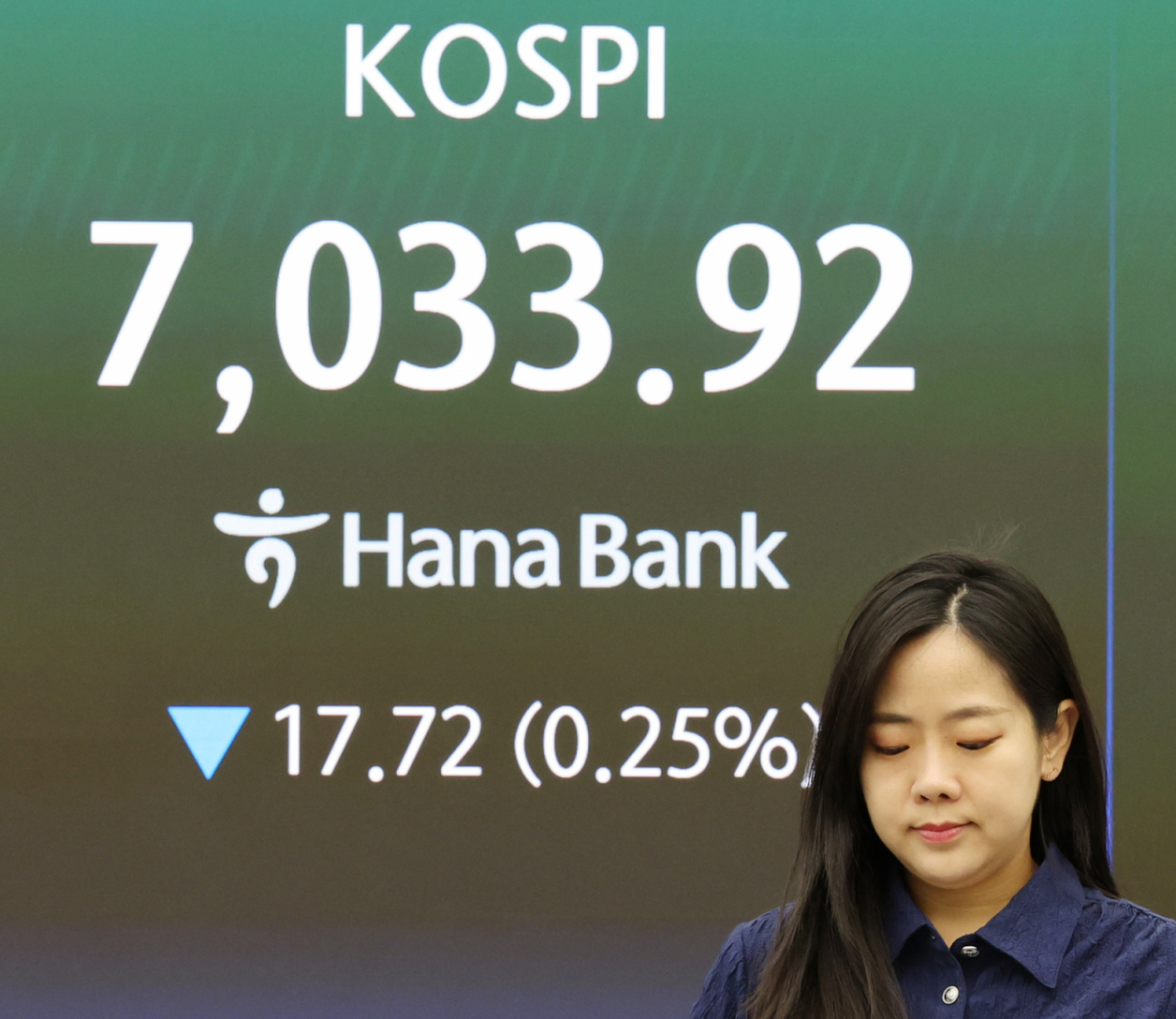
Although supply-demand pressures intensified on the simultaneous expiration of futures and options, the KOSPI held the 7,000-point line on the 10th. The KOSDAQ closed higher after institutional investors bought more than 1 trillion won in net purchases. While TSMC’s record-breaking sales are expected to lift semiconductor investment sentiment, macroeconomic variables such as the U.S. consumer price index (CPI) remain key.
On this day, the KOSPI closed down 17.72 points (0.25%) from the previous trading session at 7,033.92. After opening down 12.79 points (0.18%) at 7,038.85, the index fluctuated before ultimately holding the 7,000-point line.
According to the Korea Exchange, as of 3:55 p.m., institutional investors made net purchases of 511.9 billion won, while retail investors bought 366.7 billion won in net terms. Foreign investors sold 2.547 trillion won in net terms, but institutional investors shifted from net selling to net buying, supporting the index.
The KOSDAQ closed up 6.55 points (0.79%) at 836.92. After opening down 5.31 points (0.64%) at 825.06, it closed higher in the afternoon session thanks to net buying by institutional investors.
In the KOSDAQ as well, institutional investors drove gains with net purchases of 1.3052 trillion won. Retail investors, who had been buying early in the session, turned to net selling and offloaded 248.3 billion won. Foreign investors sold 1.0536 trillion won in net terms.
Lee Kyung-min, a researcher at Daishin Securities, analyzed: “In the KOSPI, institutional investor selling pressure subsided, leading to a V-shaped rebound that defended the 7,000-point line despite external pressures. Even with overlapping supply-demand events from the regular revision of KRX sector indices and the simultaneous expiration of futures and options, sectoral fluctuations remained limited.”
Although U.S. stocks fell for three consecutive days, major semiconductor stocks did not tumble significantly after TSMC reported record-breaking sales. Samsung Electronics and SK Hynix closed roughly flat. Im Jeong-eun, a researcher at KB Securities, noted: “Rising oil prices combined with the impact of futures and options expiration created a volatile trading session. TSMC’s August sales setting a new record supported investment sentiment.”
TSMC’s strong sales performance is positive for improving semiconductor investment sentiment. Positive reviews of Meta’s AI agent “Muse” and SK Hynix ADRs (American Depositary Receipts) reaching new highs are also seen as tailwinds for the semiconductor sector.
However, external macroeconomic variables remain, including rising international oil prices due to geopolitical risks in the Middle East and monetary policy directions influenced by U.S. price indicators. On local time on the 10th, August producer price index (PPI) data will be released, followed by CPI data on the 11th.
Researcher Im Jeong-eun stated: “Even if the KOSPI reclaims the 7,000-point level, short-term volatility is inevitable due to uncertainties surrounding oil prices, interest rates, and U.S. price indicators. The market’s direction will depend on outcomes from key events such as U.S. PPI, CPI, and earnings reports from Adobe and Oracle.”

 in STOCK
