

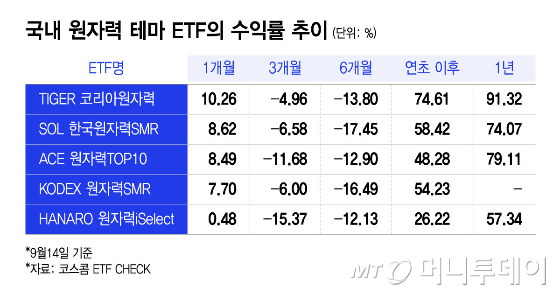
Domestic nuclear-themed ETFs (exchange-traded funds) have rebounded in performance, sweeping the top ranks for one-month returns recently. This comes after news emerged that South Korea and the United States are approaching final signatures on a U.S. investment project centered on constructing eight nuclear power plants in the U.S., prompting a synchronized rise in stock prices of related companies.
According to KOSCOM ETF CHECK data on the 14th, 'TIGER Korea Nuclear' recorded a one-month return of 10%, ranking third among all domestically listed ETFs.
Other funds also posted relatively high returns and secured top positions: 'SOL Korea Nuclear SMR' (8.62%), 'ACE Nuclear TOP10' (8.49%), and 'KODEX Nuclear SMR' (7.7%).
The primary driver behind the strong short-term performance of domestic nuclear-themed ETFs is South Korea's U.S. investment project. Both sides have agreed to include in their final project memorandum the direction of constructing eight nuclear power plants in the U.S., with reports indicating that a final signature (MOU) ceremony could take place as early as the 18th. As expectations for nuclear-related stocks grew, stock prices of constituent ETFs rose accordingly.
The securities industry also unanimously assesses that U.S. investment will be a positive factor for South Korea's nuclear power value chain. Researchers Nam-hyun Jang and Tae-hee Kim of Korea Investment & Securities stated, "While the U.S. government has clearly expressed its intention to expand nuclear power, supply chains capable of repeatedly executing large-scale nuclear plant construction remain limited. If U.S. investment is linked with nuclear construction, the role of South Korea's nuclear value chain—possessing repeated construction experience and core equipment supply capabilities—is expected to expand."
This news served as a lifeline for domestic nuclear-themed ETFs. These funds surged earlier this year, occupying three of the top five positions in Q1 ETF returns (based on reinvested distributions), but later faced corrections due to profit-taking sales and capital flows shifting toward semiconductor stocks. In fact, six-month returns for all these funds stood at around -10%.
Experts advise that even if the final agreement does not include the construction of eight nuclear plants, investing in nuclear ETFs remains valid from a long-term perspective. While short-term return volatility may depend on whether the MOU is signed, considering the surging electricity demand driven by AI (artificial intelligence) investments and the technological competitiveness of South Korea's nuclear companies, medium- to long-term growth drivers are considered robust.
Kim Jeong-hyun, head of the ETF Group at Shinhan Asset Management, said, "Even if the nuclear-related agreement falters, it is likely due to political issues rather than a negation of South Korea's nuclear technology capabilities. South Korea's technological prowess has already been proven, and given that nuclear power possesses the characteristic of being a security asset, it would be difficult for the U.S. to exclude South Korea in practice."
Kim Seung-cheol, head of the ETF Investment Division at NH AMUNDI Asset Management, analyzed, "The U.S. aims to finalize 10 new nuclear projects by 2030, and cooperation between South Korea and the U.S. on nuclear power is expected to materialize starting with the U.S. investment project. Furthermore, abundant electricity is required to operate AI data centers, necessitating the construction of numerous nuclear power plants."

 in STOCK
