

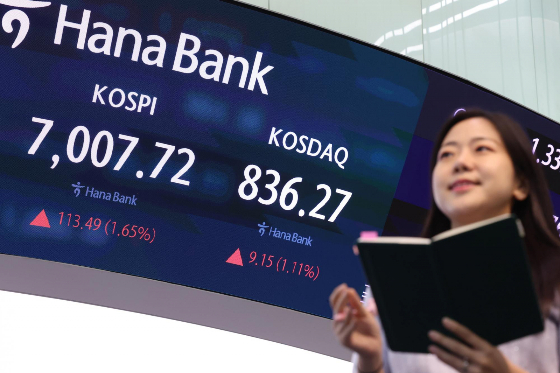
KOSPI closed above the 7,000 mark for the first time in six trading days on a closing price basis. Despite base rate hikes in both the United States and Japan, buying pressure is believed to have surged amid expectations that AI (artificial intelligence) infrastructure investments would lead to solid earnings. In terms of supply and demand, both retail investors and foreign investors sold net, but the index was supported by share buybacks from Samsung Electronics and SK Hynix.
On the 21st, KOSPI closed at 7007.72, up 113.49 points (1.65%) from the previous trading day. This marked its first close above the 7,000 level in six trading days since the 10th.
On this day, institutional investors purchased 1.4923 trillion won worth of stocks on the KOSPI market (based on Korea Exchange figures). Retail investors sold 2.9789 trillion won worth, while foreign investors sold 160.2 billion won worth. Foreign investors and pension funds recorded net purchases in the range of 100 billion won and 300 billion won respectively during trading hours but turned to net selling before the market closed. Other corporations, presumed to be conducting share buybacks for Samsung Electronics and SK Hynix, recorded a net purchase of 1.6585 trillion won.
Lee Kyung-min, FICC Deputy Head at Daishin Securities, stated, "While we need to consider the supply-demand effects triggered by SanDisk's inclusion in the U.S. S&P 100 index, expectations for semiconductor earnings persisted due to TrendForce's forecast of rising memory prices and comments from Intel's CEO (Chief Executive Officer) highlighting worsening memory supply shortages." He further analyzed, "Major events such as the U.S. September Federal Open Market Committee (FOMC) meeting and the Bank of Japan (BOJ) monetary policy decision meeting were absorbed, easing external uncertainties, while AI semiconductor momentum came to the fore, resulting in sector-specific differentiated market trends."
Among KOSPI sectors, medical devices and precision instruments closed with strong gains exceeding 5%. Distribution, electrical and electronics rose more than 2%, while finance, manufacturing, securities, and insurance each gained over 1%. Electrical and gas, pharmaceuticals, and real estate ended with slight gains, whereas chemicals, machinery and equipment, telecommunications, and construction finished with slight declines. Non-ferrous metals, transportation equipment and parts, and metals fell more than 1%.
Among the top market capitalization stocks in KOSPI, Samsung Electronics rose by over 4%. Samsung C&T, linked to Samsung Electronics through equity and business relationships, surged by around 4%. Samsung Electro-Mechanics and Samsung Life Insurance each gained more than 2%. SK Hynix and SK Square closed with slight gains and a rise of around 4%, respectively. KB Financial Group rose by over 1%. Hyundai Motor and LG Energy Solution declined by around 1% and 3%, respectively.
KOSDAQ closed up 9.15 points (1.11%) from the previous trading day at 836.27.
In the KOSDAQ market, retail investors recorded a net purchase of 142.7 billion won. Foreign investors and institutional investors recorded net sales of 99.1 billion won and 30.6 billion won, respectively.
Among KOSDAQ sectors, machinery and equipment, and medical devices and precision instruments rose by more than 2%. Electrical and electronics, distribution, manufacturing, telecommunications, and general services each gained around 1%. Chemicals, transportation equipment and parts, pharmaceuticals, and IT (information and communications) services closed with slight gains. Non-ferrous metals and finance ended with slight declines. Paper and wood fell by around 1%, while construction dropped by about 2%.
In the top market capitalization stocks of KOSDAQ, strong performance was particularly evident among materials, components and equipment (소부장) semiconductor stocks. Wonik IPS and Eoptechne rose by more than 6%. Simtek and HPSP gained around 3% and 1%, respectively. AlteoGen, Rainbow Robotics, and Rino Industrial closed with slight gains. EcoPro and EcoPro BM both fell by over 1%.
On this day, in the Seoul foreign exchange market, the won/dollar exchange rate closed weekly trading at 1,381.0 won, down 2.3 won from the previous day's closing price.

 in STOCK
