

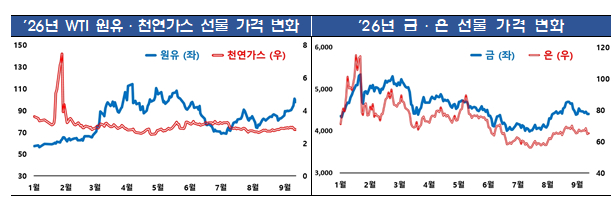
As geopolitical risks from the Middle East have increased volatility in commodity prices such as crude oil, gold, and silver, financial authorities are urging caution regarding investments in commodity ETPs (exchange-traded products). This is because leverage and inverse products make up a significant portion of these offerings, which can lead to substantial short-term losses or even delisting.
According to the Financial Supervisory Service on the 22nd, price volatility for energy commodities (crude oil, natural gas, etc.) and metal commodities (gold, silver, etc.) has increased this year. Crude oil prices under WTI (West Texas Intermediate) futures rose 97% from $57.3 per barrel on January 2 to $113 on April 7. On July 6, they fell 39% to $68.6, then surged again by 46% to $100 on the 11th.
Gold futures prices, which were $4,361 per ounce on January 1, jumped 23% on January 29 before falling 18% on March 26. They rose another 11% on April 17.
As of the 11th, the market capitalization of commodity ETPs (ETNs and ETFs) stood at 12.4 trillion won, accounting for about 2% of all ETPs. The issue lies in the fact that leverage and inverse products make up a high proportion—37%—of commodity ETPs. Compared to regular products, leverage and inverse products exhibit greater volatility tied to underlying asset prices and are more prone to inflows of short-term speculative capital. In particular, among crude oil and natural gas ETPs, the share of leverage and inverse products reaches 88% and 93%, respectively.
The Financial Supervisory Service emphasized that investors should be cautious as commodity prices may experience unexpected volatility expansion. Commodity prices are determined by various factors in international markets, making it difficult for individual investors to accurately predict price movements. Moreover, since geopolitical risks in the global commodity market have not been fully resolved, there remains a possibility of further volatility expansion.
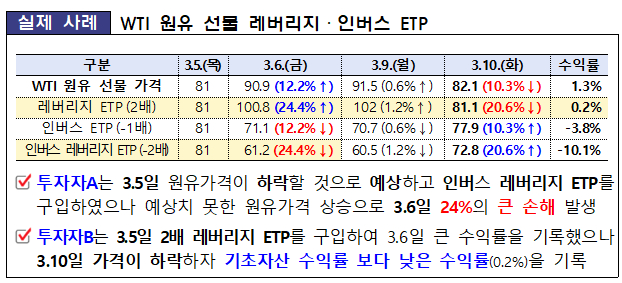
Leverage and inverse products can lead to losses expanding rapidly in volatile markets. Even if underlying asset prices merely fluctuate up and down repeatedly, negative compounding effects may occur where cumulative returns fall below the returns of the underlying assets. In fact, investor A purchased an inverse leverage ETP on March 5 expecting crude oil prices to decline but suffered a 24% loss the next day, on the 6th, due to an unexpected rise in crude oil prices.
Another concern is the deviation rate (premium/discount) of commodity ETPs. Due to frequent inflows of short-term speculative capital, imbalances in supply and demand can lead to deviations. While these deviations tend to normalize over time, if market prices that are temporarily overvalued converge toward intrinsic value, investors may incur losses equivalent to the deviation rate.
Additionally, ETNs (exchange-traded notes) may be delisted if their prices fall below 1,000 won due to sharp rises or falls in commodity prices. Especially for ETNs issued after 2021, clauses exist that mandate early liquidation if prices drop below 1,000 won, resulting in automatic delisting. Even for ETNs issued before 2021, if prices fall extremely low—for example, to 100 won or less—managing the deviation rate becomes impossible, potentially leading to delisting.
A Financial Supervisory Service official stated, "We will continue monitoring abnormal signs such as trading volumes and deviation rates of commodity ETPs, especially leverage and inverse products. If investment risks expand, we plan to take proactive measures, including issuing additional consumer alerts."

 in STOCK

