

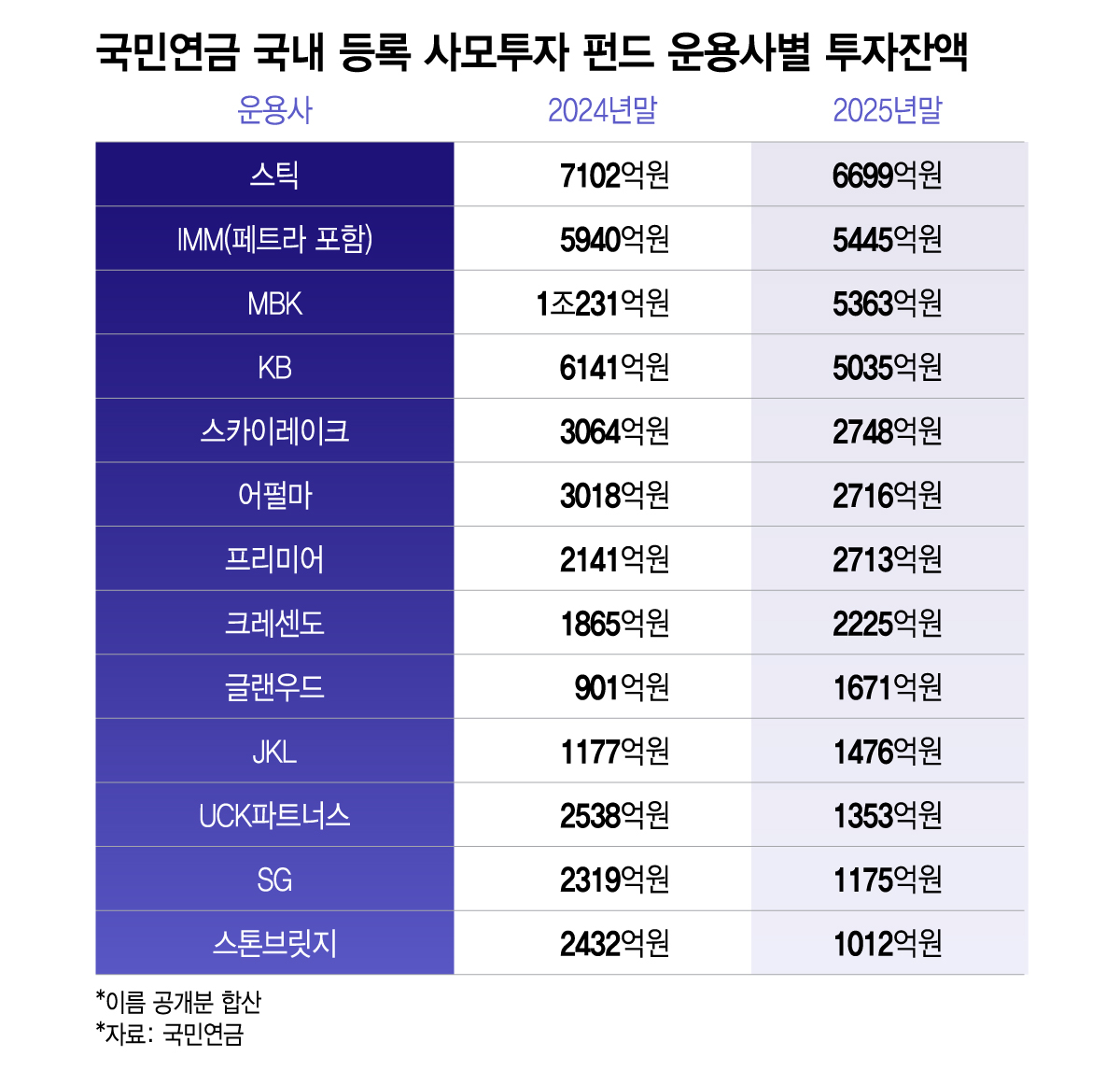
The National Pension Service is increasingly concealing its private fund investment details. The scale of funds with hidden names has grown by more than 4 trillion won in one year. This is due to an increase in cases where information such as non-consent from asset managers and sensitive investment data is withheld, leading to a 27% year-on-year decline in the investment balance of domestic registered funds whose names are disclosed.
According to the National Pension Service's public disclosure on investment status by private investment fund (fund) item on the 22nd, as of the end of last year, there were 161 items with hidden fund names out of the list of domestic and foreign invested private funds, totaling 23.7468 trillion won, accounting for 33.1% by amount. The number of non-disclosed items increased by 32 in one year, and the non-disclosed amount rose by 4.3397 trillion won (22.4%). The proportion of non-disclosure increased by 3.5 percentage points in one year. In last year's investment disclosure, a new reason titled 'reflection of sensitive information sensitive to fund names' appeared in six cases.
Domestic registered private funds (private equity firms·PEFs·investment partnerships) whose names are disclosed were also not spared from the impact. As of the end of last year, their investment balance was 6.4287 trillion won, a decrease of 2.3966 trillion won (27.2%) compared to the previous year. This appears to be due to the concealment of fund names for investment or removal from the list due to reasons such as asset manager non-consent, fund withdrawal, or loss handling.
According to the National Pension Service, investment balance refers to the book value calculated by subtracting withdrawals and loss-handled amounts from the invested capital. In the December 2024 disclosure, 12 domestic funds whose names were publicly disclosed, along with items matching their amount and type, were marked with numbers such as 'Private Fund 37' in last year's end-of-year disclosure due to 'asset manager non-consent.' The investment balance of these 12 funds was 656.3 billion won, the same as the previous year's disclosed amount.
By asset manager, as of the end of last year, the investment balance related to MBK Partners decreased by 47.6% in one year to 536.3 billion won. This was due to the disappearance of a 488.4 billion won fund from the 2015 No. 1 fund list from the records. Stonebridge fell by 58.4% to 101.2 billion won. SG Private Equity decreased by 49.3%, UCK Partners (formerly Unison Capital Korea) by 46.7%, and KB by 18.0%. Stick Investment decreased by 5.7% to 669.9 billion won, and IMM decreased by 8.3% to 544.5 billion won. SkyLake and Everpool each decreased by around 10%.
On the other hand, Glenwood Private Equity increased by 85.5% to 167.1 billion won. Premier Partners (26.7% increase), JKL Partners (25.4% increase), and Crescente Equity Partners (19.3% increase) also saw increases.
The National Pension Service conceals fund names based on exception clauses under the Public Information Act and its own management guidelines. Even disclosed items are limited to investment balances and fund names; subscribed amounts, paid-in capital, withdrawal amounts, and valuation amounts are not disclosed by fund.
In contrast, the disclosure scope of U.S. public pension funds appears different. The California Public Employees' Retirement System (CalPERS), California State Teachers' Retirement System (CalSTRS), Florida State Board of Administration (SBA), and Washington State Investment Board (WSIB) disclose subscribed amounts, paid-in capital, distribution amounts, net asset value (NAV), internal rate of return (IRR), and total value multiple (TVPI) for each private fund they have invested in.
CalSTRS announced that as of the end of June 2025, the internal rate of return on its investment in MBK Partners Fund No. 6 was -30%. CalPERS and CalSTRS are among the pension funds cited by the National Pension Service as examples to justify the autonomy of the fund management headquarters and expanded compensation. In this regard, the investment banking industry points out that the national policy direction of increasing public disclosure requirements related to financial investments conflicts with the National Pension Service's stance on non-disclosure of investment details.
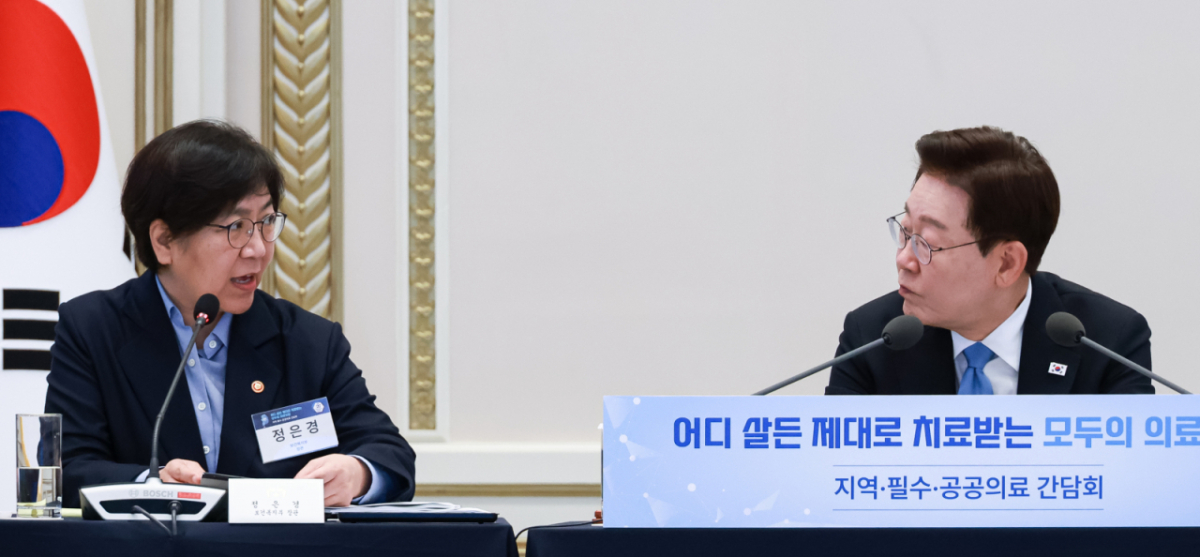
Concerns have been raised that the National Pension Service's disclosure scope is excessively narrow compared to transparent return disclosures in the United States. Earlier, President Lee Jae-myung stated at a State Council meeting in May regarding the performance of the National Growth Fund, which citizens voluntarily join: "It seems that those who feel left out amidst the stock market boom should look for opportunities here (in the National Growth Fund)," and added, "We must ensure competition is clearly promoted by either regularly disclosing the operational status of fund managers or applying pressure."
While the government has demanded higher levels of disclosure for funds to which citizens voluntarily subscribe, the National Pension Service, which is mandatory for enrollment, has instead seen an expansion in non-disclosure.

 in STOCK

