

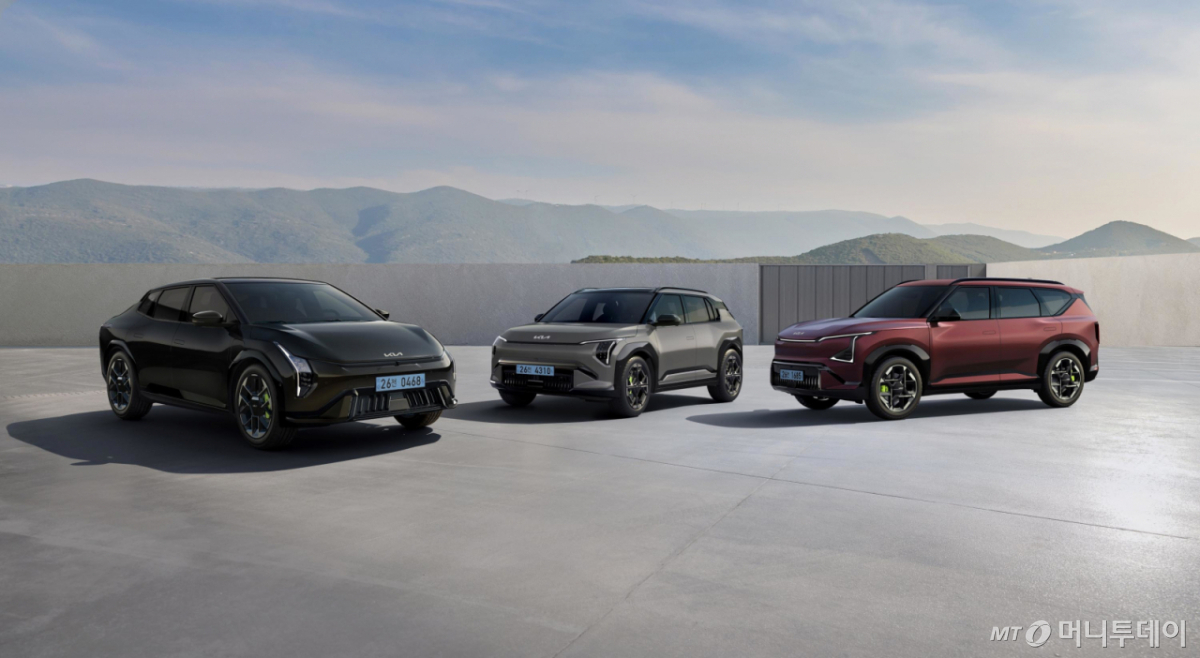
The share of electric vehicles in Kia’s total sales continues to grow. While sales excluding electric vehicles remain flat, the expansion of entry-level electric vehicles and PBVs (purpose-built vehicles) is driving overall sales growth.
According to industry sources and Kia’s IR data released on the 22nd, Kia’s global retail sales from January to August this year reached 2.163469 million units, a 5.3% increase compared to the same period last year. Among these, electric vehicle sales totaled 273,963 units, marking a 73.6% surge. The share of electric vehicles in total sales rose from 7.7% to 12.7%, an increase of 5 percentage points (p). Sales excluding electric vehicles and hybrid-electric vehicles dropped slightly by 0.4% to 1.889506 million units, meaning the entire growth in sales volume was driven solely by electric vehicles.
The impact of new models was significant. EV5 sales increased to 48,403 units thanks to the addition of newly produced domestic models, while EV4 sales jumped from 5,955 units in January–August last year to 30,036 units this year. PV5, Kia’s first all-electric purpose-built vehicle (PBV), sold 38,932 units, and the compact electric SUV EV2, which began sales this year, moved 18,163 units. In contrast, EV6, launched in 2021, saw its sales decline by 37.1% from 36,945 units to 19,315 units.
The expansion of electric vehicle share was led by Europe. Although Kia struggled last year due to a mismatch between the electrification trend in the European market and its new model launch schedule, the company believes that starting from the first quarter this year, its LINE-up has begun aligning with market changes. In fact, Kia’s European sales rose 9% to 377,227 units, of which electric vehicles accounted for 127,006 units—an 86.6% increase. The share of electric vehicles in European sales climbed from 19.7% to 33.7%, meaning one out of every three cars sold by Kia in Europe was an electric vehicle. In Europe alone, PV5 sold 19,126 units, EV4 19,111 units, EV5 18,352 units, and EV2 17,547 units. Domestic electric vehicle sales also surged by 129% to 96,429 units, further contributing to the rising share.
In response, Kia is increasing local production in Europe. The company invested approximately €180 million (about 180 billion won) to retrofit its Žilina plant in Slovakia for electric vehicle production, establishing a mixed production system capable of manufacturing internal combustion engine vehicles, hybrid-electric vehicles, and electric vehicles. Following the launch of EV4 last August, production of the EV2 Yangsan began this year. As a result, among the 195,000 units shipped from this plant in January–August this year, 48,023 were electric vehicles, accounting for 24.6%. Kia plans to increase the plant’s annual electric vehicle production capacity to around 180,000 units by next year, including 80,000 EV4s and over 100,000 EV2s.
Kia also plans to boost sales in the second half of the year, focusing on hybrid-electric vehicles in the U.S. market and electric vehicles in Europe. The company has set a target of selling 1 million won electric vehicles by 2030. In Europe, it aims to account for 66% of its projected 746,000-unit sales volume with electric vehicles by the same year.
An industry executive stated, “As a result of Kia’s efforts since launching the EV6 in 2021 to expand its diverse electric vehicle LINE-up covering all segments, it has solidified its position as a brand leading the electric vehicle era.” The executive added, “In terms of PBV models, Kia is continuously expanding its new LINE-up beyond PV5 to include models like PV7, thereby increasing sales volume (scale).”

 in INDUSTRY
