

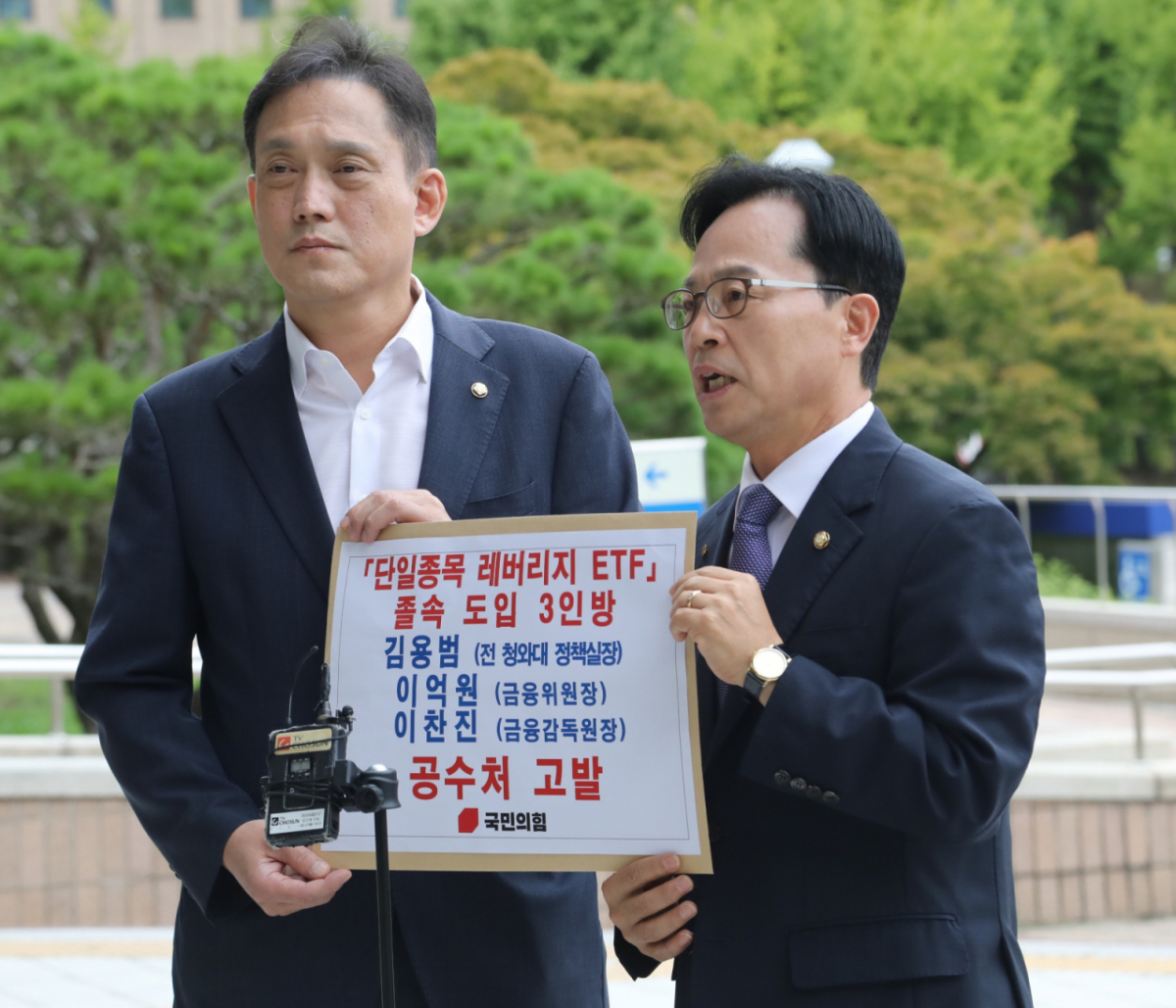
The question of accountability for single-stock leveraged exchange-traded funds (ETFs) is expected to be the biggest issue at the first National Assembly audit targeting the Lee Jae-myung administration next month. The opposition bloc is likely to characterize single-stock leveraged ETFs as a mismanagement by the Lee Jae-myung government and launch concentrated criticism. The financial investment industry is also closely monitoring discussions on witness selection for the audit, bracing for potential fallout that could reach the sector.
According to the financial investment industry and political circles on the 23rd, the National Assembly's Committee on Finance will hold a plenary session on the 28th, immediately after the Chuseok (Mid-Autumn Festival) holiday, to continue discussions on adopting the 2026 audit plan. While several standing committees, including the Committee on Legislation and Judiciary and the Committee on Trade, Industry, Energy and Small and Medium Venture Companies, have already adopted their audit plans and witness lists, the Finance Committee has yet to finalize even its basic schedule. According to multiple sources in the Finance Committee, it is highly likely that the audit plan and institutional investor witness list will be adopted on the 28th.
The most prominent issue at the first Finance Committee audit in the second half of the 22nd National Assembly is the accountability for the single-stock leveraged ETF incident. The opposition bloc has been emphasizing the frame that "the launch of ETFs was a government mismanagement" through early audit press releases.
People Power Party lawmakers on the Finance Committee, including Kim Jae-seop and Park Jun-tae (Rep.), have been successively distributing materials received from relevant institutional investors regarding the closed-door meeting hosted by Cheong Wa Dae on January 13 this year. They aim to conduct pinpoint scrutiny into who first proposed the introduction of single-stock leveraged ETFs, what procedures were followed until their listing on May 27, and whether there was any external pressure or hasty process from Cheong Wa Dae during that period.
Veteran People Power Party lawmaker Song Eon-seok criticized on Facebook on the 18th, stating, "President Lee Jae-myung's response regarding single-stock leveraged ETFs at his press conference was particularly irresponsible," and adding, "It is hard to accept that Chu Jin-han (President), who reported on the introduction of high-risk financial products while making stock market support a core economic policy, does not know who made the decision or on what basis."
Pointers have also emerged regarding structural problems in the financial investment industry revealed by the single-stock leveraged ETF incident. According to materials received from the Korea Financial Investment Association by People Power Party lawmaker Park Seong-hoon, among the 16th single-stock leveraged ETFs listed domestically, the liquidity provider (LP) staff at the 24th securities firms submitting quotes numbered only one to six per company. Kiwoom Securities was found to have two people managing an average of 10,802,914 units daily, while Daol Investment Securities had one person managing an average of 15,343,519 units daily.
Political parties other than the People Power Party are also making single-stock leveraged ETFs a major issue at the audit and launching offensive moves.
Han Chang-min, a Social Democratic Party lawmaker on the Finance Committee, criticized that the government's introduction of single-stock leveraged ETFs actually expanded the market pie and created demand. According to materials received from the Korea Securities Depository by Han (Rep.), domestic investors' holdings of overseas-listed Samsung Electronics and SK Hynix single-stock leveraged ETFs increased from $62.33 million at the end of last year to $316.27 million by the end of June this year. Although holdings decreased to $76.62 million by the end of August after regulations such as raising the minimum deposit requirement were implemented, it is pointed out that the product launch created market demand.
Rebuilding Korea Party lawmaker Kim Hyeong-yeon also pointed out that the authorities' ETF management policy was inadequate. According to materials received from the Korea Exchange by Kim (Rep.), exchange regulations were amended only 72 days after June 1, when the negative (-) discount rate of ETFs first exceeded the management standard.
It is known that there are clear differences in stance between ruling and opposition parties regarding witness and reference person applications for the audit on single-stock leveraged ETFs. The People Power Party is considering applying for witnesses including former Cheong Wa Dae Jeong Chaek (Head) Kim Yong-bom, as well as CEOs of securities firms and asset management companies.
On the other hand, some Democratic Party of Korea lawmaker offices are reportedly planning to call the chairs and bank presidents of the five major financial holding companies as witnesses to question them on issues such as housing loans and inclusive finance.
In this situation, the financial investment industry is closely watching the ruling and opposition discussions over who will be selected as audit witnesses or reference persons. A source in the financial investment industry said, "There is nothing confirmed at this point, so we are continuously monitoring the situation," adding, "We are on edge about whether witness applications and selections will continue to include not only high-ranking officials from the authorities but also CEOs of securities firms and asset management companies, as the opposition bloc strongly presses for accountability over single-stock leveraged ETFs."

 in STOCK
