

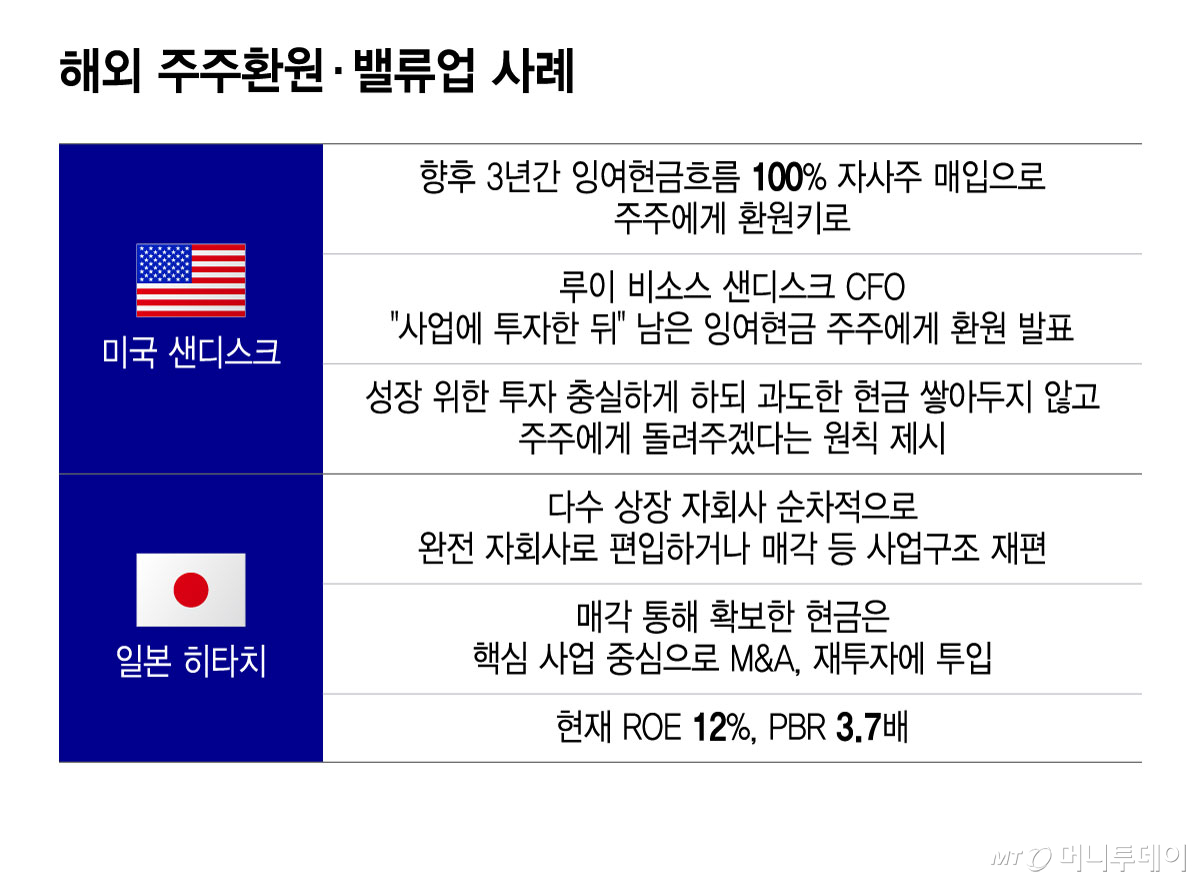
#U.S. flash memory storage device manufacturer SanDisk announced last month that it would return 100% of its FCF (free cash flow) to shareholders via share buybacks over the next three years. Louis Voso, SanDisk's Chief Financial Officer (CFO), stated that excess cash remaining after investing in business operations would be returned to shareholders. This clearly established a principle: invest fully in growth while avoiding hoarding more cash than necessary and returning it to shareholders. Following the announcement of this shareholder return principle, SanDisk's stock price, which had fallen to $1,015.89 (closing price) on July 29 amid concerns about peak memory prices, began rising and reached $1,777.80 on the 25th—a 75% increase.
#Japan's Hitachi is cited as a model case for its value-up program. Once classified as a distressed company, Hitachi underwent a major overhaul of its business portfolio to transform into a high-quality enterprise. Previously, it owned numerous listed subsidiaries, but it gradually converted subsidiaries in sectors such as metals and construction into wholly-owned subsidiaries or sold them off. Cash generated from these sales was used for M&A (mergers and acquisitions) and reinvestment focused on core businesses. Currently, Hitachi's ROE (return on equity) exceeds 12%, and its PBR (price-to-book ratio) has reached 3.7 times.
These cases demonstrate that capital allocation aimed at corporate growth and competitiveness is the core of a value-up program, rather than shareholder return mechanisms like share buybacks or dividends alone. However, in South Korea, announcements have focused solely on the scale of shareholder return through share buybacks and cancellations. Experts point out that to achieve a genuine value-up program that raises corporate valuation, companies must present both shareholder return policies and capital allocation principles together.
Kim Beom-jun, a professor of accounting at Catholic University of Korea, stated, "The prerequisite for treasury stock cancellation or dividends is that the company must earn money; only then can it distribute profits to shareholders." He added, "The problem is that attention has become overly focused on treasury stock cancellation or TSR (total shareholder return), leading to relatively less interest in whether companies are investing appropriately to strengthen their inherent competitiveness and prepare for the future."
Shareholder return measures such as share buybacks and cancellations fundamentally involve returning FCF—cash generated from business operations minus investment needs—to shareholders. However, critics warn that aggressively buying back shares at the expense of R&D or facility investments can undermine the very essence of corporate growth.
The market is also focusing more on a company's profit-generating capacity than on shareholder return itself. Early in the year, stocks of companies with high treasury stock holdings surged amid expectations for new policies, only to be followed by a wave of profit-taking sales—evidence that investor attention has shifted beyond mere buyback announcements.
Lee Jeong-bin, a researcher at Shinhan Investment Corp., analyzed in a report titled "Changes in the Treasury Stock Framework After the Third Amendment to the Commercial Act": "In the medium to long term, a company's ability to generate profits remains the primary driver of stock prices; treasury stock policies are merely supplementary variables." He further noted, "We have now entered a phase where investors must select companies that can maintain or improve their ROE even after treasury stock cancellation. Investment strategies need to shift toward fundamentals."
Overseas investors also emphasize that Korean companies should make strengthening fundamentals the goal of their value-up programs. Shin Byeong-mook, head of Korea Exchange's New York office, stated, "There is both expectation and concern regarding South Korea's value-up program initiatives." He added, "Requests from overseas institutional investors have significantly increased for concrete plans to raise ROE above 8% by improving capital efficiency."

 in STOCK
