

Cancelling shares reduces the number of outstanding shares but does not increase the money a company earns. Spending money on dividends or share buybacks increases the portion returned to shareholders, but it simultaneously reduces the cash held by the company. Ultimately, experts point out that the key to raising corporate valuation lies not in how many shares are burned, but in where the company spends its earnings.
Sustained stock price rises difficult with large-scale share cancellation alone
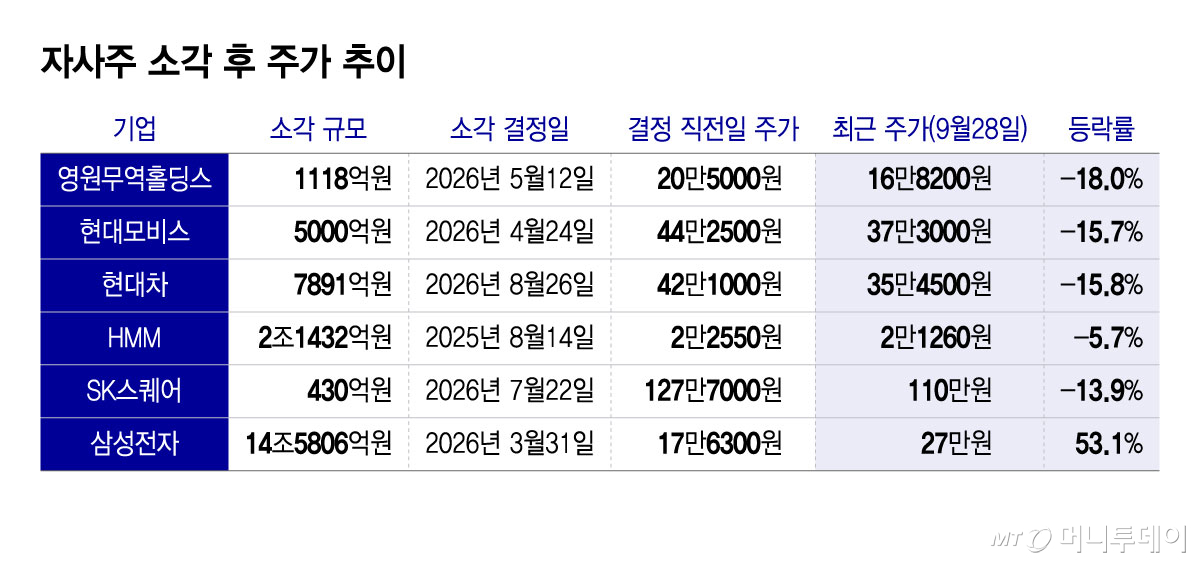
According to the financial investment industry on the 28th, SK Square decided to cancel approximately 43 billion won worth of treasury shares after the mandatory cancellation rule took effect last July, yet the stock price fell by 1.84% that day. The closing price that day was 1.1 million won, which is 13.9% lower than the day before the cancellation decision.
Before the mandatory cancellation rule took effect, KB Financial Group announced a plan in February last year to conduct share buybacks and cancellations worth 520 billion won in the first half of the year, but the stock price plummeted by 6.7% the day after the announcement. Shinhan Financial Group also pushed forward with share buybacks and cancellations totaling 650 billion won in the first half of last year alone. While active shareholder returns received positive evaluations, voices followed that non-bank affiliates' performance and capital ratios must be considered together. The message is that merely cancelling a large number of shares is insufficient; consistent profitability must underpin it.
Stock prices move according to numerous variables such as earnings forecasts, industry conditions, interest rates, and market situations. These cases demonstrate that share cancellation is just one of many factors determining stock prices and that sustained price increases are difficult to expect from large-scale cancellations alone.
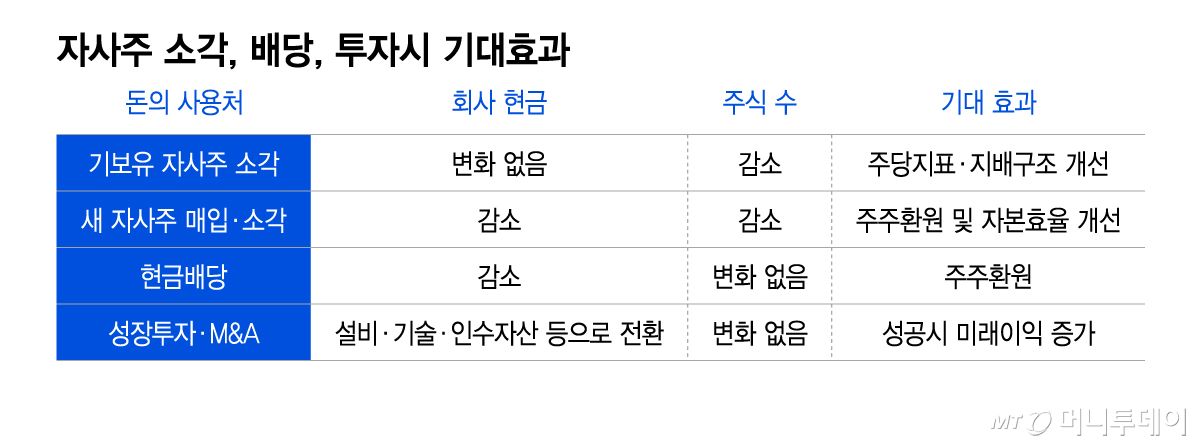
The reason why share cancellation does not immediately lead to an increase in corporate valuation is simple. Cancelling already-held treasury shares does not bring new cash into the company, nor does it increase sales or operating profit. While the total number of shares decreases, the company's assets such as factories, technology, and cash, or its business profitability, do not change.
When dividends are paid or newly purchased shares are cancelled, corporate cash actually decreases. If a company earns 100 billion won and holds it as is, 100 billion won in cash remains with the company. Conversely, if that money is used for dividends or to buy back shares, funds go to shareholders while corporate cash decreases accordingly. It is merely a difference between whether money stays within the company or passes to shareholders.
Where earnings are spent matters more than how much is burned
In a recently published paper, Professor Choi Dong-jun of Chungnam National University distinguished between share cancellation itself and an increase in corporate valuation. Professor Choi analyzed that cancelling shares does not change the assets held by the company or its earnings, so cancellation itself is essentially neutral to corporate valuation.
The financial investment industry believes that appropriate levels of shareholder returns can vary depending on a company's growth stage and investment opportunities. Companies capable of generating high returns through R&D (research and development), facility investments, or M&A (mergers and acquisitions) may benefit from reinvesting earnings to enhance corporate valuation. Conversely, for companies lacking investment opportunities, increasing dividends or share buybacks and cancellations rather than hoarding excessive cash can be a way to improve capital efficiency.
Consequently, experts point out that we must examine not only the scale of dividends or share cancellations but also a company's "capital allocation" policy. This is because how earnings from business are allocated among growth investments, M&A, debt repayment, and shareholder returns—and the resulting profitability—determine corporate valuation.
A financial investment industry official stated, "If a company earns money well and can reinvest it in good investment opportunities to generate more profits, that is also a way to enhance shareholder value." He added, "Conversely, if it is difficult to achieve sufficient returns even with investment, it is better to return the money to shareholders." He emphasized, "A true value-up program is not about paying out dividends unconditionally or burning many shares, but about using the company's funds in the most valuable way possible."

 in STOCK

