

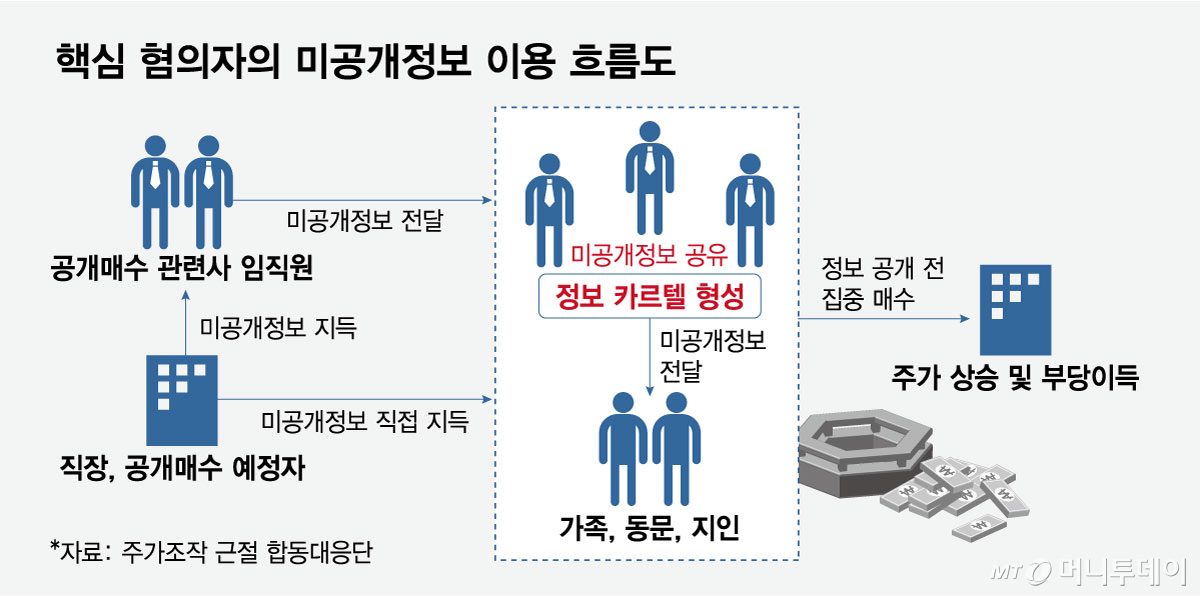
A group that diverted internal information, such as mergers and acquisitions (M&A) of listed companies, in advance to secure illicit gains worth 20 billion won has been identified. The suspects are financial elites connected through close ties from the Seoul National University business club. It was investigated that they formed a so-called 'cartel' and shared information for five years.
The Joint Response Team against Stock Market Manipulation (hereinafter the Joint Response Team), composed of the Financial Services Commission, the Financial Supervisory Service, and the Korea Exchange, announced on the 29th that it has begun compulsory investigations into more than 10 people suspected of obtaining illicit gains exceeding 20 billion won by using information on the restructuring of the governance structure of listed companies, such as tender offers, and M&A (use of undisclosed information). The Joint Response Team conducted searches and seizures at more than 20 locations, including the workplaces and residences of the suspects, on the same day.
They are suspected of securing illicit gains exceeding 20 billion won by buying stocks in advance before positive undisclosed information, such as tender offers or M&A, was disclosed to the market, and then selling them at high prices after the stock price rose following the disclosure of the information. They are also suspected of passing this information to family members and acquaintances so that they could use it for stock trading. It was investigated that five stocks were involved in the use of undisclosed information.
The key suspects are narrowed down to around five individuals. They are senior and junior colleagues from the Seoul National University business club and have maintained their relationship while working at the same global consulting firm. Subsequently, they moved to private equity fund management companies, listed companies, etc., holding executive positions and performing M&A-related duties. According to the Joint Response Team, based on long-standing close ties, they formed a powerful 'information cartel' and continuously and repeatedly shared positive undisclosed information.
Specifically, it was investigated that an employee of a company promoting M&A (planned tender offer) among the key suspects diverted internal information, and suspects working in the financial industry shared undisclosed information learned during their work processes.
A source from the Joint Response Team explained, "They were in positions where they could know information about listed companies related to their duties." He added, "The companies where the suspects worked are unrelated to this case," stating that "they pursued personal gain targeting stocks unrelated to their affiliated companies."
The Joint Response Team viewed the case as serious because information sharing was repeatedly carried out over a long period within an intimate information cartel, rather than being a one-time deviation by a specific individual. Moreover, the key suspects were professionals with confidentiality obligations while performing M&A-related duties. The information spread even to family and acquaintances, significantly increasing the number of unfair trade actors.
Information on the restructuring of the governance structure of listed companies, such as tender offers, or M&A is a representative positive important information that has a significant impact on stock prices immediately upon disclosure. The Capital Markets Act strictly prohibits using this information for trading before it is disclosed to general investors, or allowing others to use it.
To prevent the concealment of illicit gains, the Joint Response Team also took measures to suspend payments on some suspects' accounts.
This case was first detected by the Korea Exchange during market surveillance, and later came to light after the Joint Response Team confirmed additional suspicions following a two-year coordinated investigation between institutional investors. The suspects were not insiders of the companies for the relevant stocks, and their age groups differed, making detection difficult. A source from the Joint Response Team said, "They were not insiders of the companies related to the five stocks that became targets of suspicion, and there were differences in age groups, making it difficult to find connections," adding that "identifying that they came from the same university club was effective."
There is also a possibility that the number of suspects will increase with additional investigations such as searches and seizures. The Joint Response Team plans to swiftly conclude its investigation based on the results of the searches and seizures and take follow-up measures, including reporting to law enforcement authorities and imposing surcharges of up to twice the amount of illicit gains.

 in STOCK
