

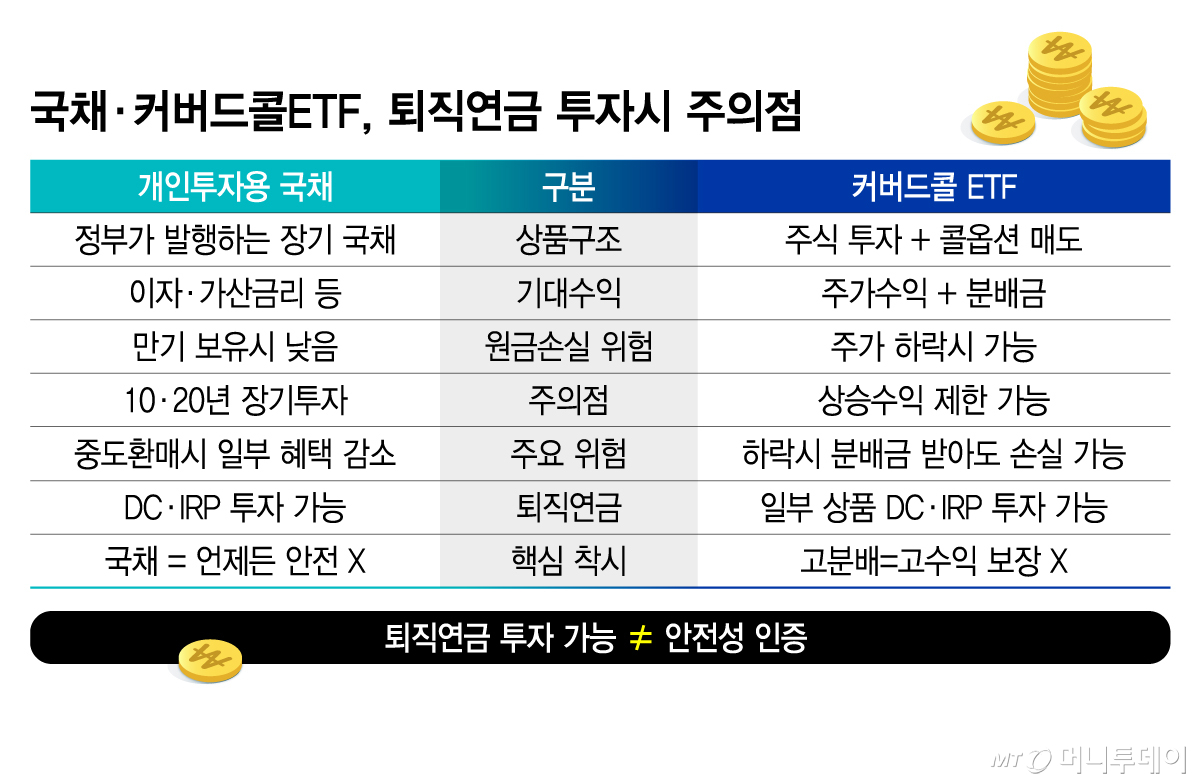
Retirement pensions are rapidly shifting from "retirement savings" centered on principal and interest guarantees to "retirement investment," where participants directly select products. This month, 10-year and 20-year government bonds for individual investors were included in retirement pensions for the first time, and some covered call ETFs (exchange-traded funds), which carry a risk of principal loss, can be invested up to 70% of accumulated assets. Since being available for purchase in a retirement pension does not necessarily mean the product is safe, there are calls to strengthen mechanisms that ensure participants properly understand the distinct risks associated with each product as options expand.
From 20-year government bonds to "high risk" ETFs… The pension shopping basket widens
According to the financial investment industry on the 29th, retirement pension accumulated assets reached 501.4 trillion won at the end of last year. While the proportion of DB (defined benefit) plans is decreasing, DC (defined contribution) plans and IRPs (individual retirement pensions), which are managed directly by participants, are growing rapidly, and investments in performance-linked products such as TDFs (target date funds) and ETFs are also increasing.
The range of available products has also expanded. Starting this month, 10-year and 20-year government bonds for individual investors can be purchased through DC plans and IRPs. Because they are issued by the government, holding them until maturity guarantees the return of principal and interest, but they are products premised on long-term holding. If redeemed early, participants cannot receive benefits such as additional interest rates and compound interest associated with long-term holding. It is necessary to sufficiently inform retirement pension participants about product characteristics, including the burden of long-term holding and the reduction in benefits upon early redemption.
Covered call ETFs are different in nature. These products pursue distributions by using premiums received from selling call options, in exchange for giving up a portion of profits from stock price increases. Monthly distribution types pay out distributions every month. If stock prices fall, there is a risk of principal loss, and in rapidly rising markets, upside gains may be limited.
KB Asset Management's RISE 200 Weekly Covered Call is a "high risk" product with an investment risk rating of Level 2. The prospectus explicitly states that the full amount of principal is not guaranteed and that investors bear the risk of loss. If stock prices surge sharply in a short period, performance may be significantly lower than that of general equity funds due to the covered call strategy.
However, this product can be invested up to 70% of accumulated assets within retirement pensions. This does not mean the product's safety has been recognized, but rather that it can be purchased within the risk asset investment limits of DC plans and IRPs. If participants interpret the fact that a product is "available for purchase in a retirement pension" as a signal that it is a "safe product for retirement funds," there is a concern that they may underestimate the actual investment risk.
The Financial Supervisory Service also classified covered calls as a fund type with "potential to mislead consumers." This is because target rates of return can be mistaken for guaranteed rates of return. Accordingly, starting on the 30th, a "Standard Template for Core Fund Risks" will apply to newly launched covered calls and nine other types of public funds. This requires informing investors about the possibility of principal loss and product-specific special risks using simple language, graphs, and charts.
"Risks by product must be fully understood… Detailed information provision is needed"
Properly communicating the risks of each retirement pension product has become important because participants' responsibilities have grown accordingly. Unlike DB plans, DC plans and IRPs require participants to directly select investment products, and the results are reflected in their own retirement assets.
Hong Won-gu, a research fellow at the Korea Capital Market Institute, pointed out that there is information asymmetry regarding financial companies and products under the current retirement pension system, and that significant search costs are incurred when comparing and selecting products. He emphasized that as the variety of products available for investment in retirement pensions increases, information provision must also become more sophisticated to ensure participants can fully understand and select based on distinct characteristics of each product, including not only returns but also the possibility of principal loss, long-term holding burdens, and revenue structures.
The OECD has also recommended that since DC participants directly choose their investment strategies, information should be provided in a way that allows them to easily understand and compare risks, expected returns, and costs by product. Research fellow Hong stated, "Having many options does not necessarily lead to active selection," adding, "In complex decision-making environments, there is actually a higher likelihood of delaying decisions or choosing familiar principal-and-interest-guaranteed products."

 in STOCK
