

"Tell me about Korean stocks"... K-stocks heat up Wall Street in New York
"Intermediating Korean stocks for U.S. institutional investors has been a business we have continued since the establishment of NH Investment & Securities' New York branch in 1992. This year, I am acutely aware that the investor base and interest in Korean companies have changed on an entirely different scale from the past."
"In New York, a financial hub, there has been a noticeable increase in overseas investors who are curious about South Korea's value-up program and the detailed status of individual companies. Since the opening of omnibus accounts for foreign investors this year, we receive inquiries from 'overseas big players' at least once or twice a week even without actively soliciting them."
Five financial investment industry experts met by Money Today in New York, U.S., from the 14th to the 17th all said they are feeling a shift in the standing of the K-capital market this year. They noted that not only the United States but also other countries are showing interest in the Korean market and seeking more information about Korean companies as "future investment destinations."
The growing interest in the Korean market has become both a new challenge and an opportunity for South Korean securities firms based in New York. They have entered a leap of growth, evolving from simple stock intermediation into so-called "K-capital market investment hubs" that coordinate investor education on the K-capital market and corporate site visits.
Jin Sang-won, head of NH Investment & Securities' New York branch, which opened in 1992 in New York, the world's most developed financial hub for capital markets, said, "The interest and atmosphere toward the Korean market that I feel on the ground have completely changed." The change Jin feels most strongly is the expansion of the investor base. Not only U.S. institutional investors but also pension funds and institutional investors from various countries, including Canada and India, are visiting NH Investment & Securities' New York branch to invest in the Korean market.
The scope of interest in the Korean market has broadened, and its depth has increased. Jin said, "In the past, focus was centered on representative large-cap stocks such as Samsung Electronics and SK Hynix, but now demand is strong for seeking out individual companies even within the same semiconductor sector," adding, "As a result, the investment scope has expanded to include mid-cap stocks." The sectors of interest, which were once solely focused on semiconductors, are diversifying into robotics, healthcare, and finance.
As interest in the Korean market grows, the way K-companies are invested in by New York-based players is also changing. Overseas big investors now request that meetings with Korean companies be arranged and ask for research reports on domestic industry trends and corporate outlooks. Jin said, "This means they have begun to view the Korean market not just as a trading market but as a market for long-term investment," adding, "This trend has been commonly observed among institutional investors in the U.S., as well as investors in Europe and Asia."
More investors are also seeking information on the infrastructure and policy direction of the K-capital market. According to local officials, overseas big players consider the government's capital market policy direction and companies' value-up programs quite important when deciding to invest in the Korean market.
Shin Byung-mok, head of Korea Exchange's New York office, said, "Interest in our country's market is intense. When institutional investors decide to invest in Company A in our country, they inquire about that company's value-up program and even information about other companies related to Company A," adding, "Even without actively reaching out, we receive requests for such detailed information at least once or twice a week."
In particular, with the opening of omnibus accounts for foreign investors this year, inquiries from large overseas financial institutional investors have increased in number and become more detailed. The exchange has reached a point where it must provide customized responses to each firm's inquiries.
Expectations and concerns coexist regarding our country's value-up program. Until now, the focus was on programs aimed at boosting market indices and individual stock prices, but now investors are expecting a value-up program that enhances companies' earnings resilience. Shin said, "Opinions are emerging that policy goals should be set to increase the intrinsic value of companies," explaining, "Some investors also suggest improving the capital efficiency of Korean companies and presenting target levels for ROE (return on equity)."
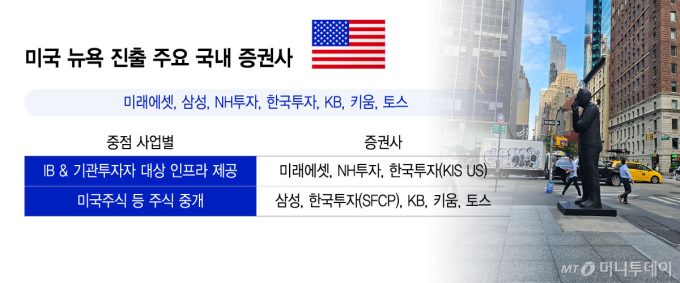
In line with the elevated standing of the K-capital market, domestic securities firms that have entered New York are using this year as a new leap forward to expand their business scope. KIS US, the investment banking subsidiary of Korea Investment & Securities, has entered the structured finance market, including ABS (asset-backed securities), in addition to acquisition financing. Kiwoom Securities' New York branch, which completed the U.S. regulatory approval process in June this year, will begin its direct U.S. stock intermediation service in October.
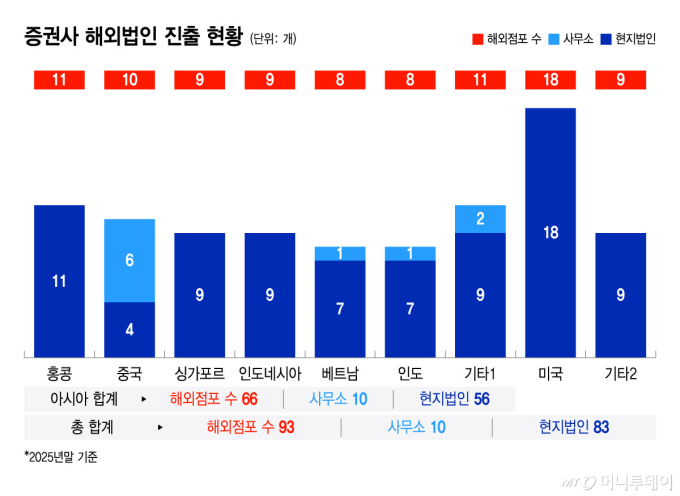
New York branches growing with K-capital, expanding business into fintech investment and structured finance
Local subsidiaries of securities firms based in New York, a global financial hub, are using the elevated standing of the K-capital market as a lever to expand their business areas. While the goals of major securities firms' New York branches varied, they shared a common purpose: "to provide better products and services to Korean clients using know-how gained locally."
New York branches of securities firms are opening doors for Korean retail investors to invest in U.S. non-listed companies and entering local structured finance markets to build expertise. This is an attempt to diversify the revenue sources of local subsidiaries while also broadening the business scope of the parent securities firms themselves.
NH Investment & Securities, Korea Investment & Securities, and Kiwoom Securities' New York branches, met in Manhattan, U.S., from the 14th to the 17th, were each preparing to expand their business areas amid a "new leap forward." NH Investment & Securities' New York branch, which opened in 1992, has set a plan to increase the contribution of IB (investment banking) revenue to 50% in the medium to long term.
NH Investment & Securities' New York branch is challenging itself with a new business—direct investment in U.S. companies—beyond its "traditional business" of stock intermediation. On the 9th, it partnered with U.S. investment banking firm PEAK6 to cooperate on local capital market infrastructure and investments in VC (venture capital) and fintech companies.
Jin Sang-won, head of NH Investment & Securities' New York branch, said, "As seen in the cases of SpaceX, which listed this year, and Anthropic, which is scheduled to list, investor interest in U.S. non-listed companies is enormous," explaining, "If the New York branch directly invests in promising companies, it can provide more accurate information to domestic WM (wealth management) clients who are interested." It is expected that by having the New York branch, as an investor, directly review and convey the latest financial statements and due diligence reports, the effect of reducing information asymmetry will be achieved.
In fact, in the U.S. investment market, companies and distribution platforms that intermediate non-listed stocks for retail investors are newly emerging. NH Investment & Securities' New York branch is also considering investments in AI technology and fintech companies to reflect demand for investing in pre-IPO (initial public offering) companies. Jin said, "We plan to focus on increasing investment accessibility to fintech and AI companies that are changing the financial landscape and making direct strategic investments," adding, "We will collaborate with local AI financial infrastructure firms like LinqAlpha to discover growth-oriented deals."
There is also a plan to create a "New York success story" in real estate and infrastructure finance, which is considered a strength of NH Investment & Securities domestically. The New York branch is considering a method of investing in real estate funds as an LP (limited partner). Jin said, "To provide better solutions including non-listed stocks and alternative assets, our goal is to enhance PI (proprietary investment) capabilities and strengthen headquarters WM client services based on this," adding, "We will transform into an investment platform for the Americas region that discovers and invests in good U.S. assets."
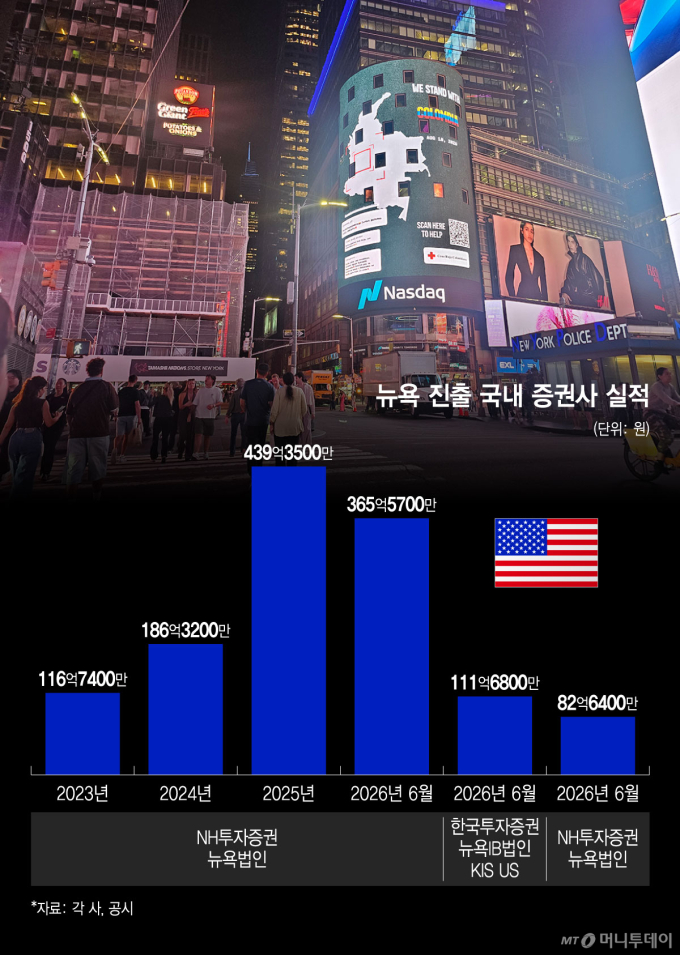
KIS US, the New York IB subsidiary of Korea Investment & Securities, has stepped into the structured finance market. Unlike other securities firms' New York branches, KIS US is an IB-specialized subsidiary that does not directly intermediate stock trading. Through a thorough localization strategy, it has achieved results in the acquisition financing sector, posting net income for the current period of approximately 18.8 billion won through August last month.
However, this year's acquisition financing market environment is not easy. Mergers and acquisitions have decreased due to concerns that AI (artificial intelligence) will shrink the SW (software) industry, and as transactions involving the extension of existing loans and contracts have increased, KIS US's opportunities have narrowed.
Amid this, an opportunity to enter the structured finance market opened up as regulations on the banking industry in the U.S. tightened. Woo Yeon-gwang, head of KIS US, said, "ABF (asset-backed finance) is a bank-centric market, but due to strengthened regulations, it has become difficult for banks to structure and hold loan receivables," adding, "We have entered the ABF business by purchasing banks' loan receivables and structuring and productizing them into forms suitable for customer investment, such as RMBS (residential mortgage-backed securities)."
According to global investment firm KKR, the size of the U.S. private ABF market increased from 706.6 trillion won in 2022 to 829 trillion won in 2024, and is projected to grow to 1 quadrillion 464 trillion won by 2027.
KIS US has established a joint venture called CAP with global alternative investment manager Canyon Partners and Japan's Dai-ichi Life, among others, to purchase high-quality loan receivables. It is also considering structuring these into products such as MBS (mortgage-backed securities) for sale and management.
KIS US's ultimate goal is to build expertise and experience in the U.S. capital market, where IB and structured finance are most developed, to meet the diverse needs of Korea Investment & Securities' clients. Woo said, "In 20 to 30 years, our country's capital scale will grow larger, and the products customers want will become more diverse," adding, "While competing with local U.S. financial firms, we will build expertise in IB and structured finance, source direct deals, and respond to the diverse investment needs of Korean clients."
There are also securities firms newly entering traditional businesses. Kiwoom Securities is in the final stages of inspection, aiming to launch its direct U.S. stock intermediation service in October.
Kiwoom Securities acquired a securities license in June last month by acquiring a local securities firm established in the 1990s. As the No. 1 domestic retail stock trading firm, Kiwoom Securities is establishing a New York branch to innovate overseas stock services in the medium to long term. Lee Yun-gu, head of Kiwoom Securities' New York branch, said, "For example, fractional stock trading service has become possible, but if orders are processed through other U.S. securities firms, the introduction of such new services may be delayed," adding, "With a local branch, we can immediately upgrade systems according to the situation and launch new services."
With the launch of Kiwoom Securities' New York branch service, competition among domestic securities firms is also expected to become more intense. As each securities firm internalizes U.S. stock intermediation, healthy competition is anticipated that will increase benefits and convenience for retail investors.

 in STOCK


