

Retail investors have been engaging in what is known as 'two-handed investing,' selling off large amounts of Samsung Electronics and SK Hynix shares over the past month while simultaneously buying back into these two stocks through exchange-traded funds (ETFs). This trend is interpreted as an effort to reduce the burden of concentration in domestic leading stocks following volatility shocks from single-stock leveraged ETFs, while maintaining semiconductor exposure through indirect investment.
According to Korea Exchange (KRX) on the 1st, domestic retail investors net sold a total of 1,831 trillion won worth of Samsung Electronics and SK Hynix shares in September alone. By stock, SK Hynix (968.8 trillion won) and Samsung Electronics (862.2 trillion won) ranked 1st and 2nd, respectively, in net selling by retail investors.
In contrast, financial institutions net bought a total of 483.1 trillion won worth of Samsung Electronics and SK Hynix during the same period. With Samsung Electronics at 377.41 trillion won and SK Hynix at 105.69 trillion won, these two stocks ranked 1st and 2nd in net buying by financial institutions. Supply and demand from financial institutions are considered to reflect the indirect investment flow of retail investors. This is because when individuals buy ETFs, securities firms acting as liquidity providers (LPs) purchase the constituent stocks of the ETF.
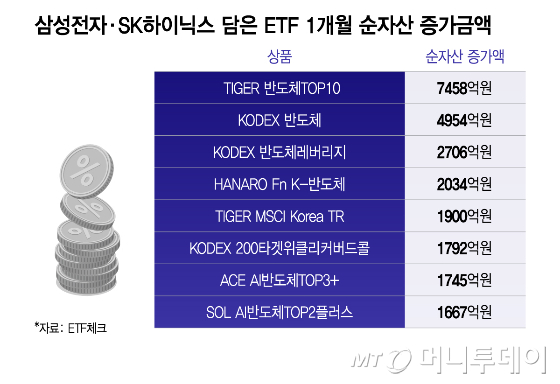
In fact, many products with high composition ratios of Samsung Electronics and SK Hynix appeared in the top rankings for ETFs by net asset increase over the past month. Specifically, these include TIGER Semiconductor TOP10 at 74.58 trillion won, KODEX Semiconductor at 49.54 trillion won, KODEX Semiconductor Leveraged at 27.06 trillion won, HANARO Fn K-Semiconductor at 20.34 trillion won, TIGER MSCI Korea TR at 19 trillion won, KODEX 200 Target Weekly Covered Call at 17.92 trillion won, ACE AI Semiconductor TOP3+ at 17.45 trillion won, and SOL AI Semiconductor TOP2 Plus at 16.67 trillion won.
It can be seen that retail investors are disposing of physical shares of Samsung Electronics and SK Hynix while reinvesting in semiconductors through ETFs.
Despite continued expectations for earnings growth in the two stocks, it appears that retail investors' large-scale disposal of semiconductor shares was driven by a combination of profit-taking desires and investment psychology aimed at reducing volatility risk.
Analysts also suggest that the possibility of changing supply and demand conditions is influencing retail investor sentiment. Until now, large-scale share buybacks by Samsung Electronics and SK Hynix have absorbed a significant portion of selling pressure from foreign investors and others. However, once the share buybacks conclude, this safety net for supply and demand may weaken. Concerns that volatility could increase again are said to be making direct investment hesitant.
Yang Il-woo, a researcher at Samsung Securities, stated, "From an investor's perspective, there can be concerns about a supply gap after the end of share buybacks," adding, "While it is unlikely that stock prices will fall further on already known factors, volatility may increase."
Some in the securities industry view retail investors' selling of semiconductor stocks not as a simple exit from the sector, but as a shift in investment style. It is analyzed that the investment criterion is shifting from an individual stock focus to a portfolio-centric approach.
Expectations for a semiconductor supercycle (period of boom) remain strong, as September export and import trends released on the same day showed that semiconductor exports surpassed $60 billion (approximately 82 trillion won) for the first time in history, driven by expanding memory demand and increased export volumes.
A source in the securities industry said, "It is difficult to say that expectations for the semiconductor industry have diminished just because individuals sold Samsung Electronics and SK Hynix," adding, "It appears to be a calculation to reduce risk while not completely withdrawing from the semiconductor market, which still holds high growth expectations."

 in STOCK
