

The baton of the semiconductor rally, previously led by Samsung Electronics and SK Hynix, was passed to stocks in materials, components and equipment. As expectations grew that capital investment (CAPEX) in semiconductor processes would increase due to expanded AI (artificial intelligence) investment, the upward momentum of materials, components and equipment stocks was notable in September. The securities industry anticipates improved earnings for these stocks, viewing them as having high investment appeal.
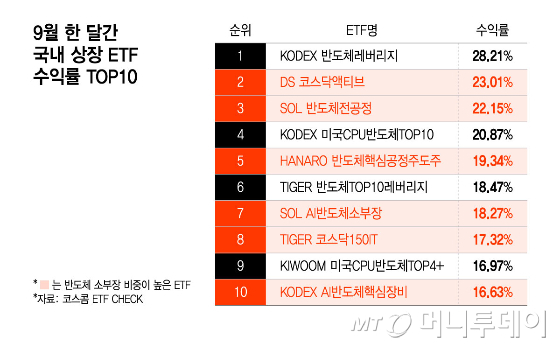
According to KOSCOM ETF CHECK and other financial investment industry sources on the 3rd, four semiconductor materials, components and equipment-themed ETFs ranked among the top 10 domestic listed ETFs by return (including leverage and inverse products) over the past month of September. Including products with a high allocation to materials, components and equipment, this number increases to six.
Among these, DS KOSDAQ Active recorded a return of 23.01%, placing it second in overall ETF returns. It achieved the best performance excluding leverage products. As of the end of September, the top 10 holdings in the DS KOSDAQ Active portfolio accounted for 47.3% of its weight, with eight semiconductor materials, components and equipment stocks making up 39.7% of that portion.
In addition, △'SOL Semiconductor Front-End Process' (22.15%), △'HANARO Semiconductor Core Process Leaders' (19.34%), △'SOL AIBan Do-che-so (Director)' (18.27%), △'TIGER KOSDAQ 150 IT' (17.32%), and △'KODEX AI Semiconductor Core Equipment' (16.63%) also showed high returns.
The strength of semiconductor materials, components and equipment stocks has changed the landscape of KOSDAQ market capitalization. At the end of August last month, there were 10 such stocks among the top 20 by market capitalization, but this number increased to 13 within a month. Jusung Engineering closed trading at third place in market capitalization, overtaking Ecopro BM from fifth place. Padu, Eugene Technology, TCK, and Test newly entered the top 20.
Experts in the financial investment industry diagnose that expectations of increased capital investment by memory semiconductor companies, including major clients Samsung Electronics and SK Hynix, served as a driving force for the rise in materials, components and equipment stocks. They explain that supply has failed to keep up with AI-driven memory demand, leading to continued capacity expansion, and that expectations for improved orders and earnings for materials, components and equipment suppliers have overwhelmed the burden of rising interest rates. On the 30th (local time), Micron also announced in its fourth-quarter fiscal year 2026 earnings release that it plans to invest approximately $25 billion in the first half of fiscal year 2027. This is close to this year's annual capital expenditure scale.
Kim Un-ho, a researcher at IBK Investment & Securities, analyzed, "Samsung Electronics has decided to close its back-end process line located in Cheonan and build an HBM (High Bandwidth Memory) production line." He added, "Expectations formed that Samsung Electronics would outsource production elements it had previously internalized, resulting in a large rebound centered on the back-end process." He further noted, "Subsequently, a cycle of 'matching keys' occurred in the order of back-end process, front-end process, and materials within semiconductors."
It is estimated that supply and demand also influenced the stronger upward momentum compared to large-cap semiconductor stocks. In the case of Samsung Electronics and SK Hynix, this means that profit-taking by investors who bought at high prices continued, limiting their upside potential. Jeong Seong-in, an executive at DS Asset Management, stated, "Materials, components and equipment stocks have undergone significant corrections in the past, causing selling investors to exit, resulting in relatively less supply and demand distortion."
The securities industry judges that there are many investment opportunities in materials, components and equipment companies and recommends a buy strategy as valid. Kim Rok-ho, a researcher at Hana Securities, evaluated, "Amid massive capacity expansion by semiconductor companies, equipment market forecasts have been continuously revised upward, and back-end process investments by domestic memory manufacturers are also being fully activated." He added, "Both front-end and back-end process companies are in a range where investment ideas remain valid."

 in STOCK
