

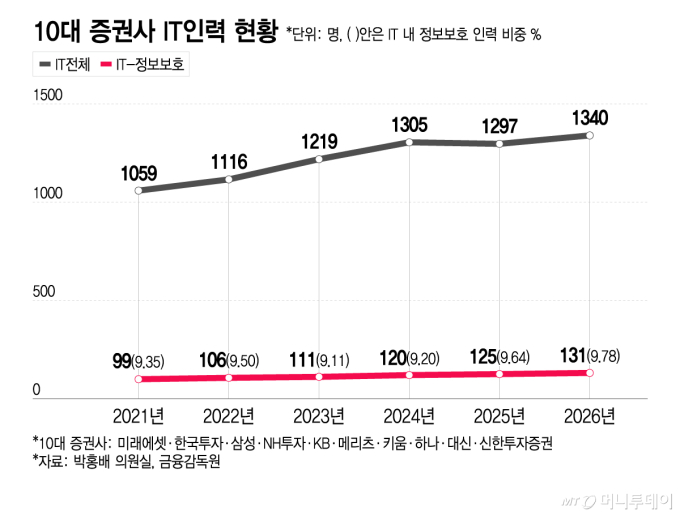
It has been confirmed that the number of information protection personnel at South Korea's top 10 securities firms increased by only six, from 125 at the end of 2024 to 131 in the first half of this year. The average is 13 per brokerage, and their share of IT (information technology) staff stood at 9.78%, remaining in the 9th% range for the sixth consecutive year.
It has also been revealed that external hacking groups have recently scanned domestic securities firms for security vulnerabilities. As AI (artificial intelligence)-driven hacking has breached even the security walls of major banks, there are calls for brokerages to first expand their security personnel.
According to documents submitted on the 6th by the Financial Supervisory Service to the office of Democratic Party of Korea lawmaker Park Hong-bae, a member of the National Assembly's Political Affairs Committee, the number of executives and employees handling IT tasks at securities firms rose by 281, from 1,059 in 2021 to 1,340 in the first half of this year. Among them, personnel responsible for information protection increased by 32, from 99 to 131.
By brokerage, some firms increased their information protection staff while others reduced it. Mirae Asset Securities grew by six (31.6%), from 19 in 2021 to 25 in the first half of this year, and NH Investment & Securities increased by six (37.5%), from 16 to 22. Shinhan Investment Corp added seven (50%), rising from 14 to 21. In contrast, KB Securities remained unchanged at 14. Daishin Securities decreased from five to four. Meritz Securities saw its IT staff grow from 37 to 50, but its information protection personnel increased by only one, from one to two.
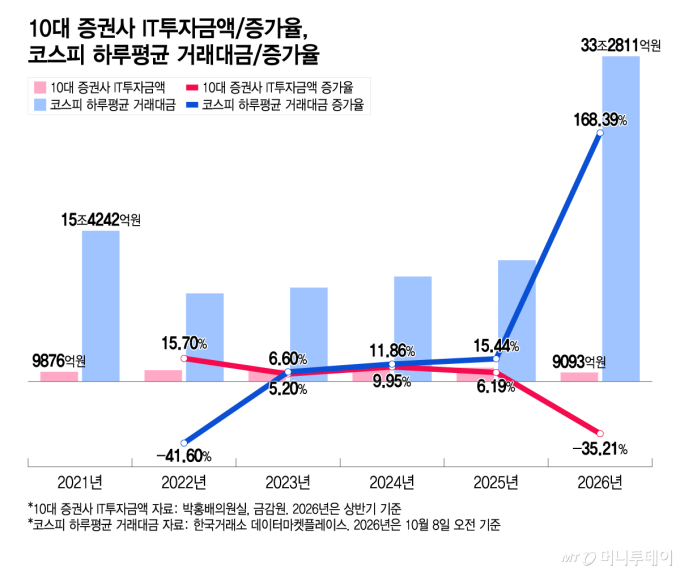
IT investment amounts by securities firms are also failing to keep pace with the speed of growth in domestic stock trading. IT investment includes not only information protection but also IT security and development solutions. According to Park Hong-bae (Rep.), the IT investment executed by the top 10 securities firms last year was 1 trillion 403.4 billion won, a 6.19% increase from the previous year. This falls short of even half the growth rate (15.44%) in the daily average trading value of KOSPI over the same period. In both 2023 and 2024, the growth rate of IT investment was lower than the growth rate of KOSPI trading value.
The fact that increased budgets have not translated into more security personnel is also cited as a problem. From 2021 to 2025, IT investment by the top 10 securities firms rose by 42.1%, from 987.6 billion won to 1 trillion 403.4 billion won, while information protection personnel increased by only 26.3%. In other words, even as IT investment grew, the share allocated to information protection remained stagnant.
Brokerage security has come under scrutiny due to a series of recent hacking incidents in the financial sector.
"Even banks were breached…" Financial authorities closely monitor brokerages
As intrusion incidents have occurred at banks, savings banks, and capital companies, financial authorities believe damage could spread to securities firms and are monitoring the situation. Brokerages, like the entire financial sector, are reviewing their external touchpoints and authentication/access control systems. No cases of hacking damage at securities firms have emerged yet. A Financial Supervisory Service official stated, "If banks were breached, it means hackers can breach anywhere if they set their minds to it," adding, "We are closely monitoring the situation to prevent further spread of damage."
The scanning by hacking groups is understood to be a pre-intrusion preliminary investigation. A senior figure in the financial investment industry said, "It has been determined that hackers scanned (checked) several securities firms for security vulnerabilities," adding, "While they did not actually attempt to connect, this is an extremely serious matter, so the industry is strengthening security to the maximum extent by monitoring and sharing the situation in real time."
Similar incidents have already occurred repeatedly around the securities industry. Last year, several private fund operators suffered hacking damage. It is known that cloud servers of a computer management company outsourced by some private fund operators were hacked, leading to the leakage of internal data. Since most private fund operators sell products through distributors such as securities firms and do not hold investor personal information, the damage was not significant, but the possibility remains that some personal information related to discretionary contracts may have been leaked.
Three years ago, an incident was detected in which approximately 830,000 customer records were leaked from the investment contest platform of Yuanta Securities and used for unlisted stock investment fraud. The group, while managing this platform, used the information they secured to impersonate an investment advisory firm and defrauded 36 people of approximately 600 million won. In July last year, there was also an incident where an LS Securities employee received a fake email and placed a stock order for a foreign investor. Although it was not a direct hack, the lack of functioning internal controls led to financial damage, and the investor is known to be claiming losses of around 8 billion won.
In all three cases, the breach occurred from the periphery rather than the main computer system. In this recent bank incident as well, external partnership and ancillary channels such as loan solicitors' and employees' business manual apps were the "weak links." This is why opinions are emerging that third-party IT risk management at securities firms must be strengthened. Recently, brokerages have been expanding partnerships and cooperation with virtual asset businesses, asset management companies, and non-financial channels.
In this regard, a financial investment industry official explained, "We are applying the authority's guidelines for third-party IT risk management in the same way as the banking sector." Another financial investment industry official stated, "Just as there are clear security vulnerabilities at small private fund operators, the financial investment industry has them too, so we must take this opportunity to conduct inspections and formulate countermeasures."
The Financial Supervisory Service is expected to announce measures for the entire financial sector, including securities firms, such as establishing a security system that "defends against AI attacks with AI." As seen in the LS Securities case, it also appears likely to demand strengthening of internal control systems at brokerages. Ahead of the Financial Services Commission's national audit on the 8th, the National Assembly's Political Affairs Committee is also urging the industry to strengthen IT security and information protection. Park Hong-bae (Rep.) stated, "As the scale and trading volume of the stock market have grown rapidly, it is necessary to check whether brokerage security systems are at a level commensurate with that growth," adding, "Financial authorities and the securities industry must recognize financial security as essential infrastructure for investor protection and proactively strengthen overall security capabilities in both systems and personnel."

 in STOCK

