

As Lee Hyung-il, Deputy Prime Minister for Economic Affairs and Minister of the Ministry of Economy and Finance, has signaled a cautious stance on the virtual asset taxation scheduled to take effect next year, expectations for a deferral are rising. Given the strong backlash not only from the industry but also from investors, voices are growing louder that the tax system and infrastructure should be reorganized to ensure proper taxation.
According to the virtual asset industry on the 11th, Deputy Prime Minister Lee stated at the National Assembly’s Budget and Economic Planning Committee’s national audit on the 6th that he would "broadly gather diverse opinions" regarding virtual asset taxation. Opposition voices are emerging not only from the opposition party but also from the ruling party. Min Byung-deok, Senior Vice Chairman of the Policy Committee of the Democratic Party of Korea, proposed that the current tax schedule should be reconsidered.
With the 23rd general election scheduled for April 2028, the atmosphere is increasingly favorable to the possibility of a deferral. If virtual asset taxation is implemented as planned starting January 1 next year, taxes on income generated next year will be declared and paid for the first time in May 2028. Since the general election will be held before this initial declaration and payment, the political sphere has no choice but to consider the voting intentions of virtual asset investors in their 20s and 30s.
The industry is maintaining a cautious stance despite these expectations. An industry official said, "Expectations for a deferral of virtual asset taxation are emerging as some members of the ruling party, following the opposition, have voiced the need for a deferral, and Deputy Prime Minister Lee has also signaled a cautious stance." The official added, "However, nothing has been finalized yet, so the atmosphere remains tense."
Backlash from investors is also fierce. A petition titled "Petition for a Two-Year Deferral of Crypto Taxation," submitted to the National Petition system in late August, garnered over 50,000 signatures in less than a month. According to a survey conducted last month by Web3 research and consulting firm Tiger Research on 2,423 domestic virtual asset investors, 73% of respondents opposed the implementation of the current virtual asset tax regime. Among those in their 20s to 40s, the opposition rate reached 75%. However, 51% of respondents answered that they could accept taxation if the flaws in the current system were sufficiently addressed.
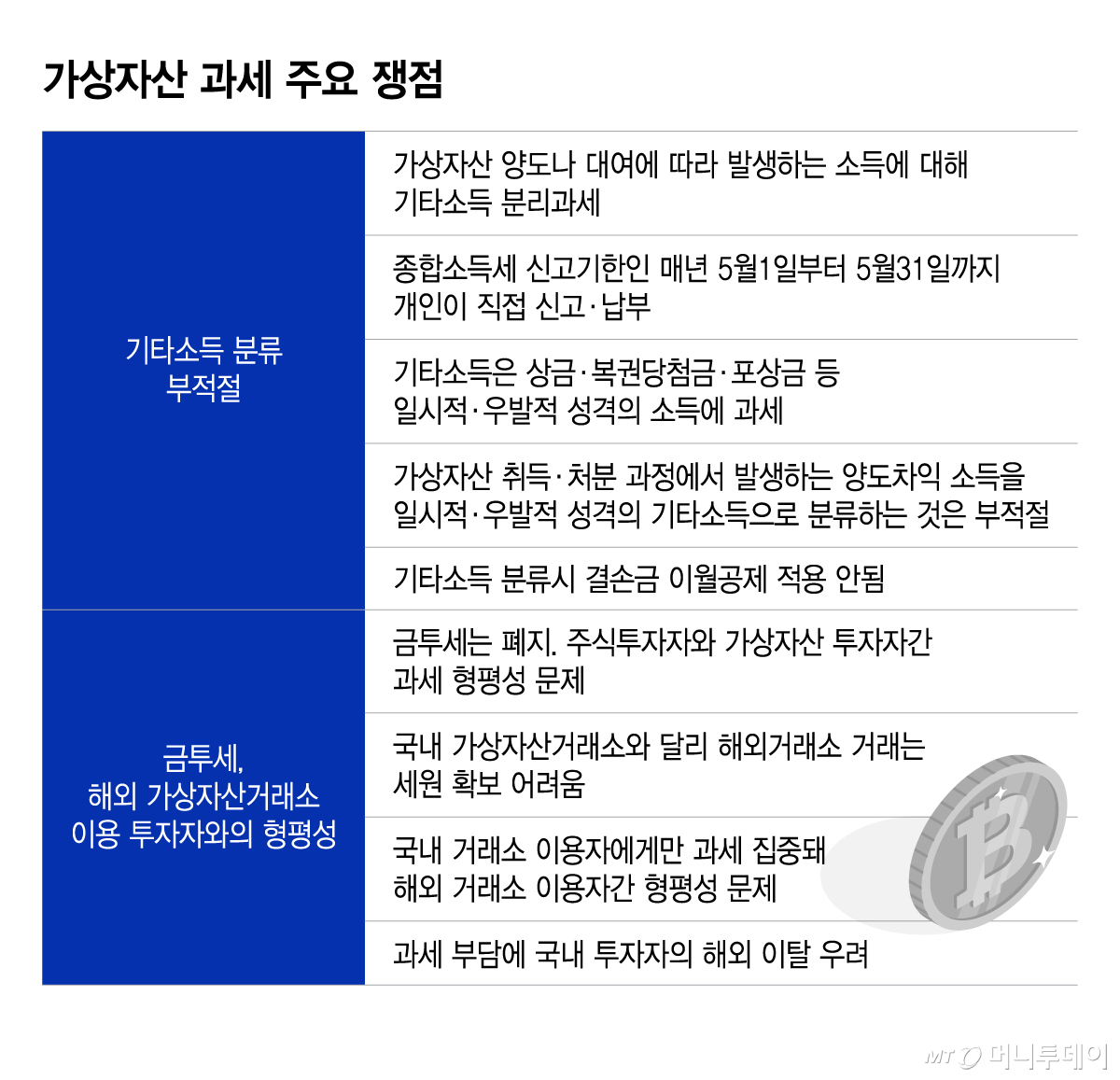
The industry cites investor harm as the biggest problem with the current tax system. Virtual asset income is classified as miscellaneous income, requiring investors to file separate returns and pay taxes during the annual comprehensive income tax filing period. This can be resolved relatively easily if transactions are conducted on domestic virtual asset exchanges such as Upbit and Bithumb. The issue lies in the fact that investors often use multiple overseas virtual asset exchanges simultaneously. The current structure requires investors to directly gather transaction information scattered across various exchanges, calculate profits and losses, and file their returns themselves.
It is pointed out that a large number of delinquents may emerge because the 2030 generation, which constitutes the main investor base for virtual assets, is not accustomed to tax filing and payment and must compile related documents individually for reporting. The complex and cumbersome filing procedures could also lead to strong tax resistance. Unlike major countries such as the United States and the United Kingdom, loss carryforward deductions are not applied, meaning there is no mechanism to offset losses, which is also cited as a problem.
The issue of tax fairness between users of domestic virtual asset exchanges and those using overseas exchanges is also being raised. While transactions on domestic exchanges are relatively easy to track, it is difficult in reality to secure the tax base for transactions on overseas exchanges. In this situation, taxation could be concentrated solely on users of domestic exchanges. Concerns have also been raised that the tax burden may encourage domestic users to move their assets abroad.
Another industry official said, "It is not that the industry or investors are against taxation itself." The official added, "We believe that proper taxation should be implemented by considering factors such as tax classification, tax standards, infrastructure development, and consistency with the Digital Asset Basic Act."

 in STOCK
