

In AI (artificial intelligence) data centers, tens of thousands of GPUs (graphics processing units) constantly exchange data. Until now, electrical signals were transmitted through copper wires, but as speeds increase, heat and power losses grow, driving a shift toward optical communication that transmits signals using light. The component that converts electrical signals into light is the optical transceiver, and within it, the laser chip generates the light. The problem is that silicon, the fundamental material of semiconductors, cannot be used to create lasers. Silicon handles electricity well but does not emit light. Therefore, laser chips are manufactured on a special substrate called indium phosphide (InP), which combines indium and phosphorus.
Indium phosphide has recently emerged as a core component of AI optical communications, drawing market attention. Lumentum, known to hold over 80% of the advanced optical communication laser chip market alongside Coherent, stated at a technology event held in Paris last July that supply falls short of demand by more than 30%. The company also warned that the shortage of indium phosphide could become more severe than the current scarcity of memory semiconductors.
Nvidia invested a total of $4 billion ($5.36 trillion won, based on an exchange rate of 1,340 won per dollar), or $2 billion each, in Lumentum and Coherent last March to secure laser supply in advance. This year's demand for indium phosphide substrates is estimated at 2.6 million to 3 million units, while global production capacity stands at only 600,000 to 750,000 units per year.
Only three major suppliers worldwide mass-produce indium phosphide substrates: Japan's Sumitomo Electric Industries and JX Metals, and the United States' AXT, headquartered in Fremont, California. According to Reuters and other reports, AXT and Sumitomo Electric together account for nearly 80% of global production, while JX Metals holds approximately 10%. Consequently, Wall Street experts expect AXT to be a major beneficiary of expanded investment in AI optical communications. AXT is one of five semiconductor companies expected to benefit from the transition to next-generation co-packaged optics (CPO).
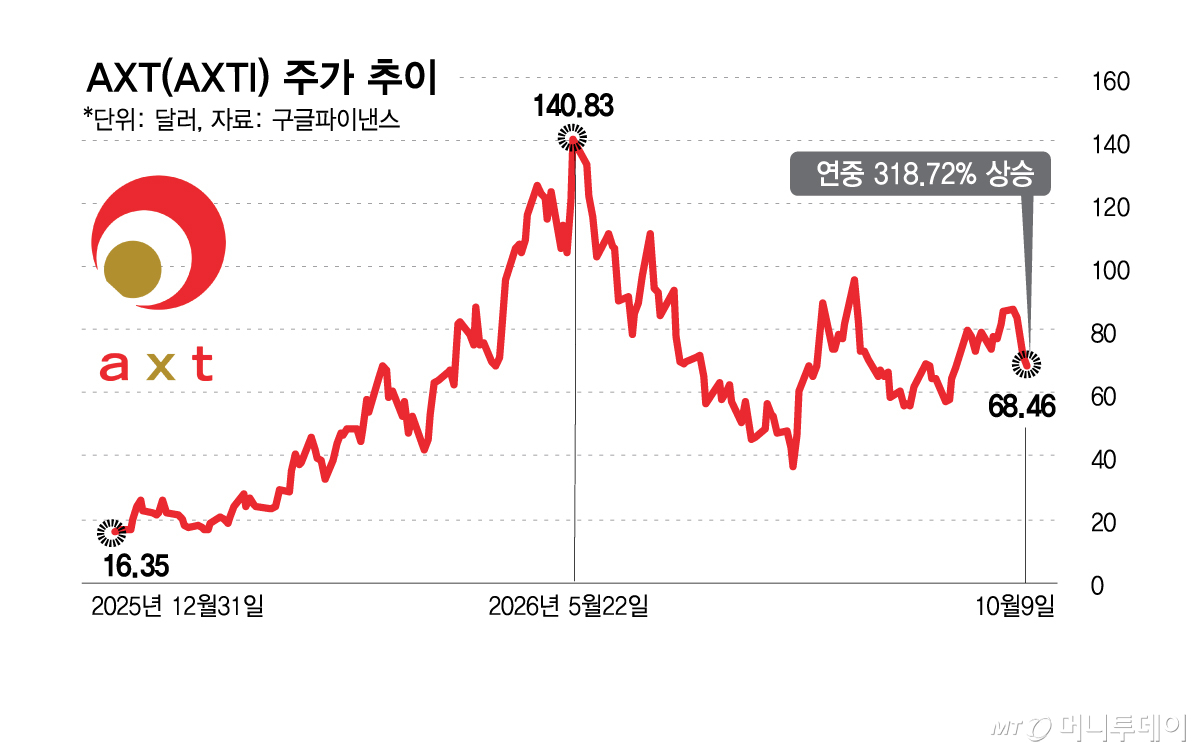
Stock prices had already priced in these expectations. AXT shares, which fell to $1.16 last April, surged to $143 this May. The stock is currently trading at around $68. AXT's weakness lies in the fact that, despite being a U.S.-listed company, all of its factories are located in China, meaning it must obtain export permits from the Chinese government to ship products overseas. Last year's drop in share price to the $1 range was also driven by China adding indium phosphide to its list of export-controlled items.
Startup by a materials engineering PhD from Bell Labs… Crystal growth technology developed under a U.S. Department of Defense project
Morris Young, the CEO who founded AXT, is a materials engineer. He majored in metallurgical engineering at National Cheng Kung University in Taiwan before moving to the United States, where he earned a master’s degree from Syracuse University and a doctoral degree from Polytechnic Institute (now the New York University Tandon School of Engineering). He worked at AT&T Bell Labs starting in 1979 and transferred to Lawrence Livermore National Laboratory in 1985, where he served as a physicist. In 1986, while still employed at the laboratory, he co-founded the company with Theodore Young and Davis Chang; it was initially named Vestal Corporation. The company later changed its name to American Xtal Technologies, and AXT is derived from the initials of that name.
What Young used as the foundation for his business was a new method for producing compound semiconductor substrates. Substrates are made by slicing thin wafers from an ingot, which is a solid mass formed by melting raw materials and then solidifying them into a single crystal. The fewer defects in the atomic arrangement within the crystal, the higher the quality of the substrate. AXT employs a technology called the vertical gradient freeze (VGF) method. In this process, raw materials are melted in a crucible, and the temperature is gradually lowered from the bottom over several days to slowly solidify them. This operates on the same principle as freezing water: rapid freezing produces air bubbles, while slow freezing yields clear ice.
In the early days, U.S. government research projects provided significant support. In March 1994, AXT secured a gallium arsenide substrate development project from the U.S. Ministry of National Defense, receiving $6.1 million (8.2 billion won) over four years. The condition was that the company would retain the rights to the technology developed under the project. After selling its first product in 1990, the company posted annual profits until its initial public offering, with Hewlett-Packard, Motorola, Sony, and Siemens becoming customers. In 1997, revenue stood at $25.3 million (33.9 billion won), of which gallium arsenide substrates used in mobile phone components accounted for 94.9% of product sales. Indium phosphide, the company's current mainstay, was not sold until late 1997. AXT listed on NASDAQ in May 1998 at an initial public offering price of $10.
In the same year, AXT established a subsidiary in Beijing called Beijing Tongmei () and began relocating its factory to China, completing the transfer of all production processes by 2004. This was done to reduce factory operating costs, labor costs, and material costs. It chose a different path from major competitors that produce in Japan and Germany. AXT subsequently invested in shares of more than 10 Chinese companies that manufacture raw materials such as gallium, arsenic, and crucibles, securing a supply chain spanning from raw materials to substrates.
Dotcom Collapse and China Export Controls Push Stock Price to $1; AI Optical Communications Demand Drives Turnaround to Profit
After its listing, the company went through several major crises. As the dot-com bubble burst, revenue fell from $18.8 million (145.8 billion won) in 2001 to $34.71 million (46.5 billion won) in 2003, and the company posted a net loss of $81.18 million (108.8 billion won) in 2002. The share price, which had exceeded $47 in 2000, dropped to $0.67 by early 2003.
The recent crisis stemmed from China's export controls. The Chinese government added gallium and germanium to its list of controlled export items in August 2023, followed by indium phosphide in February of last year. This means that all three substrates manufactured by AXT can no longer be shipped overseas without a license from China's Ministry of Commerce. Compounded by sluggish industry conditions and export disruptions, revenue fell from $141.1 million (189.1 billion won) in 2022 to $88.3 million (118.3 billion won) last year. In the first quarter of last year, the gross profit margin dropped to negative 6.4%. This means that the more products were sold, the greater the losses became. That is why the stock price was pushed down to $1.16 in April of last year.
At the time, deteriorating performance appeared inevitable, but the company weathered a major crisis after securing its first export licenses for customers in Europe and Japan in June of last year. Coinciding with this, surging demand for optical transceivers for AI data centers led to an influx of orders. The company raised approximately $100 million (134 billion won) through a capital increase in December of last year, and another $632.5 million (847.6 billion won) at $64.25 per share in April this year, using the proceeds to expand its Beijing plant.
These changes are reflected in the company's financial results. Second-quarter revenue this year reached $47.59 million (63.8 billion won), a 164.8% increase from the same period last year, significantly exceeding the forecast of approximately 3.4 billion won presented by the company three months ago. Indium tin oxide (ITO) sales amounted to $30.7 million (41.1 billion won), more than double the first-quarter figure of $13.6 million, marking a record high for a single quarter. The gross profit margin surged from 8.0% a year earlier to 44.9%, and the company returned to profitability with a net income of $11.1 million (14.9 billion won). Over the two days of the 30th and 31, following the contract with Lumentum and the earnings release, the stock price rose by 63%.
It is also noteworthy that customers have begun to pay in advance to secure supply allocations. In June, China's Casella Technologies agreed to purchase a total of 173 million yuan (approximately $25.4 million) worth of products for the year 2027, committing to pay the full amount upfront within this year. In the same month, Coherent agreed to make an advance payment of $22.29 million (29.9 billion won) under a three-year supply agreement for indium phosphide substrates with a diameter of 150 mm. In July, Lumentum reserved production capacity for six years through the end of 2031, agreeing to pay a deposit of $43.5 million (58.3 billion won). This indicates that customers are compelled to make advance payments to secure supply due to shortages. Industry forecasts also suggest that the price of indium phosphide substrates in the fourth quarter will rise by more than 10%, exceeding the initially expected increase of 3% to 5%. This would mark the fourth consecutive quarterly price hike since the fourth quarter of last year.
Low-defect substrates, rapid capacity expansion, and raw material self-sufficiency: Three reasons why customers choose AXT
AXT's competitive advantages can be summarized in three key areas. First is substrate quality. From the perspective of laser chip manufacturers, fewer defects in a substrate mean more functional chips can be harvested from each wafer. AXT's indium phosphide substrates are recognized for having the lowest defect density in the market, which helps improve customer yield rates. Growing indium phosphide crystals requires maintaining extremely high pressure inside the crucible. The methods for simultaneously managing temperature and pressure are largely trade secrets not disclosed externally, making it difficult for new entrants to replicate. The company holds 198 patents.
Rapid capacity expansion is also cited as a strength. AXT is increasing production by converting space previously used for gallium arsenide to indium phosphide and modifying the design of its crystal growth furnaces to boost productivity. The company aims to expand its indium phosphide production capacity to approximately 0.6 billion won (80.4 billion won) per quarter by the end of this year, and to roughly $130 million (174.2 billion won) by the end of next year. In April, the stated targets were $35 million by the end of this year and $65 million to 0.7 billion won by the end of next year; however, these goals have been raised to nearly double within three months. Sumitomo Electric plans to invest 18 billion yen to triple its production capacity by fiscal year 2028, while JX Metals intends to spend 120 billion yen to increase capacity seven- to tenfold by fiscal year 2030. Until the Japanese companies complete their expansions, AXT is positioned to scale up its output the fastest.
Raw material self-sufficiency is also cited as a key competitive advantage. Indium, the raw material for indium phosphide, is refined by China, which accounts for approximately 70% of global refining output. AXT's subsidiary, Jinmei, recently began refining high-purity indium, and the company's subsidiary also manufactures the crucibles used to grow crystals. Since 2022, AXT has operated a recycling process that reuses indium phosphide scraps generated during production as raw material. As a result, the company enjoys strong cost competitiveness. While competitors require two and a half to three years to expand their facilities, AXT can increase capacity in a shorter period at lower costs by utilizing existing buildings. The fact that the majority of its technical sales personnel hold doctorates in physics or materials engineering is also evaluated as a strength, as it allows them to directly solve problems with customer engineers.
AXT's next-generation product is a 150 mm diameter indium phosphide substrate. AXT manufactures substrates ranging from 50 mm to 150 mm in diameter, and as the substrate size increases, the number of chips produced per wafer rises, which lowers the laser cost per unit, making it advantageous. As of the end of last year, out of a total workforce of 1,541 employees, only 23 were based at the U.S. headquarters, while 1,517 worked in China. The company had 1,137 manufacturing personnel and 216 research and development staff, with all R&D activities conducted at its factories in China.
Sharp earnings growth, steady revenue increase... US-China tensions the biggest variable
AXT's annual revenue was $141.1 million (189.1 billion won) in 2022, $75.8 million (101.6 billion won) in 2023, $99.4 million (133.2 billion won) in 2024, and $88.3 million (118.3 billion won) in 2025. Revenue for the first half of 2026 was $74.51 million (99.8 billion won). Last year, 67% of revenue came from substrates and 33% from raw materials such as gallium and germanium, but in the second quarter of this year, indium phosphide alone accounted for 64.5% of revenue. By region, China accounted for 66%, Europe centered on Germany for 19%, and North America for less than 1%.
The company forecast third-quarter revenue at $66 million (88.4 billion won), a 39% increase over the second quarter. This figure includes only shipments that have already received export licenses or do not require them. The backlog exceeds $100 million (134 billion won) and is filled with orders through next year. Cash and investment assets as of the end of June stood at $748.8 million (1.034 trillion won), while short-term borrowings were $84.23 million (112.9 billion won).
Wall Street's assessment is largely positive. Four out of five analysts recommend a buy, while one recommends hold, and the average target price stands at $91.60 (12.27 million won), significantly higher than the current share price. Of course, there are also no few concerns. The biggest risk lies in export licenses. Due to U.S.-China tensions, a considerable amount of orders remain unfulfilled because export licenses have not been obtained. This is also why AXT's customers have entered into long-term contracts with Japanese companies to diversify their supply sources. Expansion by competitors is another variable. Market research firm LightCounting predicted in April that the shortage of indium phosphide would be resolved by the end of this year.
The first hurdle that will determine the direction of the stock price is the third-quarter earnings release scheduled for October 29. Key factors include whether the company meets its revenue forecast of $66 million, the magnitude of fourth-quarter price increases, export licenses to the United States, and the schedule for the 150mm substrate Yangsan facility.
◇ AXT Key Milestones
1986
Founded in California by Maurice Young and others, the company was then named Vestal Corporation.
1990
GaAs substrates produced via the vertical gradient freeze (VGF) method begin sales
March 1994
US Department of Defense awards contract for gallium arsenide substrate development project; $6.1 million over four years
May 1998
Listed on NASDAQ at an IPO price of $10. Founded Beijing Tongmei in the same year.
2004
All production processes have been fully relocated to China. Morris Young steps down as CEO
July 2009
Morris Young returns as CEO
August 2023
China implements export controls on gallium and germanium
February 2025
China imposes export controls on indium and tellurium. April stock price: $1.16
June 2025
First export permit for indium tin oxide; shipments to European and Japanese customers resume
April 2026
Capital increase of $632.5 million at $64.25 per share
June 2026
Long-term supply contracts with Cassella and Coherent; Tongmei withdraws IPO application
July 2026
Lumentum signs six-year production capacity reservation contract; Q2 revenue reaches $47.59 million, turning profitable

 in STOCK


