

The calculation behind companies' initial public offerings (IPOs) has become complex, triggered by overlapping listing guidelines introduced to protect shareholder rights. As market cooling accelerates, the recovery of investment funds by private equity funds (PEFs) that invested on the condition of a listing has been completely blocked. Although they are exploring various options such as share sales and mergers and acquisitions (M&A), the market slump continues as a vicious cycle repeats where tied-up capital prevents new investments.
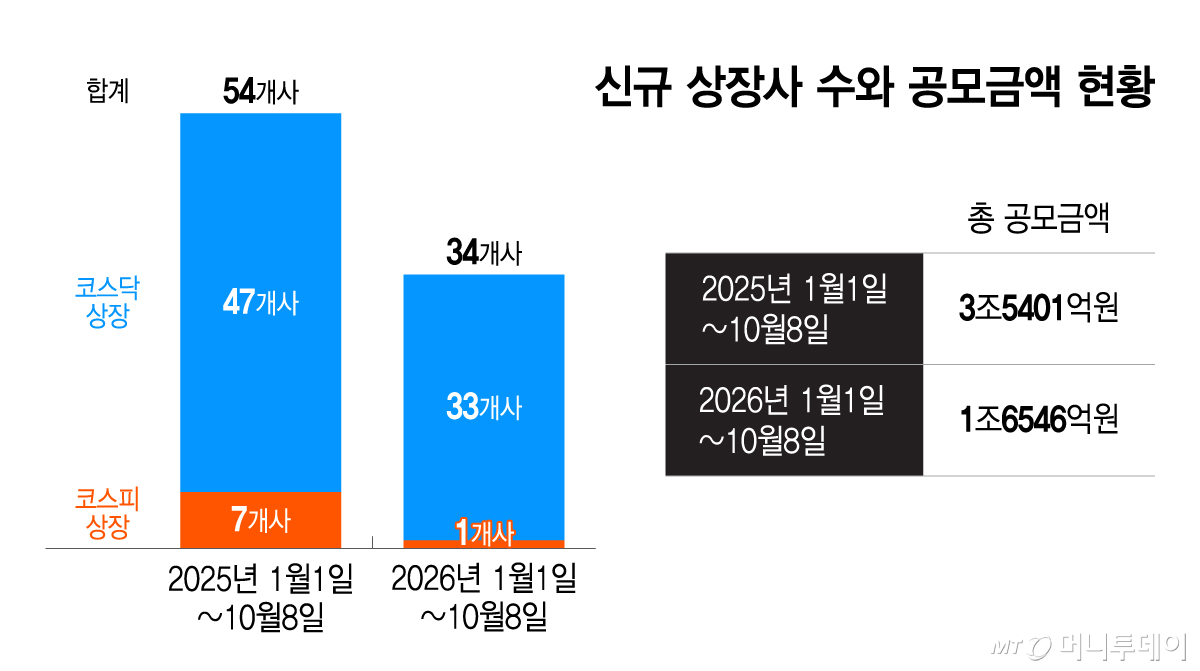
According to financial investment industry sources on the 8th, the number of newly listed companies from the beginning of this year through that day was tallied at 34 (excluding SPACs and SPAC mergers). While 33 companies entered the KOSDAQ, only one company listed on the KOSPI. This is a decrease of 20 companies (37.0%) compared to the same period last year, which saw 54 listings (7 on KOSPI, 47 on KOSDAQ).
The offering amount also decreased. From January 1 to October 8 this year, the total offering amount for KOSPI and KOSDAQ listed companies was 1.6546 trillion won, falling short of half of the same period last year (3.5401 trillion won).
Last year, companies cited as IPO big fish, including Myungin Pharmaceutical, Daehan Shipbuilding, Daishin Value REIT, Dalba Global, and LG CNS, all listed simultaneously. In contrast, the only big fish to enter the KOSPI this year is K bank. This indicates a significant contraction of the market compared to last year, when companies from various industries listed.
The securities industry cites the government's overlapping listing regulations as a key cause. It is noted that listings by major conglomerate affiliates, which accounted for a large portion of big deals in the past, have been blocked due to exchanges' stance against overlapping listings. Companies have also successively withdrawn or indefinitely postponed their listing plans.
For a subsidiary created through a physical spin-off to list, it must obtain consent from parent company shareholders through a special resolution. Even with shareholder consent, it must clear the exchange's strict preliminary review threshold.
Accordingly, HD Hyundai Robotics, established by physically spinning off HD Hyundai's robotics division, once postponed its IPO plans. However, as listing possibilities opened up recently with cases like Deoksan Nepcore entering the KOSDAQ as an exception to overlapping listings, it is reported that HD Hyundai Robotics is also reconsidering its IPO push at a late stage.
LS Group, which has faced ongoing controversy over overlapping listings, is completely reviewing its affiliate IPO strategy. The IPO plan for LS's great-granddaughter company, Essex Solutions, was officially withdrawn in January last month. Consequently, the capital raising plan that LS had prepared for equipment investment has also been disrupted.
The situation is even more awkward for financial investors (FIs) who invested on the premise of a listing. A representative case is SK Ecolab. SK Ecolab raised 1 trillion won through a pre-IPO in 2022. According to option agreements made with FIs at the time, the listing should have been completed by July last month, but as it was not feasible, the investment funds were repaid to the FIs. While rebalancing could be used to aim for an overlapping listing exception, the current situation makes pushing for an IPO difficult.
Blocked recovery of funds leads to a slump across the entire market. The returns on hedge fund products that adopted a strategy of investing in unlisted companies to gain profits after an IPO have fallen to a low of -60% this year. Most IPO hedge funds' returns are limited to 1%. Analysts say a vicious cycle is repeating where unrealized losses on funds tied up in the funds grow, preventing reinvestment.
Experts point out that capital recovery channels must be broadened along with regulations. Lee Young-kyung, Senior Research Fellow at the Korea Institute of Financial Studies, stated, "In our country, investors' capital recovery paths are not diversely realized through means such as M&A and secondary share sales in addition to listing, so overlapping listing regulations can make corporate capital raising difficult and lead to a decline in corporate growth." She added, "(Overlapping listing regulations) require us to consider together ways for companies to raise funds through various channels."
An IB industry official said, "In the past, holding companies were created to prevent circular shareholding, with companies placed underneath them. If overlapping listings are regulated, there is concern that domestic listed companies may move overseas." The official added, "Since the timing of stock trading is not uniform, it is not easy to aim for overlapping listing exceptions either, so efforts should focus on establishing clear criteria."

 in STOCK
