

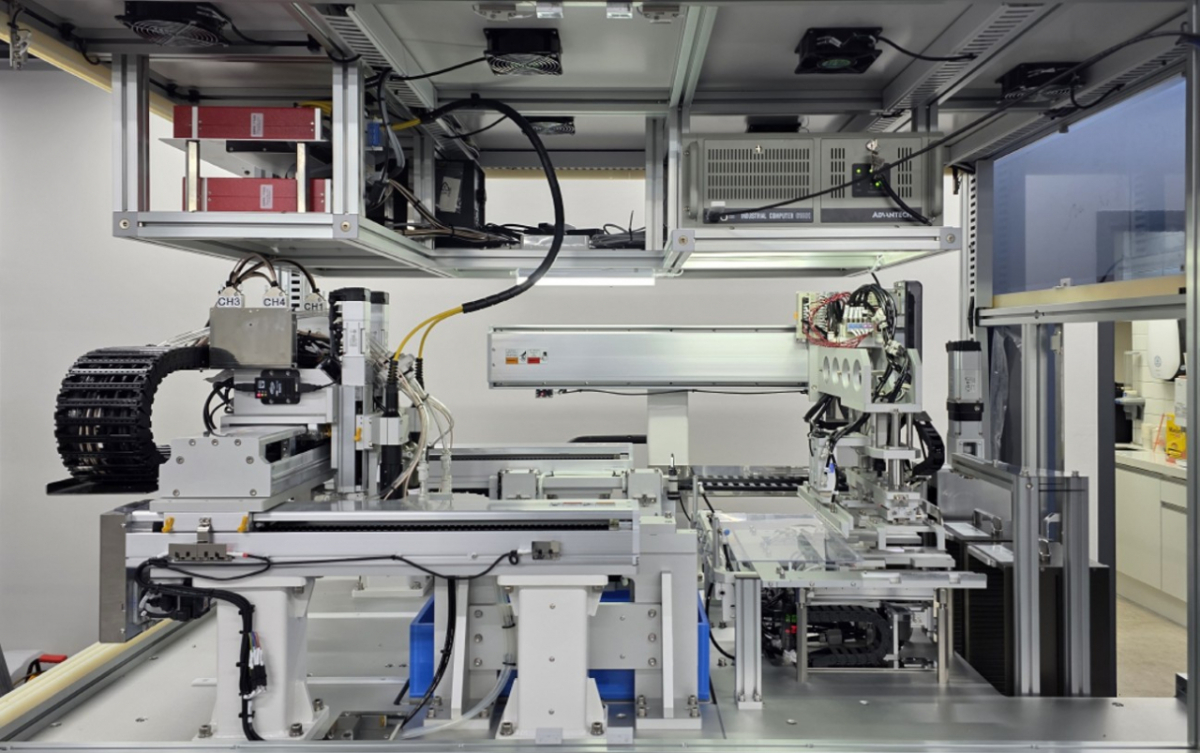
Hanwool Semiconductor, a specialist in semiconductor and electronic component inspection equipment, has achieved domestic production of core inspection equipment previously monopolized by Japanese companies and entered the value chain of a major Taiwanese electronic components company.
On Wednesday, Hanwool announced that it had secured an order for its self-developed ultrasonic flaw detector for multilayer ceramic capacitors (MLCCs) from a subsidiary of Taiwan's Delta Electronics group.
Delta Electronics, the parent group of the client, is a global manufacturer in power supply units and thermal management solutions, with annual consolidated revenue reaching approximately 25 trillion won. Operating large-scale production hubs and subsidiaries in locations including its headquarters in Taiwan, Thailand, and China, it supplies core power components to global information technology (IT) and server manufacturers.
This order is significant as it secures a global supply foundation for domestic equipment in the MLCC ultrasonic flaw detector market, which has been effectively monopolized by Japanese Company H. Hanwool plans to expand technical verification and supply negotiations with global customers on the basis of this order.
In particular, high-capacity and high-reliability MLCCs used in artificial intelligence (AI) servers and data centers require precise quality control that can detect even microscopic internal defects. Hanwool Semiconductor's ultrasonic flaw detector was developed by combining non-destructive testing technology with an AI-based automatic judgment function, enabling the inspection of internal defects without damaging the product and automatically distinguishing between good and defective items.
The company's self-developed AI integrated platform, "HaWAIe," analyzes inspection data to subdivide the characteristics and types of internal defects. It also provides a monitoring function that allows real-time verification of inspection results and defect types. The company plans to enhance inspection speed and AI judgment performance to respond to the transition from sampling inspection to 100% inspection.
It is currently conducting equipment specification consultations and tests with global MLCC manufacturers. It plans to expand its scope of application according to each customer's production conditions and quality standards, while pursuing additional orders.
The company is also advancing the development of an automation system that links pre- and post-ultrasonic inspection processes. The concept involves connecting everything from alignment and mounting on printed circuit boards (PCBs) to ultrasonic inspection, AI judgment, and product sorting into a single system, thereby increasing the level of automation in the inspection process and improving production efficiency.
The domestic production of the equipment is also expected to diversify the supply chain for inspection equipment in the domestic electronic components industry. If application expands to domestic production lines, it is projected that reliance on imported equipment will decrease, allowing for rapid response to maintenance and specification changes by process.
A company official said, "We will respond to the transition to 100% inspection in MLCC manufacturing processes by enhancing high-speed ultrasonic inspection and AI automatic judgment technology." The representative added, "We plan to expand equipment supply to global customers and broaden our business scope with automation solutions that link pre- and post-inspection processes."

 in STOCK
