

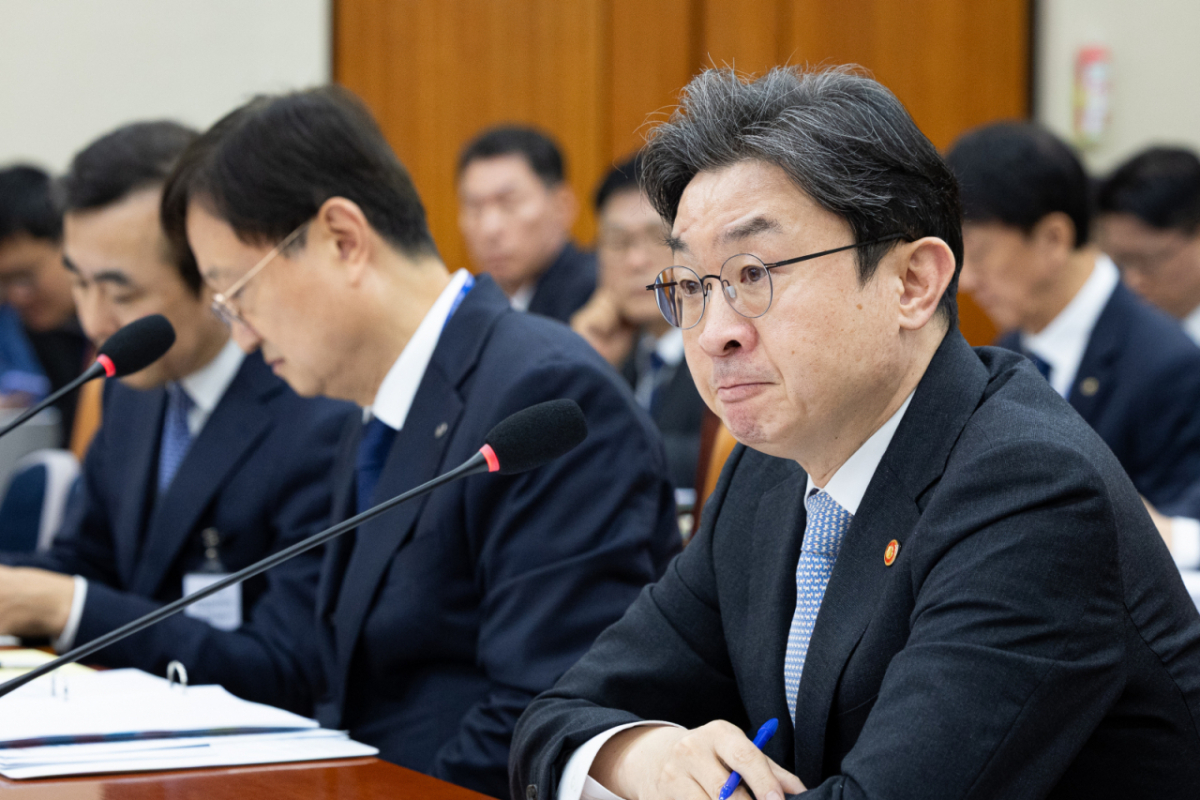
Yeo Ya (Rep.)s expressed opinions that supplements are needed regarding the government's capital market revitalization policies, including the public disclosure of a list of companies with low PBR (Price-to-Book Ratio) and changes to the entity responsible for inspecting voting rights under the Stewardship Code. They raised concerns that during the government's capital market revitalization process, there could be significant side effects, such as companies with temporarily low market capitalizations being delisted and minority shareholders actually suffering investment losses.
Yeo Ya (Rep.)s belonging to the National Assembly Political Affairs Committee pointed out at the comprehensive audit of the Financial Services Commission and Financial Supervisory Service held at the Seoul Yeouido National Assembly on the 22nd that policies should be improved in a direction that minimizes side effects related to the government's capital market revitalization policies.
Lee Kang-il, a lawmaker from the Democratic Party of Korea, stated, "According to domestic research, the most important reason why Korean companies have low PBR is their lack of growth drivers. The results show that listed Korean companies actually have lower PBRs when their dividend payout ratios are higher," adding, "This shows that expanding dividends or burning treasury shares alone cannot solve the PBR problem."
Lee (Rep.) expressed the opinion that financial authorities should carefully re-examine the situation ahead of the release of the low PBR list on November 2. Lee (Rep.) claimed, "For the first time in our country, a list of low PBR companies is being released, and it seems up to 220 companies will be included," arguing, "A company should not be evaluated based solely on low PBR."
Furthermore, Lee (Rep.) raised issues such as the possibility that companies might publicly disclose plans to improve corporate valuation 'falsely' to be excluded from the low PBR list, and the fact that a system for evaluating how much improvement companies have made after low PBR disclosure has not yet been specifically established. Lee (Rep.) stated, "Since 2023, we have been demanding efficient management improvements considering the cost of capital for major listed companies," emphasizing, "It is important to focus on whether profitability is significantly improved and what investments are being made to enhance corporate capital efficiency, rather than simply expanding dividends."
Lee (Rep.) expressed the opinion that instead of a blanket release of the low PBR list, different prescriptions should be applied by company group. This includes examining how much companies lacking growth potential invest in R&D (Research and Development) costs or new business ventures, providing exit routes to allow for the decisive cleanup of low-profit businesses with low capital efficiency, and requiring companies with weak governance structures to go through a process to restore shareholder trust.
Regarding Stewardship Code fiduciary duty activities, opinions were raised that the Financial Supervisory Service should oversee the performance of fiduciary duty activities by each institutional investor. Park Hong-bae (Rep.) from the same party stated, "There are no regulations excluding participation by institutional investors who do not properly implement the Stewardship Code, and compliance inspections are entrusted to the Stewardship Code Development Committee commissioned by the ESG Standards Institute, leading to many opinions asking 'will this work properly?'" and asked, "There is an opinion that the Financial Supervisory Service should conduct compliance inspections, and a bill on this content has been submitted. Does the Financial Services Commission agree?"
Lee Eui-won, Chairman of the Financial Services Commission, said, "While the obligation for compliance inspections has been strengthened, are not the follow-up measures following the inspections insufficient?" He added, "I empathize with the committee member's point that (follow-up measures after inspection compliance) need to be clarified further in legal interpretation, and we will comprehensively examine the necessity of institutional improvements considering overseas cases."
Park (Rep.) mentioned that institutional investors who actively seek to exercise shareholder rights, such as Truston Asset Management, face realistic barriers. Park (Rep.) claimed, "When institutional investors actually take action to actively engage in shareholder activities, they must bear various legal costs and significant burdens," arguing, "Supervisory institutions should not leave this unattended." Additionally, regarding the issue of joint holders with 5% or more shares, he noted that legal violations could occur and suggested that the scope of joint involvement and joint holding needs to be clearly organized.
Furthermore, Park (Rep.) stated, "Supervisory authorities should evaluate whether institutional investors and companies had proper dialogue during the exercise of voting rights, whether they faithfully explained the reasons for exercising voting rights, and whether they engaged in active shareholder engagement activities such as shareholder proposals when necessary," adding, "Only then will asset managers be chosen by the market, and those who formally (fulfilled their duties) will face disadvantages."
Park Seong-hun, a lawmaker from the People Power Party, expressed concern regarding the 'Jeonju exit' measure for KOSDAQ stocks below 1,000 won, stating, "Even companies with technological capabilities and growth potential can face delisting risks if they fail to meet market capitalization criteria due to temporary stock price drops." He also mentioned that courts have put a brake on delisting based on market capitalization criteria.
Park (Rep.) emphasized, "Unreasonable raising of standards in Korea could lead to a wave of lawsuits against delisting decisions, and the damage will be passed directly to minority shareholders," adding, "Even when applying market capitalization criteria, we must establish exceptions or grace periods for companies with good profitability and cash flow over a certain period, and take action to amend regulations to prevent harm to minority shareholders by guaranteeing opportunities for explanation."
Lee (Chairman) stated, "While the swift and strict exit of underperforming companies is the most urgent task to be resolved for the normalization of the KOSDAQ market," he added, "various issues in the operation process will be supplemented."

 in STOCK
