

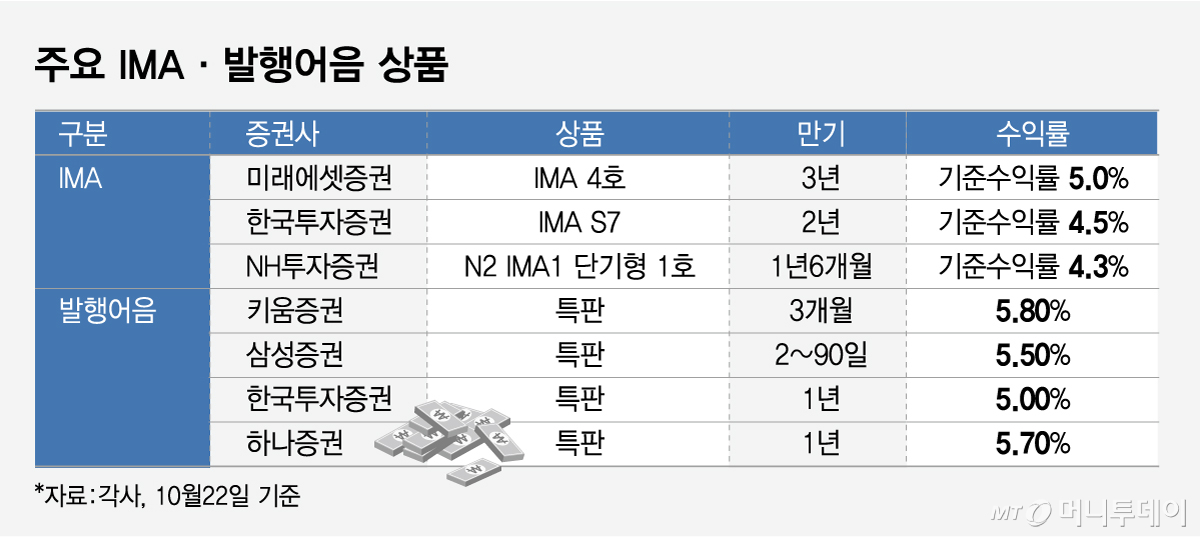
As concerns over stock market instability grow, funds are flowing into securities firms' banknotes and Integrated Margin Accounts (IMAs). To attract investors, securities firms are also continuously unveiling banknotes and IMAs boasting yields of 4% to 5%, which are higher than those of regular deposits and savings accounts.
According to industry sources on the 22nd, securities firms are launching banknote and IMA products with yields in the 4th% to 5% range. This is considered a high level, given that the average one-year maturity interest rate for representative time deposits at the five major banks hovers around 3.6% annually.
Banknotes are financial instruments issued by securities firms to raise funds, paying an agreed-upon interest rate. An IMA is a performance-linked product in which a securities firm manages customer-deposited funds for corporate finance and other purposes, distributing returns based on performance. The securities firm presents a benchmark yield for the IMA and pays customers up to that yield without deducting performance fees. For management returns exceeding the benchmark yield, a portion of the excess is distributed to customers.
Recently, Hana Securities began special sales of one-year contract banknotes offering a special annual yield of 5.7%. The special sale will run until the 20th of next month, with a maximum subscription limit of 5 million won per person. Kiwoom Securities also launched a special sale of three-month maturity banknotes with an annual interest rate of 5.8% in early this month. The total sales cap is 10 billion won, and the per-person limit is 1 million won.
Samsung Securities, which received approval for its banknote business last month, launched a one-year maturity product with an annual interest rate of 4.3% and banknotes with maturities ranging from 2 to 90 days at an annual interest rate of 5.5% last month. This month, it also released one-year banknotes at an annual rate of 4.3%.
Korea Investment & Securities has also unveiled a special sale of one-year maturity banknotes with an annual yield of 5%. Separately, it launched the IMA product "Korea Investment IMA S7." The benchmark yield for the management period is 4.5% annually (approximately 9.0% cumulative over two years). Returns up to this level are paid to customers without performance fees, while 60% of the excess management returns above the benchmark yield are distributed to customers.
Investor response has also been enthusiastic. The 1 million won limit banknote with an annual yield of 4.3% released by Samsung Securities last month sold out within two days of its launch. Kiwoom Securities' first banknote, introduced last month, was also completely sold out within a week of sales. NH Investment & Securities' IMA product, "N2 IMA1 Short-term No. 1," also reached its 1 million won fundraising limit just three days after sales began, resulting in an early close. Thus, banknotes and IMAs released by securities firms are selling out within days of their launch.
A representative from Korea Investment & Securities stated, "IMA demand among investors is relatively high, as it pursues both stability and yield." Analysts note that this surge in demand stems from investors who wish to manage funds for short periods while seeking stable returns amid increased volatility in domestic and global stock markets and interest rates.
The fact that banknotes and IMAs are relatively stable products is also a major reason for their popularity. Although banknotes are non-guaranteed principal and interest products, they are issued based on the creditworthiness of the securities firm, so the likelihood of investors losing their principal is low unless the securities firm goes bankrupt. An IMA is a performance-linked product that guarantees principal repayment to customers if they hold it until maturity, even if the yield records a negative return.
However, since banknotes with interest rates in the 4th% to 5% range are special sales, limits may be exhausted on a first-come, first-served basis, or there may be restrictions on eligibility and subscription amounts, so conditions should be verified before subscribing. Additionally, as banknotes are not covered by deposit insurance, the credit risk of the issuing securities firm must also be considered. In the case of IMAs, early termination may result in principal losses depending on management performance. Furthermore, actual investor returns may fall short of expectations after the deduction of performance fees.

 in STOCK
