

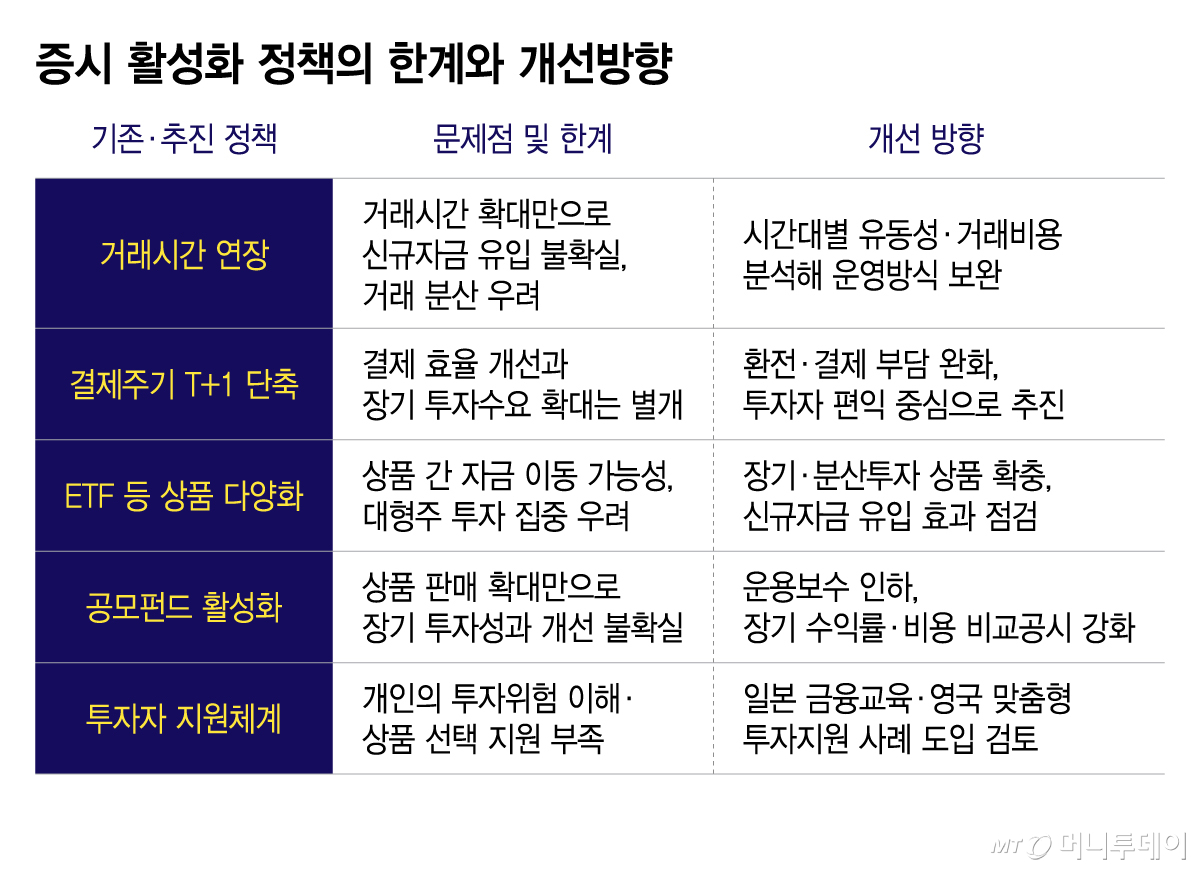
Although the government is pushing various measures to revitalize the stock market, including extending trading hours and shortening the settlement period, there are concerns that these may not necessarily lead to actual capital inflows or an expansion of long-term investment. This is because merely increasing trading opportunities and organizing market infrastructure does not significantly increase incentives for investors to hold stocks over the long term. There are calls for urgent policies that, alongside improving trading convenience, enhance the long-term investment performance of retail investors and secure a stable supply-demand foundation.
Improving trading convenience… but inflow of long-term investment funds is a separate issue
According to the financial investment industry on the 26th, the government has been promoting improvements in market accessibility and trading convenience, such as expanding trading hours, shortening the stock settlement period, and diversifying investment products, to revitalize the stock market. However, these policies are focused on improving the environment for buying and selling stocks, so their effects on attracting new investment funds or increasing long-term holdings need to be verified separately. There is a growing call to evaluate the performance of stock market revitalization policies not only by trading volume or the number of products, but also by the scale of new capital inflows, investors' long-term holding status, and changes in actual transaction costs.
The recent sharp drop in the stock market has once again highlighted the importance of a stable supply-demand foundation. The issue is how effective the stock market revitalization measures pursued by the government have been in improving unstable supply and demand. While the extension of trading hours currently being pushed by the government is a policy to enhance investment convenience, it remains uncertain whether it will lead to new capital inflows. Existing trades may simply be dispersed over a longer period, and during low-volume time slots, the spread between bid and ask prices could widen, potentially increasing transaction costs for investors.
The same applies to the policy of shortening the stock settlement period from two days after the trading day (T+2) under current rules to one day after (T+1). While this offers advantages such as reducing settlement risk and allowing sellers to receive proceeds faster, improved settlement speed does not guarantee an increase in long-term investment demand. The burden of currency exchange and settlement for foreign investors, as well as the system readiness of securities firms, must also be considered.
There are also concerns that expanding investment products such as ETFs (Exchange-Traded Funds) is difficult to judge solely by increases in the number of products or trading volume. If existing investment funds are merely shifting from individual stocks or open-end funds to ETFs, the effect on new capital inflows into the overall stock market is limited. Furthermore, if investment concentrates on some large-cap stocks, there are limits to expanding investment demand to small- and mid-cap stocks.
Japan and UK expand investor base… need for improved long-term returns and transaction costs
Major overseas countries are promoting policies to support the long-term asset formation of retail investors. Japan expanded its Nippon Individual Savings Account (NISA) system in 2024 and made the tax-free holding period permanent. According to the Financial Services Agency of Japan, as of July this year, there were approximately 28 million NISA accounts. However, since NISA accounts allow investment in overseas stocks and funds as well, an increase in account numbers does not necessarily mean that all funds are flowing into the Japanese stock market.
Japan is also working to expand household participation in the investment market through financial education. Through the Financial and Economic Education Promotion Organization (J-FLEC), established in 2024, it educates individuals with limited investment experience on long-term and diversified investing and asset formation methods. The aim is to broaden the investor base so that household funds previously held in deposits and savings accounts flow into investment products such as stocks and funds, and to encourage long-term investment over short-term capital gains, thereby building a stable supply-demand foundation for the stock market.
The UK is also expanding investment support from financial institutions to draw household funds into the stock market. The "Targeted Support" system introduced in April this year allows financial firms to propose suitable investment options to customer groups with similar investment purposes or circumstances. The aim is to encourage individuals who have been holding cash assets due to the burden of professional investment advisory costs or a lack of investment experience to enter the investment market, and to broaden the base for long-term stock and fund investment.
There are also calls for support measures that can enhance the long-term investment performance of domestic retail investors. Suggestions include securities firms and asset management companies providing diversified investment products tailored to investment purposes and risk profiles, and expanding information provision so that fees and long-term returns by product can be easily compared. There is also an opinion that domestic equity open-end funds need to be revitalized not simply by expanding sales, but by lowering management costs and improving long-term investment performance.
Recently, voices are growing within the financial investment industry that the focus of future stock market revitalization policies should shift from short-term trading expansion to stable capital inflows and improved long-term investment performance. A market expert said, "Retail investors must be able to verify the results of long-term investing and build trust in the market; only then can capital outflows be reduced and a stable supply-demand foundation built even when stock market volatility increases."

 in STOCK
