

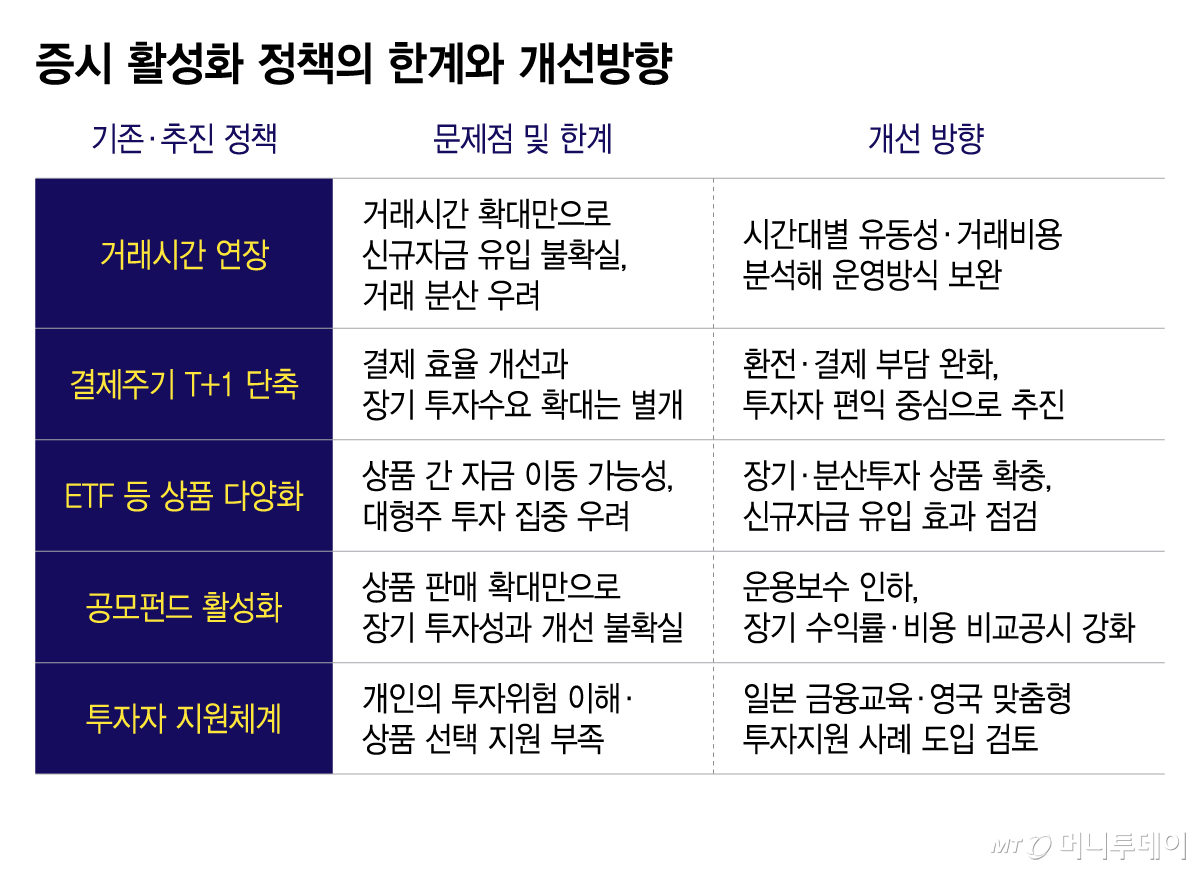
Although the government has pursued measures to normalize the stock market, including protecting shareholder rights and eradicating unfair trading, there are indications that these efforts have been insufficient to resolve supply-demand instability in the market and issues of investor trust. Given that recent sharp declines in the stock market have exposed the limitations of existing policies, voices are growing that the additional measures signaled by President Lee Jae-myung must include fundamental invigoration plans that allow investment capital to flow in stably and remain for long periods.
According to the financial investment industry on the 26th, while the government's focus on resolving stock market undervaluation has succeeded in attracting investor attention, policies linking this to sustained investment demand have been relatively lacking. Even if investment appeal increases, if investment capital flows out every time the market fluctuates, it will be difficult for the effects of stock market normalization to last.
In fact, on the 15th, the KOSPI plunged 7.57% amid large-scale net selling by foreigners. Although external negative factors were the direct cause, the vulnerability of the domestic stock market to shocks from foreign selling was highlighted again. This raises questions about whether there is a sufficient stable buying base to absorb capital during sharp declines, even though investment funds flock in during periods of rising stock prices.
There are also indications that the criteria for invigorating the stock market must change. Simply raising stock prices or increasing trading volume makes it difficult to encourage retail investors to choose domestic stocks as a means of long-term asset formation. Policies aimed at boosting stock prices, such as the introduction of single-stock leverage ETFs (Exchange-Traded Funds) and the deferral of National Pension Service rebalancing, are representative examples. Rather than such short-term support measures, it is important to create conditions where investors can expect returns commensurate with risk and continue investing even when market volatility increases.
Opinions suggest that additional measures should be pursued in a direction that promotes the inflow and long-term holding of domestic and foreign investment capital and reduces costs and inconveniences felt by investors. It is also pointed out that policy outcomes should be evaluated based on the expansion of the investor base, supply-demand stability, and improved long-term investment performance, rather than short-term index gains or trading volume.

 in STOCK
