

As the Cheong Wa Dae is considering an additional deferral of cryptocurrency taxation, weight is being placed on a plan to postpone taxation once more. While cryptocurrency investors and the industry are in a relieved mood, voices are emerging that argue that rather than merely deferring, proper discussion must be held regarding the tax fairness issue, which investors are most concerned about.
According to the financial investment industry on the 26th, it is expected that the Cheong Wa Dae will proceed with consultations with relevant institutional investors, placing weight on a deferral of cryptocurrency taxation the previous day. However, it was stated that "it is under review and nothing has been decided regarding this."
If a deferral is decided, cryptocurrency taxation will be postponed for the fourth time. During this period, cryptocurrency taxation, which was introduced through an amendment to the Income Tax Act at the end of 2020 and was scheduled to take effect in 2022, has been deferred three times due to reasons such as inadequacies in the tax system and investor protection mechanisms.
The industry is in a relieved mood, stating that they have bought some time for now. However, opinions are emerging that since tax fairness has emerged as the biggest issue, it must be resolved during the deferral period.
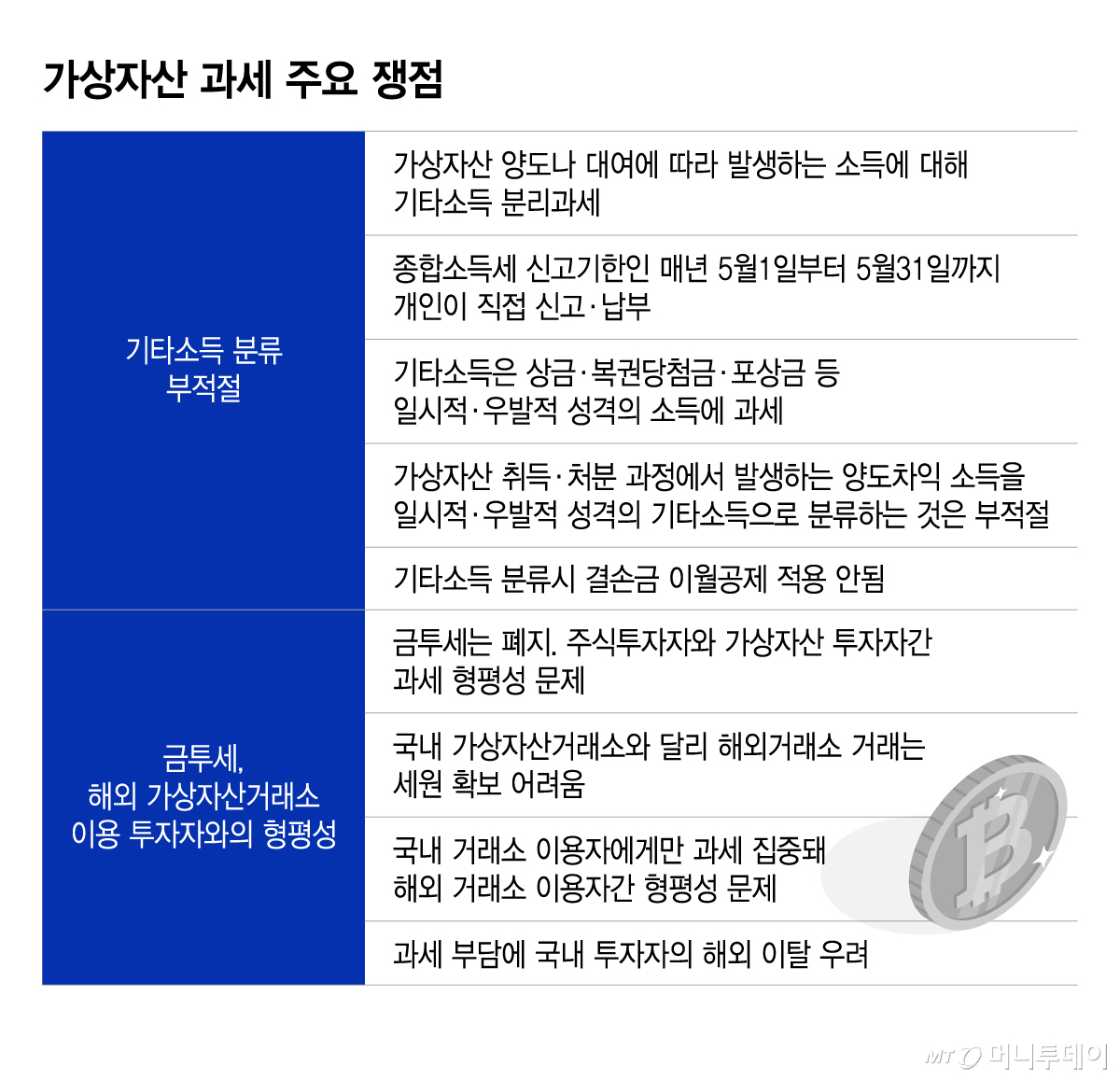
Regarding cryptocurrency taxation, the issue of fairness with domestic stock investors is first mentioned. Currently, no tax is levied on domestic stock transactions due to the abolition of the Financial Investment Income Tax, but there is an argument that it is unreasonable to tax only cryptocurrency investors.
There is also a fairness issue between users of overseas cryptocurrency exchanges and users of domestic cryptocurrency exchanges. It is relatively easy to grasp transaction details, etc., for domestic exchanges, but it is difficult to secure the tax base when using overseas exchanges. Therefore, it is explained that taxation will be concentrated on users of domestic exchanges, ultimately encouraging outflow to overseas markets.
The government has argued that it can utilize the OECD (OECD) Crypto-Asset Reporting Framework (CARF) starting next year. This means that cryptocurrency transaction information can be shared among CARF participating countries. However, implementation timing varies by country. According to data from the National Assembly Budget Policy Office, 29 countries including Canada, Switzerland, Singapore, and Hong Kong are scheduled to begin their first information exchange in 2028, while the United States is scheduled to do so in 2029. Information exchange gaps are unavoidable depending on implementation timing.
Opinions are also emerging that it is necessary to improve areas where investor dissatisfaction is high, such as the fact that 'loss carryforward deduction,' which allows losses to be carried over to the following year and deducted from future profits, is not possible under the current system, and that the basic deduction amount is limited to 2.5 million won.
An industry official said, "The atmosphere suggests weight is being placed on a deferral, but it is still in a state where one cannot feel at ease," adding, "If a deferral is decided, discussions should be held in the direction of improving areas with high investor dissatisfaction, such as tax fairness issues, carryforward deductions, and basic deduction amounts."
Meanwhile, if cryptocurrency taxation is implemented, those who earn more than 2.5 million won annually from cryptocurrency investments starting next year will have to pay 22% of their income (20% other income tax · 2% local income tax) as tax. Taxes on income generated next year will be declared and paid for the first time in May 2028.

 in STOCK
