

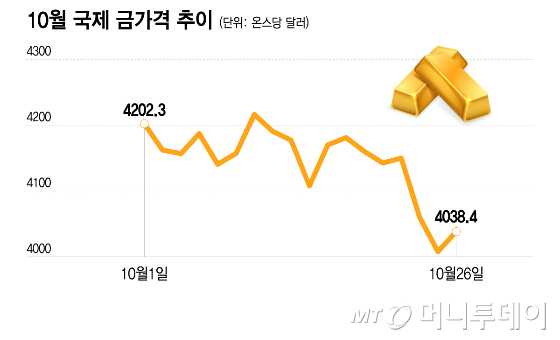
Amid a downward trend in domestic and global stock markets, the price of gold, a safe-haven asset, is fluctuating under pressure on the $4,000-per-ounce mark. Typically, when equity markets are unstable, investment funds tend to flow into gold, but recently the two have been weak together. Analysts say that as the trend toward raising base rates domestically and abroad intersects with instability in global financial markets, investor interest is shifting from gold to cash-like assets.
According to the financial investment industry and foreign media on the 27th, the international spot gold price fell to $3,975.23 per ounce intraday on the 23rd (local time). This marks the first time since July that the spot gold price has dropped below $4,000.
As of early this year, the international gold price had risen to an all-time high of $5,586 per ounce intraday. However, it subsequently turned downward, with the decline from the peak exceeding 28%. While the price recovered to the $4,030-per-ounce range this week due to factors such as inflows of bargain hunting and falling international oil prices, it continues an unstable trend around $4,000.
Domestic gold prices are also failing to escape weakness. The price of gold traded on the Korea Exchange (KRX) Gold Market has recently barely exceeded 170,000 won per gram. This represents a drop of more than 7% compared to the closing price of 183,480 won in early this month.
The decline in gold prices is drawing attention because domestic and global stock markets are also struggling to find signs of a rebound. The KOSPI index surpassed the 7,000 mark based on the closing price in early this month but subsequently plunged, falling into the 5,000 range. The situation is similar for U.S. stock markets. The NASDAQ index fell from 26,871.60 in early this month to 26,169.38 on the 26th. The S&P 500 index, which briefly exceeded the 7,800 mark this month, has also recently slipped into the 7,600 range.
The market is paying attention to the fact that gold prices are falling in tandem with domestic and global stock markets, which have faced downward pressure centered on tech stocks over the past three weeks, leading to a contraction in investor sentiment.
Generally, stocks are classified as risky assets that react sensitively to economic conditions and corporate earnings. In contrast, gold has been recognized as a representative safe-haven asset sought by investors when uncertainty in financial markets expands, based on its characteristics as a physical asset and its scarcity. This is why funds have historically moved from unstable stock markets to the relatively safer gold, driving up gold prices.
In particular, there is a tendency for investment demand for gold to expand when geopolitical risks, such as war, increase. However, recently, despite ongoing geopolitical uncertainty in the Middle East region, this has not translated into expanded investment demand for gold.
Capital market experts view the situation not as a weakening of gold's status as a safe-haven asset, but rather as changes in the interest rate environment fueling the simultaneous weakness of stocks and gold. While gold is used as an investment tool to hedge against inflation, it does not yield interest or dividends even when held. Therefore, as market interest rates rise, its investment appeal inevitably declines compared to financial products such as government bonds and deposits that offer expected interest income.
In fact, uncertainty remains regarding the future monetary policies of the Bank of Korea and the Federal Reserve System (Fed). In particular, rising international oil prices due to geopolitical tensions in the Middle East region are stoking inflation concerns. If upward pressure on prices intensifies, central banks' room for interest rate cuts will shrink, and the possibility of additional rate hikes may be highlighted. Such concerns are leading to higher market interest rates, which is also weighing on gold prices.
Demand for securing cash due to stock market plunges is also cited as a cause of the decline in gold prices. Investors who have incurred losses in stock investments may sell their held gold while arranging additional margin or reducing their allocation to risky assets.
Accordingly, funds from domestic investors are flowing toward cash-like financial products. Among ETFs (Exchange-Traded Funds) with the highest capital inflows over the past month, the product attracting the most funds is the parking-type ETF KODEX Money Market Active, which saw net inflows of 2.4328 trillion won during this period. This shows that demand for stable management of investment funds is growing over aggressive pursuit of returns as stock market volatility expands.
A securities industry official said, "While gold can be used as an investment tool to hedge against inflation in the long term, there is a possibility of losses due to price fluctuations in the short term," adding, "Investment strategies that select assets with relatively small price fluctuations and expected returns based on short-term interest rates, such as parking-type ETFs, while monitoring market conditions are being highlighted."

 in STOCK
