

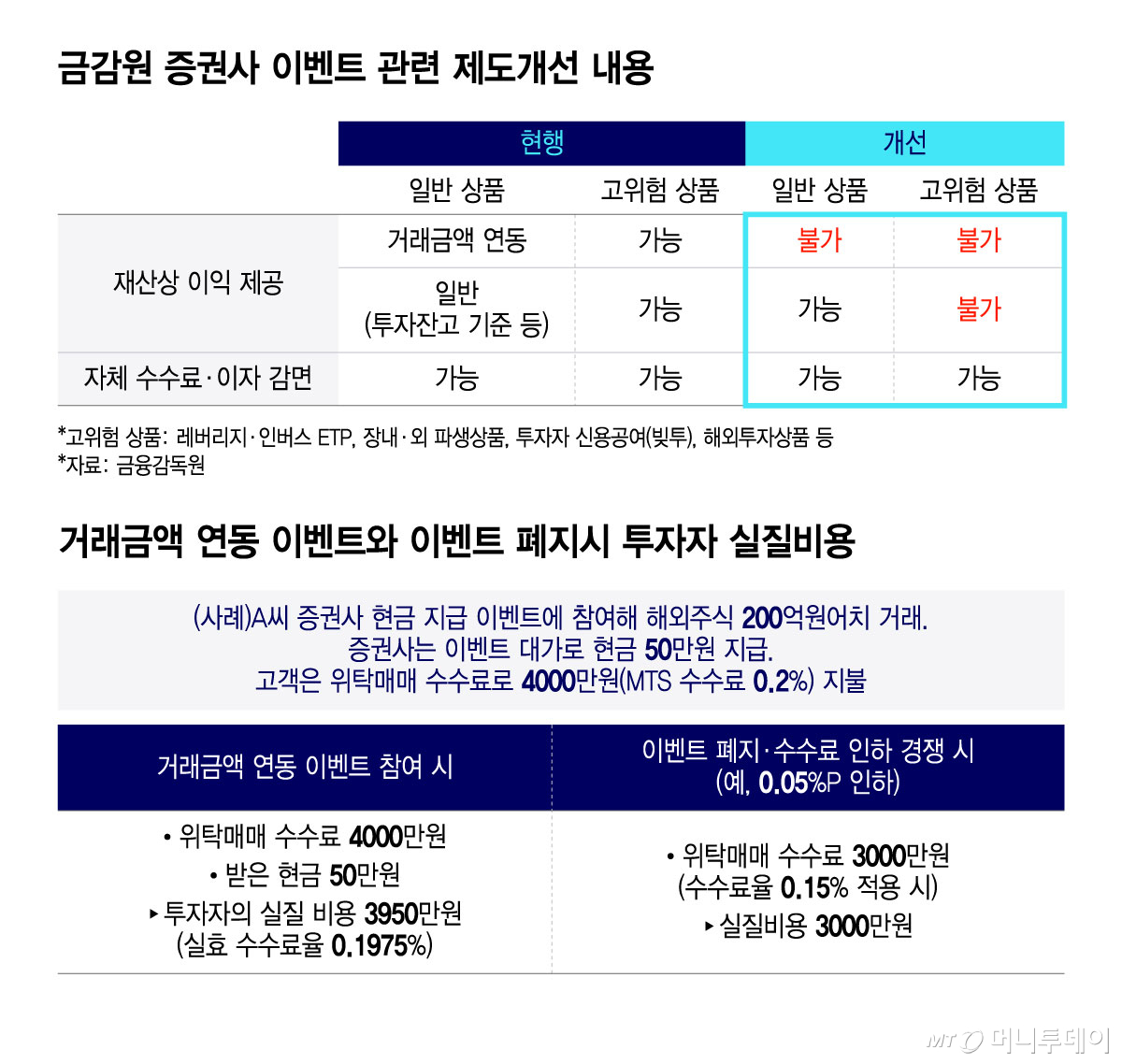
A brokerage firm conducted an event offering up to 500,000 won in cash based on the scale of overseas stock trading. An investor traded 20 billion won worth of overseas stocks and received a cash payment from the brokerage. However, they paid 40 million won in commission fees (MTS fee rate of 0.2%) for the overseas stock transactions.
In cases like this, it is pointed out that although investors appear to receive significant benefits from brokerages, it is merely an optical illusion. The 500,000 won received in cash amounts to only 1.25% of the 40th million won in commission fees actually paid by the investor. Excluding the 500,000 won cash reward, the effective fee reduction level is 39 million won, meaning the fee rate benefit merely drops from 0.2% to 0.1975%.
The Financial Supervisory Service announced on the 28th that it will regulate brokerage events that provide excessive financial benefits. This is because such events create an optical illusion of offering substantial benefits despite actual gains being minimal, while conversely inducing unnecessary frequent trading and high-risk investments in the short term, raising concerns about investor harm.
Accordingly, events providing financial benefits, such as paying cash based on trading frequency or transaction value, are fundamentally prohibited. Events related to high-risk products, including leveraged products, credit lending, and overseas investments, are also banned at the source. However, events offering fee and interest reduction benefits that provide actual gains to investors will be maintained.
Events linked to trading volume are analyzed as being more favorable to brokerages because the actual benefits returned to investors are minimal, while brokerages gain fee revenue. In an actual case, Brokerage B conducted an event paying 5 million won daily if the transaction value for all listed ETFs (Exchange-Traded Funds) met or exceeded 50 billion won. Through this, the brokerage spent approximately 6 billion won on event costs but collected approximately 51.4 billion won in commission fees. Although it appears that the brokerage is providing benefits to investors, in reality, the brokerage's profit is greater.
An official from the Financial Supervisory Service stated, "Cash-based events by brokerages utilize a portion (less than 10%) of the commission fee revenue received from investors as funding for prizes," adding, "Excessive events ultimately lead to increased burdens on investors." Investors may engage in short-term and excessive trading to meet transaction value criteria, which could conversely result in investment losses.
The Financial Supervisory Service decided to permit events providing financial benefits based on investment balances rather than trading volume. All events targeting high-risk financial investment products, such as leveraged and inverse ETPs (Exchange-Traded Products), on- and off-exchange derivatives, investor credit lending (margin investing (investing with debt)), and overseas investment products, are prohibited. Regardless of content or format, events providing financial benefits related to high-risk products cannot be conducted. This is because high-risk products carry a high risk of leading to harm such as investment losses in themselves.
The Financial Supervisory Service's move to regulate brokerage events is essentially intended to encourage competition through fee and interest reduction events. This method provides benefits without the risk of investor harm from short-term or excessive trading.
In the case of Brokerage A, if cash-based events are prohibited and an event is conducted reducing the commission fee rate by 0.05 percentage points, the fee rate would drop from 0.2% to 0.15%. In a cash-based event, the fees the investor must pay are 39 million won after excluding the 500,000 won cash reward, but in a fee rate reduction event, the cost is lower at 30 million won.
An official from the Financial Supervisory Service said, "In-house fee and interest discounts, events unrelated to trading volume, etc., remain possible," adding, "Healthy competition will lead to alleviating investors' trading cost burdens."
The Financial Supervisory Service aims to pre-announce a revision proposal for Korea Financial Investment Association regulations this month and complete the revisions within the year after gathering opinions. It plans to implement the relevant regulations starting January 1 of next year.

 in STOCK
