

Three out of four customers at domestic securities firms have an investment profile that can tolerate principal loss, and going forward, it will be possible to hold more than 70% risk assets in IRP (Individual Retirement Pension) accounts.
As the asset management industry continues to roll out products targeting demand for risk asset investments within retirement pensions, the scale of reserves for principal-and-interest non-guaranteed products is expected to grow further. However, experts advise that even with eased risk asset limits, investors should include safe assets in their portfolios to pursue an asset allocation strategy.
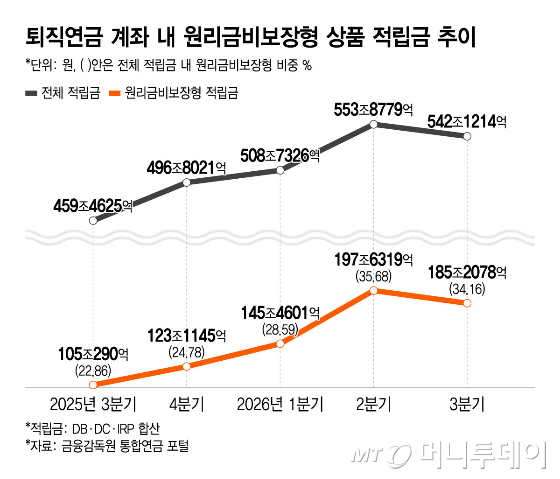
According to data from the Financial Supervisory Service's Integrated Pension Portal on Monday, reserves for principal-and-interest non-guaranteed products (DB, DC, and IRP) across all 43 retirement pension operators totaled 185 trillion won as of the end of Q3 this year. This accounts for 34.16% of total reserves of 542 trillion won.
Products within retirement pension accounts are broadly divided into three categories: △deposit-type principal-and-interest guaranteed products such as deposits, △market-based principal-and-interest guaranteed products such as government bonds and treasury bills, and △principal-and-interest non-guaranteed products such as funds, ETFs (Exchange-Traded Funds), and eligible TDFs (Target Date Funds).
Under existing retirement pension regulations, risk assets could only account for up to 70% of total reserves. However, the government announced at the end of last month, in its "Plan to Strengthen Retirement Pension Functions," that it would gradually raise this limit from 70% specifically for IRP accounts.
The share of principal-and-interest non-guaranteed products in retirement pension accounts has been steadily growing. As of the end of Q3 last year, reserves stood at 105 trillion 29 billion won, accounting for 22.86% of total reserves. This represents an increase of 11.30 percentage points in one year.
By the end of Q2 this year, when the KOSPI broke through 9,300 intraday to set a record high, the share had risen to 35.68% (197 trillion 631.9 billion won). It is expected that inflows into principal-and-interest non-guaranteed products will intensify further as risk asset limits are eased.
As domestic stock markets boomed in the first half of this year, investor attention shifted toward principal-and-interest non-guaranteed products. The market began looking for ways to invest more in domestic stocks while adhering to risk asset limits. The asset management industry presented a solution: products that are ETFs but include bonds and are thus classified as safe assets.
A representative example is the "RISE Samsung Electronics SK Hynix Bond Mixed 50" ETF, newly listed by KB Asset Management earlier this year. If an investor fills up the risk asset limit in a retirement pension account (DC or IRP type) and allocates the remaining safe assets to such products, they can hold risk assets at levels of up to 85%.
Due to overwhelming popularity, nine products composed of two to three individually listed domestic stocks and bonds have been launched since the beginning of the year, attracting 5 trillion 531.9 billion won in funds as of the 31st of last month.
However, caution is needed because a higher proportion of risk assets increases the likelihood of returns being hit during volatile or declining markets. In fact, the KOSPI plunged by 1,638 points (19%) from the end of Q2 to the end of Q3 this year.
During the same period, the sidecar mechanism (futures market circuit breaker), a market stabilization device, was triggered 20 times, and the circuit breaker was activated four times.
The industry also advises against investing 100% in a specific sector or forcibly maximizing returns just because risk asset limits have been eased. Since pension accounts are used to manage assets for retirement, they should focus on "long-term" investment and "asset allocation" more than other wealth management investments. Experts recommend constructing portfolios with products that have relatively low volatility, such as U.S. representative index ETFs, or products with built-in asset allocation, such as eligible TDFs.
An official from an asset management company said, "In a situation where volatility has increased centered on some tech stocks due to concerns over AI (artificial intelligence) investment, it is better to invest in indices that capture the entire market." The official added, "Investing everything in a specific sector is risky, so assets within the portfolio must be allocated."
Some argue that while risk asset limit regulations may have blocked additional profit opportunities, they also served as a minimum line ensuring stability through safe assets, and there are concerns that this line is becoming looser.
An official from the financial investment industry said, "In pension investing, it is important to allocate assets appropriately and hold them long-term, unlike general wealth management investments. The fact that funds may concentrate in ETFs without asset allocation or be managed similarly to other investment accounts as risk asset limits are eased is a cause for concern."

 in STOCK
