

A bill has been introduced to establish a legal basis for financial authorities to exercise emergency powers when financial investment products, such as single-stock leveraged ETFs (exchange-traded funds), threaten to disrupt the market. If passed, the amendment would allow South Korea to lower leverage limits, as Hong Kong does, from the current ±2 times to between 1 and 1.5 times.
Although single-stock leveraged ETFs have been identified as a major cause of increased stock market volatility, financial authorities lack the authority to take appropriate measures, prompting calls for legislative amendment.
The government also said on July 30, when it announced its second supplementary measure for single-stock leveraged ETFs, that it would establish a legal basis to adjust leverage ratios, similar to the Hong Kong case.
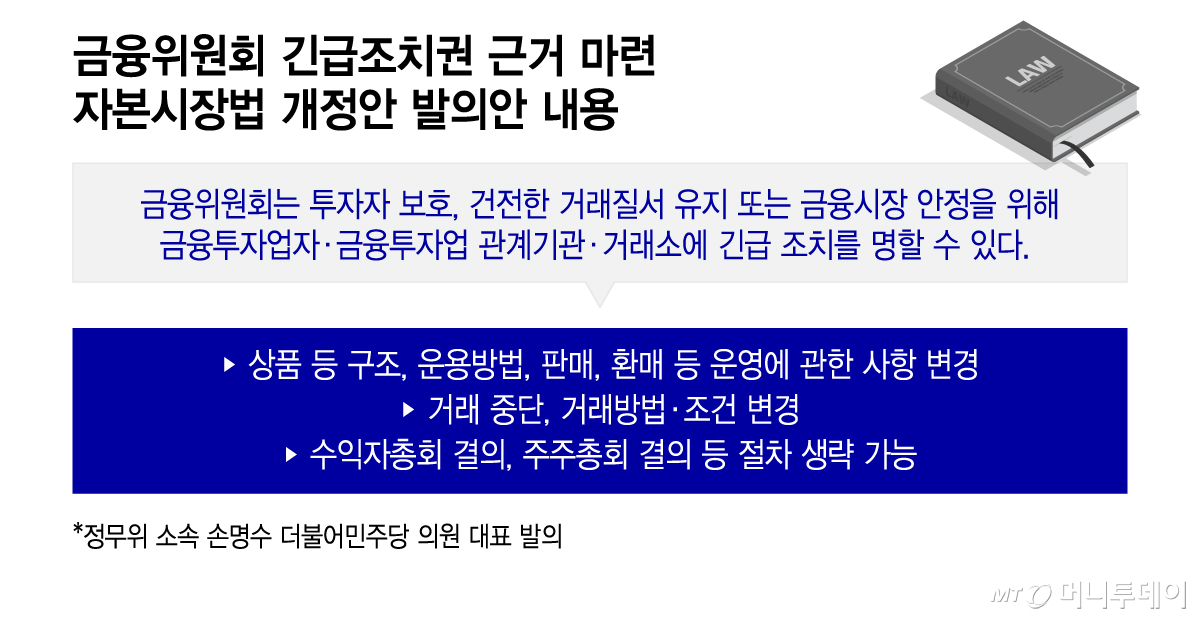
According to the proposed amendment, the Financial Services Commission may order necessary measures regarding a product if it determines that the financial investment product has or is likely to have a significant impact on capital market volatility, and such action is urgent for investor protection and maintaining sound trading order.
Possible measures include changes in operational matters such as product structure, operating methods, sales, and redemption; suspension of trading, or changes in trading methods and conditions; and omission of procedures such as resolutions at a general meeting of beneficiaries or shareholders.
The bill also sets out the requirements for invocation. It must be difficult to achieve investor protection, maintain sound trading order, or ensure financial market stability through other means, and the content of the measure order must be clear and specific, with its implementation verifiable.
If the amendment is passed, financial authorities will have a legal basis to adjust the leverage ratio of single-stock leveraged ETFs and even order a suspension of trading, similar to Hong Kong. Financial authorities will also be able to take immediate action when other financial investment products impact the market.
Previously, the Securities and Futures Commission (SFC) of Hong Kong mandated the application of a 'flexible leverage structure' after trading in single-stock leveraged ETFs listed on the Hong Kong stock exchange, including those for Samsung Electronics and SK hynix, became overheated. As a result, asset management companies can adjust the leverage ratio daily within the existing cap of up to ±2x. This means products that promised 2x returns could be lowered to 1.5x, 1x, or other levels.
In contrast, in South Korea, many argued that applying the Hong Kong case was difficult because current law requires a general meeting of beneficiaries to adjust the leverage ratio.
Under the Capital Markets Act, for a collective investment manager (asset management company) to modify the trust agreement, which is part of the fund contract, it must hold a general meeting of beneficiaries and obtain approval from more than half of the voting rights of beneficiaries and at least 25% of the total number of issued beneficiary certificates. Given that ETFs are traded like stocks, it was explained that holding a general meeting of beneficiaries is virtually impossible.
In the proposed reasons for the amendment, Rep. Son Myung-soo, a member of the financial committee of the National Assembly, said, "In Hong Kong, asset management companies were able to quickly change product structures without procedures such as a general meeting of beneficiaries, in accordance with guidelines."
He added, "In contrast, in South Korea, rapid response is difficult in similar situations due to the lack of legal basis, so we are seeking to establish a legal basis to allow for emergency measure orders."

 in STOCK
