

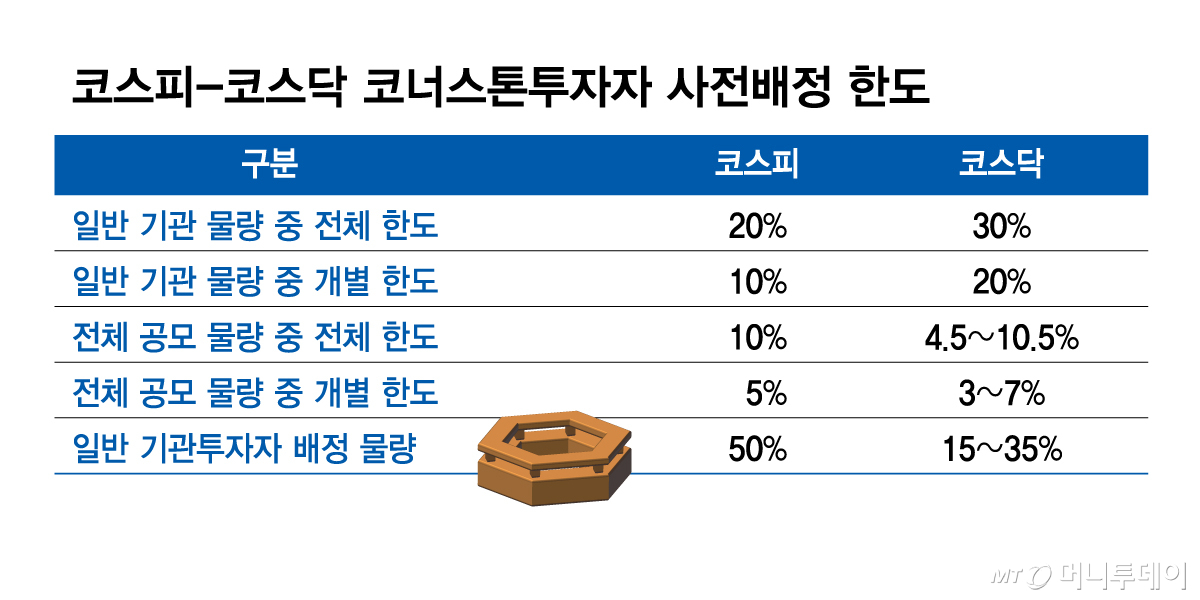
The government has decided to give KOSDAQ-listed companies pursuing IPOs (initial public offerings) more opportunities to secure institutional investors in advance. By applying a higher pre-allocation cap for IPO shares than the KOSPI, it aims to make it easier for relatively smaller companies to secure long-term investing institutional investors.
However, concerns are emerging that if institutional investors show interest only in companies with high growth potential and profitability, the new system could become a 'pie in the sky' for SMEs (small and medium-sized enterprises) that urgently need funding.
KOSDAQ pre-allocation cap raised… but actual IPO share ratio remains similar
According to the Financial Services Commission on the 3rd, an amendment to the Enforcement Decree of the Capital Markets Act, including the introduction of a cornerstone investor system, was approved at the State Council meeting that day. The cornerstone investor system, which takes effect on the 13th, allows companies to pre-allocate a portion of IPO shares to institutional investors who agree not to sell their shares for a certain period before listing. Companies can secure investment demand in advance, and institutional investors can stably receive allocations of desired IPO shares.
To encourage KOSDAQ companies to utilize the system, the government set the pre-allocation cap higher than that of the KOSPI. Among the allocation volume for general institutional investors, up to 20% for the KOSPI and up to 30% for the KOSDAQ can be pre-allocated to cornerstone investors. This considered that the KOSDAQ has a relatively smaller IPO scale and requires a larger volume to be separately allocated to policy funds such as KOSDAQ venture funds.
However, even if the KOSDAQ's allocation cap is higher, it does not necessarily mean that the share going to cornerstone investors out of the total IPO shares will definitely be larger. When converted to the total IPO share volume, the maximum is 10% for the KOSPI and 4.5% to 10.5% for the KOSDAQ. This is because the KOSDAQ allocates a large volume to policy funds, making the portion for general institutional investors relatively small. The government raised the KOSDAQ's allocation cap to compensate for this difference.
Institutional investors face up to 10-month selling restrictions… possibility of concentration in high-quality companies
The issue is that an increase in allocation opportunities does not necessarily lead to an increase in institutional investors actually making investments. Cornerstone investors cannot sell 50% of their allocated shares for six months, 30% for eight months, and the remaining 20% for 10 months. During this period, it is difficult to reduce losses by selling shares even if the stock price falls. Institutional investors must also possess own capital or entrusted assets equivalent to at least 20 times the pre-subscribed amount.
While these burdens apply equally to both the KOSPI and KOSDAQ, they could be a greater obstacle for small and mid-sized KOSDAQ companies. Since institutional investors cannot sell shares for a long period, they must consider not only a company's growth potential and profitability but also stock price volatility risks after listing. Unlike companies with stable performance that are easy to evaluate corporate valuation, small and mid-sized companies with uncertain business prospects may find it difficult to secure long-term investment commitments from institutional investors.
Companies with small IPO scales also face the limitation that even if the allocation cap is raised, the actual number of shares available for allocation is small. From the perspective of institutional investors, the amount of IPO shares they can secure is not large, yet they must endure long-term selling restrictions. Ultimately, even if the KOSDAQ's allocation cap is higher than the KOSPI's, it will be difficult to utilize the system if institutional investors do not find it attractive.
In Hong Kong, which implemented the cornerstone investor system earlier, issues have been raised that long-term holding burdens could hinder institutional investor participation. In an official consultation document released in December 2024, the Stock Exchange of Hong Kong introduced market opinions suggesting that relaxing regulations prohibiting share sales for six months could increase the number of institutional investors willing to participate as cornerstone investors. This implies that institutional investors may feel the risk of having to hold shares for a long period more strongly than the benefit of securing IPO shares in advance.
The Stock Exchange of Hong Kong considered a plan allowing half of the allocated shares to be sold from three months after listing. However, it maintained the existing six-month regulation after facing counterarguments that relaxing selling restrictions could increase investors seeking short-term profits.
Domestically as well, mandatory holding regulations intended to induce long-term investment may act as a burden in attracting institutional investors for small and mid-sized KOSDAQ companies with relatively high investment risks. Park Sang-yeon, a researcher at the Korea Capital Market Institute, stated in a report titled "Introduction and Challenges of the Cornerstone Investor System," "Long-term capital constraints may lower the incentive for cornerstone investor participation, so it is necessary to check the effects after the system's implementation."
Pointers indicate that the effectiveness of the cornerstone investor system depends less on the allocation cap and more on how many institutional investors actually willing to invest can be secured.
An official in the financial investment industry said, "While it may help high-quality KOSDAQ companies with stable performance and growth prospects, benefits for small and mid-sized companies with high investment risks could be limited," adding, "Although the government raised the KOSDAQ's allocation cap, the key is how much companies that actually need funding support can utilize the system."

 in STOCK
