

As the bond market has recently shown strength, the returns on long-term bond exchange-traded funds (ETFs) have risen. Long-term bond ETFs that incorporate strategies capable of generating higher returns when interest rates fall are particularly drawing attention. Even when investing in the same 30-year government bonds, returns vary depending on the management strategy, increasing investor interest.
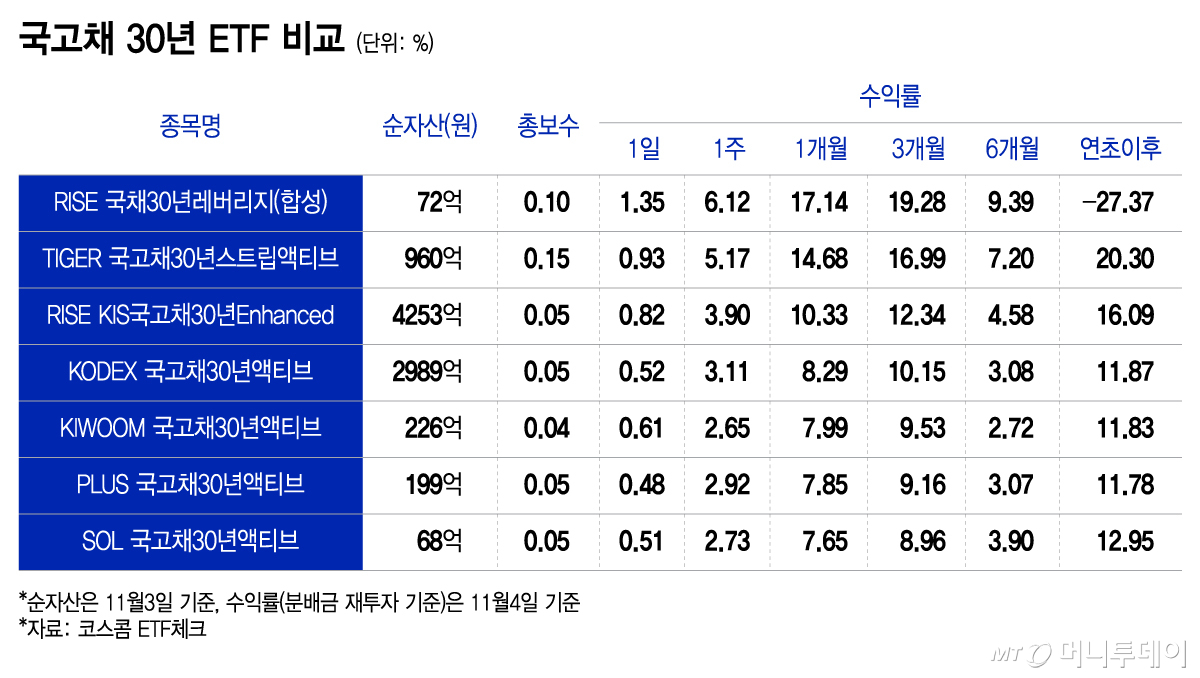
According to KOSCOM’s ETF Check on the 4th, as of that day, the one-month return (based on reinvestment of distributions) for the 'TIGER 30-Year Government Bond Strip Active' ETF was 14.68%, ranking second in returns among all ETFs (excluding leverage and inverse products).
The 'RISE KIS 30-Year Government Bond Enhanced' also ranked in the top tier with a return of 10.33%. The returns for other ETFs investing in 30-year government bonds were: △'KODEX 30-Year Government Bond Active' at 8.29%, △'KIWOOM 30-Year Government Bond Active' at 7.99%, △'PLUS 30-Year Government Bond Active' at 7.85%, and △'SOL 30-Year Government Bond Active' at 7.65%.
Kim Dong-myung, Head of the Bond ETF Management Division at Mirae Asset Asset Management, explained, "Recently, as investment sentiment toward risky assets has contracted, a perception has spread that ultra-long-term government bond yields have risen to a level that is not burdensome for buying in, resulting in supply-and-demand-driven strength in the bond market." He added, "In particular, the price appreciation effect was more pronounced in 30-year ultra-long-term bonds, which are highly sensitive to interest rate changes."
Over the past month, bond purchases by foreign investors and asset management companies have increased significantly. In addition, the Ministry of Economy and Finance decided to reduce government bond issuance by 5 trillion won from its original plan this month, following a similar move last month. The decline in the U.S. 10-year Treasury yield from the 5% range to the late 4% range also influenced domestic bond yields.
Consequently, the yield on 30-year government bonds fell from an annualized 4.538% on the 1st of last month to an annualized 4.089% on the 3rd of this month. As interest rates dropped, bond prices surged. Since a bond’s coupon rate is fixed at issuance, when market rates fall, demand increases for existing bonds that offer higher interest, driving up their prices. Long-term bonds, such as 30-year issues, react more sensitively to market rates because they have longer durations (the average recovery period of the investment).
The reason the returns on the TIGER 30-Year Government Bond Strip Active and RISE KIS 30-Year Government Bond Enhanced are higher than those of other long-term bond ETFs is that these two products are designed to maximize returns when interest rates fall.
The TIGER 30-Year Government Bond Strip Active invests in principal strip bonds with maturities of approximately 30 years. While ordinary bonds include both principal and interest, principal strip bonds are bonds from which the interest has been stripped away, leaving only the principal. Because investors do not receive interest payments along the way and instead receive the full principal at maturity, these bonds have a longer duration than ordinary government bonds. The longer the duration, the more sensitive the bond is to interest rate changes; thus, when rates fall, prices rise more sharply, and conversely, when rates rise, prices drop more significantly.
The RISE KIS 30-Year Government Bond Enhanced holds three 30-year government bond issues as its base and additionally borrows funds to purchase more of the same government bonds. This leverage strategy, which increases the investment scale, amplifies price fluctuations in response to interest rate changes.
Therefore, before investing in long-term bond ETFs, investors should carefully examine the product’s management strategy and other factors. They should also consider whether the current decline in interest rates may continue.
Kim Ji-man, a researcher at Samsung Securities, stated, "The Monetary Policy Board’s base rate hike this month, growth rate forecasts, and rising international oil prices could push interest rates back up." He added, "Now that interest rates have fallen significantly, it is appropriate to respond with split purchases when rates rebound rather than chasing the dip, and not to rush into increasing the allocation to long-term bonds."


 in STOCK

