

As the "Blue Wave" (simultaneous control of both the Senate and the House by the Democratic Party) becomes apparent in the U.S. midterm elections, the focus of the securities market is shifting back to artificial intelligence.
While a short-term rebound can be expected as political uncertainty dissipates with the end of the election, analysts say that concerns over the profitability of AI investments must be dispelled by mid-month events such as NVIDIA's earnings report for a sustained upward trend. On Wednesday, KOSPI fluctuated significantly during trading based on vote counting results, ultimately closing at 5683.80, up 35.01 points (0.62%) from the previous trading day.
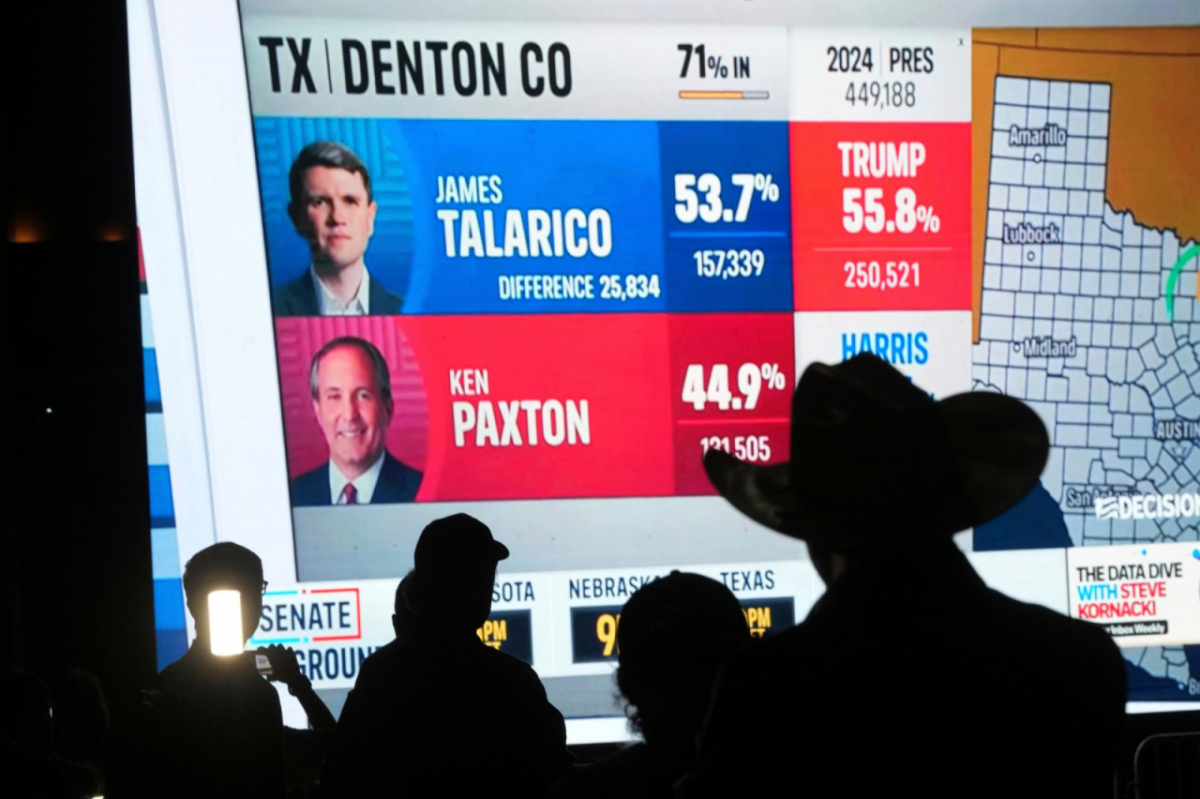
According to foreign media such as CNN and the financial investment industry, as of 3:20 p.m. Korea time, with vote counting still in progress, the Democratic Party had secured 53 out of 100 Senate seats and 216 out of 435 House seats. The party also gained the upper hand in Kansas, South Carolina, and Texas, traditionally considered "Republican Party strongholds." Given that the Democratic Party has not produced a senator from Texas since 1994, it appears that voter sentiment shifted significantly toward the Democratic Party in this election.
Tom Orlik, Bloomberg's chief economist, also predicted on the morning of the same day at the "2026 U.S. Midterm Elections and Macro Outlook Webinar" hosted by the Korea Financial Investment Association that the Democratic Party would achieve a landslide victory over the Republican Party in both the Senate and the House. He cited inflation as the reason for the Democratic Party's advantage.
Orlik said, "Inflation has risen due to policies introduced by U.S. President Donald Trump," explaining that "the trade war, the U.S.-Iran war, and the AI revolution have contributed to high inflation." The basis for this is that import prices and gasoline prices rose due to the trade war and the U.S.-Iran war, respectively, while memory chip prices surged due to the AI revolution, driving up the cost of PCs and mobile devices. Burdens for electricity and water bills also increased due to data center operations.
Orlik assessed that such election results would be positive for financial markets. This judgment is based on the view that in a stalemate where the Democratic Party controls Congress and the Republican Party holds the White House, there is a low probability of new policies, regulations, or taxes being created. According to him, the U.S. S&P 500 index has risen every year following midterm elections held since 1950.
However, he viewed that disruptions could occur in the construction of data centers, which are core facilities for the AI industry. This is because data center construction is a concern shared by both the Democratic and Republican Parties, as it raises local electricity and water bills and causes inflation.
He diagnosed that investors are now questioning AI profitability rather than immediately getting excited just because the word "AI" is attached. It is expected that this midterm election will serve as an opportunity to view the AI revolution in a balanced manner rather than with extreme optimism.
Chief Economist Orlik explained, "Most of the data centers planned in the U.S. from this year through 2028 are located in states where these midterm elections are being held," adding that "if the number of Democratic Party governors increases, or if Republican Party governors accept signals that voters do not want data centers, construction speeds could slow down."
If data center construction is delayed, orders and profitability for Korean semiconductor companies could be hit. While Orlik expects AI capital investment to continue, he analyzed that "if the U.S. stock market falls by 20% and credit spreads widen, leading to a one-year halt in data center investment, South Korea and Taiwan could suffer significant economic shocks." He explained that since these two countries are the biggest beneficiaries of the "AI boom," the impact could be substantial if the market undergoes a sharp correction.
KOSPI index fluctuates with vote counting status… Samsung Electronics also falls on data center regulation concerns
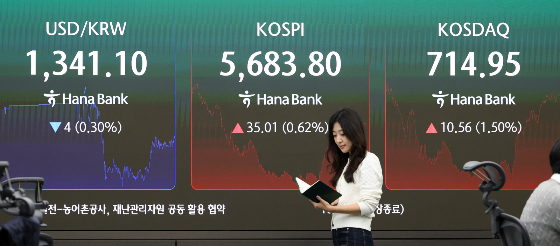
The domestic stock market showed a roller coaster trading pattern on this day, reflecting the real-time status of U.S. midterm election vote counting. This was because concerns grew that data center construction regulations would be strengthened as the Democratic Party's advantage appeared stronger than market expectations. Tech stocks fell, centered on semiconductors, but KOSPI closed with a slight gain as the decline narrowed near the end of trading.
Lim Jeong-eun and Tae Yoon-sun, analysts at KB Securities, said in a report, "The domestic stock market started with a gap-up, but shifted to a decline centered on Samsung Electronics and SK hynix, the leading semiconductor stocks, as U.S. midterm election vote counting progressed during trading."
They added that this was due to the spread of concerns over slowing data center investment as the Democratic Party's advantage became apparent. "However, it rebounded as buying inflows occurred due to the perception that the decline was excessive in the afternoon and the resolution of election-related uncertainty," they said.
The securities industry diagnoses that this midterm election could serve as material for a short-term stock price rebound. This means that regardless of the results, the market accepts the end of the election itself as the resolution of "political uncertainty." L
ike the S&P 500 index, KOSPI has historically had higher gains after midterm elections. According to Eugene Investment & Securities, during the six midterm elections held since 2000, the average KOSPI gain in November was 4.7%, which was twice the level of the overall November average (2.3%).
However, since midterm elections are a short-term event, it is widely predicted that the ultimate direction of the stock market depends again on the AI industry.
Kim Dae-jun, an analyst at Korea Investment & Securities, said, "I judge that the impact of election results on the overall index will be digested within one to two days. I expect the market's focus to shift away from political noise back to industrial fundamentals thereafter."
For a sustained rebound, the key is to confirm remaining tech company earnings, such as NVIDIA's third-quarter earnings scheduled for mid-month, to dispel concerns over AI investment profitability.
Han Ji-young, an analyst at Kiwoom Securities, said, "Even if there is a short-term rebound after the election, the continuity of the rebound depends on whether AI industry instability is alleviated or geopolitical risks are resolved, so it appears that we need to place greater importance on trends related to AI and geopolitics going forward."

 in STOCK

