

A claim has emerged that, to back the growth of small and innovative enterprises with more capital, securities firms must be included in the licensing for operating Business Development Companies (BDCs). Opinions followed that regulations such as lending limits and investment limits per single company should also be relaxed to activate BDCs.
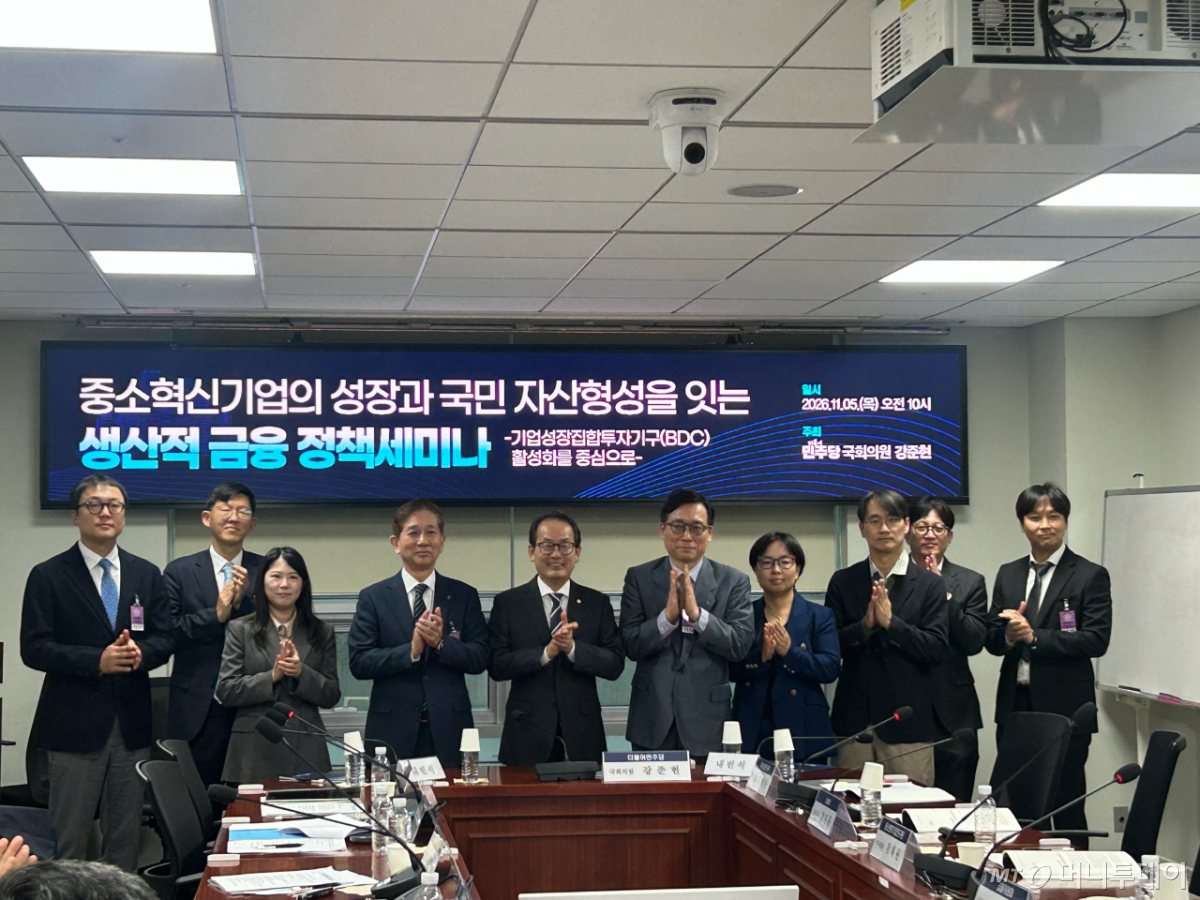
Rep. Kang Jun-hyun of the Democratic Party of Korea, a member of the National Assembly's Political Affairs Committee, held an event on Thursday at the National Assembly under the theme "Policy Seminar on Productive Finance Connecting the Growth of Small and Innovative Enterprises with National Asset Formation." The seminar was attended by various figures from the financial investment industry and academia, including Hwang Sung-yeop, chairman of the Korea Financial Investment Association, and Kim Se-wan, director of the Capital Markets Institute.
Rep. Kang said, "It is not enough to rely solely on fiscal support for (the growth of small and innovative enterprises); it is important to create a good investment environment in the market, like Silicon Valley in the United States." He added, "That is why BDCs were introduced, but they have not been well activated. If we are given homework to activate them, the Political Affairs Committee will do it."
BDCs are listed public funds established to allow retail investors to easily invest in unlisted venture and innovative companies. They must invest more than 60% of their total fund assets in venture companies. Although BDC sales have been possible since March 17, the only BDC launched so far is Shinhan Asset Management's "Shinhan Innovative Enterprise Growth Investment Trust No. 1," which targets professional investors.
Hwang said, "In line with global trends, we introduced BDCs this year by benchmarking successful cases from advanced countries such as the United States and the United Kingdom. Now is the time to refine and develop the system to suit our market conditions and characteristics." He added, "No matter how good a system is, it is difficult to see the fruits of productive finance if it is not actively utilized in the market."
Hwang had made promoting BDC activation through the participation of small and mid-sized securities firms a campaign pledge since his run for the 7th term as association chairman. He also emphasized this at a meeting marking his first 100 days in office.
While large securities firms are increasing the supply of venture capital through issued notes and Integrated Investment Accounts (IMA), small and mid-sized securities firms, which have relatively smaller equity scales, lack a clear channel. If BDCs were opened to securities firms, small and mid-sized securities firms could enter the venture capital sector by adding public investment funds to their own capital.
Kim Se-wan, director of the Capital Markets Institute, emphasized, "We will fail sometimes, but if we do not continuously discover small and innovative enterprises and grow them into global companies like Samsung or SK hynix, our country's future will be quite dark and difficult." He added, "Securing future growth drivers for our country is a very important and urgent task, and at the center of this is capital market reform through BDC activation."
"Regulations must be relaxed to activate BDCs"… Academia, venture, and securities industries speak with one voice
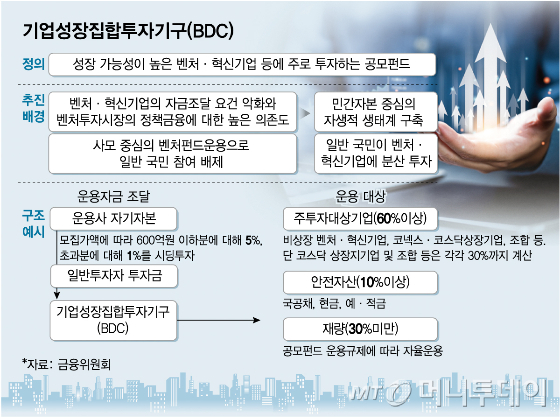
Kim Jin-young, a research fellow at the Capital Markets Institute, compared BDCs in South Korea and the United States and suggested policy tasks such as △ allowing securities firms to operate BDCs, △ phased relaxation of lending limits, and △ phased relaxation of leverage.
Kim said, "Securities firms can secure high-quality companies through deal sourcing via Initial Public Offerings (IPO) and suppress the inclusion of insolvent or information-asymmetric companies during due diligence." He added, "In the valuation stage, they prevent overpriced acquisitions and possess operational capabilities such as early loss recognition through post-investment management." He further noted, "Concerns about conflicts of interest can be sufficiently addressed by conflict-of-interest prevention mechanisms, such as internal control standards within securities firms."
Previously, the Financial Services Commission included securities firms as BDC operating entities in a revised Capital Markets Act bill submitted as government legislation in 2022. However, during discussions in the National Assembly, concerns about conflicts of interest arising from concurrent operation and sales led to the exclusion of securities firms.
Kim emphasized, "BDCs are allowed in both investment trust and investment company forms, but the company form is a suitable means for complex finance such as shareholder agreements and syndicated loans." He added, "Securities firms have experience operating businesses close to company-type models, such as Special Purpose Vehicles (SPVs), so they can also sell company-type BDCs."
He also emphasized the need to gradually raise the lending limit, one of the investment methods for BDC main investment targets, from the current 40% to launch income-type BDC products. According to him, in the United States, as of 2025, 76% of BDC products are loan investment products. Regarding leverage limits, he proposed considering a plan to gradually raise the limit from 0.5 times net assets to 2 times, similar to the United States.
Kim said, "Operating through loans allows for stable receipt of high interest income, which has established it as a high-dividend product in the United States." He added, "If operated solely with equity investment centered on stocks and stock-linked bonds, as is currently the case, recovery must be achieved within the 5th-year maturity period through IPO or Mergers and Acquisitions (M&A), which is uncertain."
In the subsequent discussion, opinions emerged that BDCs should differentiate themselves from existing bank loans and policy finance to supply substantive growth capital to venture and innovative enterprises.
Kang Ji-hoon, Representative of Romim, stated, "AI (Artificial Intelligence) companies, which incur high research and development costs, find it difficult to obtain bank loans due to a lack of collateral assets and initial revenue." He added, "Loans that consider the company's cash flow and contract performance are needed." Kang Jae-won, a research fellow at the SMEs Startups & Venture Research Institute, also emphasized, "We need to consider how loan-centric income-type BDCs will differentiate themselves from commercial loan products," adding, "From the perspective of companies seeking capital, they are thirsty for equity investment (growth-type BDCs)."
Lee Ok-hyung, Senior Executive Officer of the New Growth Strategy Investment Division at Eugene Investment & Securities, pointed out that the current BDC limit on investment in a single company is restricted to 10% each for equity and loans, making follow-on investments difficult. The original 2022 Financial Services Commission bill set the investment limit at 20% without distinguishing between equity and loans. She said, "Since Convertible Bonds (CB) are classified as equity when converted into stocks, we should examine whether setting a 10% limit helps ensure that funds flow properly and wait for growth from the perspective of Small and Medium-sized Enterprise (SME) capital supply."
Kim Seong-jin, Section Chief of the Asset Management Division at the Financial Services Commission, evaluated that securities firms' Investment Banking (IB) networks would be helpful in BDC operations, but stated, "From the government's perspective, once a system is created, it is important to first secure market trust and solidify the investor protection system." He added, "We will review areas for improvement."
He also revealed that they are actively participating in the bill for separate taxation of dividend income to encourage participation by general investors. The government included a plan in the "2026 Tax Reform Plan" announced last August to apply 9% separate taxation on dividend income received through BDC-dedicated accounts, limited to contributions of 100 million won, and also included BDCs in the investment targets of the Productive Finance ISA (Individual Comprehensive Asset Management Account).

 in STOCK

