

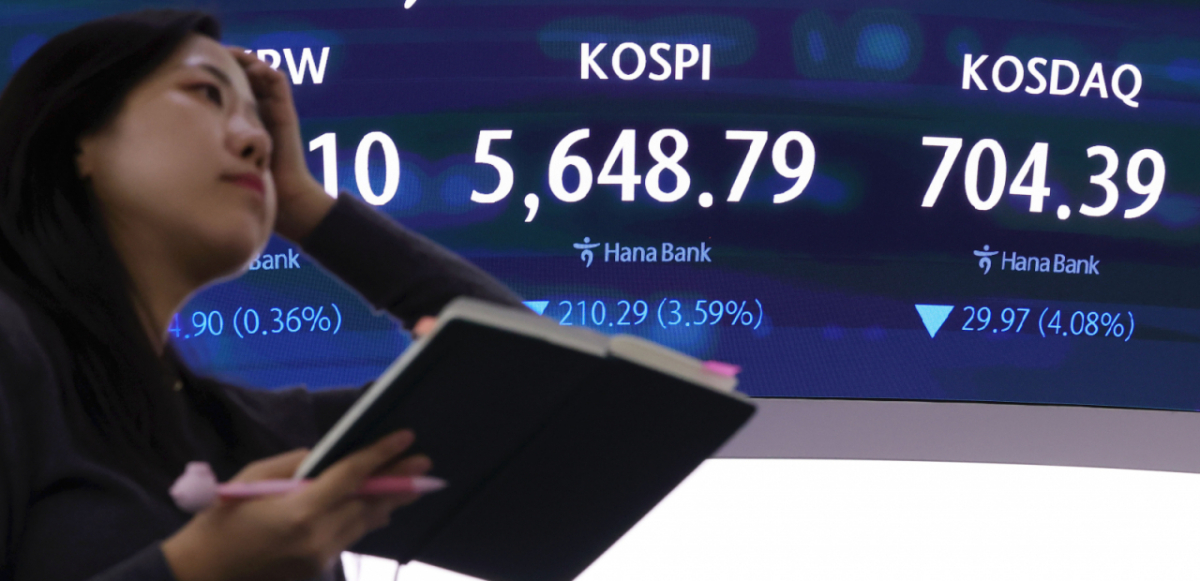
The KOSPI reversed course just a day after rebounding more than 2 percent, falling more than 3 percent. Investor sentiment weakened, particularly toward technology stocks, amid concerns over the profitability of AI investments. Foreign and institutional investors also posted combined net sales of more than 2 trillion won.
Voting in the U.S. midterm elections begins later tonight (Korea time), while chipmaker AMD is set to report its third-quarter earnings. Market attention is focused on whether the results of these events will help restore investor sentiment.
On Tuesday, KOSPI closed trading at 5648.79, down 210.29 points (3.59%) from the previous session. On that day, KOSPI fluctuated within a decline range of 2% to 4%, exhibiting a volatile market trend. It opened at 5715.19 and held above the 5700th line, but soon fell by over 3% to trade in the 5600s. Later, driven by net buying from other corporate entities, it briefly recovered to the 5730th line, but then widened its intraday decline to over 4%, dropping as low as 5615.80.
The securities industry diagnoses that the capital burden associated with AI investments, which was highlighted in the U.S. stock market overnight, dragged down KOSPI on this day. On the 2nd (local time), in the New York stock market, WTI (West Texas Intermediate) crude oil plunged by over 7% as peace agreement talks between the United States and Iran accelerated rapidly, but selling pressure emerged centered on tech stocks as concerns over AI investment profitability surfaced. The S&P 500 index closed at 7541.40, down 38.67 points (0.51%) from the previous close, while the NASDAQ Composite Index closed at 25,164.32, down 272.68 points (1.07%). The Dow Jones Industrial Average closed at 51,983.98, up 213.67 points (0.41%).
The decisive trigger was news that Oracle planned to raise a total of $20 billion (approximately 27 trillion won) by issuing $10 billion each through a rights offering (paid-in capital increase) of common stock and corporate bonds, in order to secure funding for AI infrastructure investment. Oracle’s stock price plunged 8.8%, and semiconductor stocks including Micron Technology (-5.80%), AMD (-7.52%), Intel (-8.83%), and Arm (-4.57%) also fell in tandem.
On the same day, Anthropic announced that its third-quarter revenue exceeded 12 times that of the same period last year, but it was revealed that total expenditure commitments under purchase agreements and lease contracts reached $895.4 billion (approximately 1,200 trillion won), highlighting the financial burden of AI investments.
Yang Hyeon-gyeong, a researcher at iM Securities, said, "Despite falling international oil prices and long-term U.S. interest rates driven by expectations for negotiations between the United States and Iran, tech stocks remained weak, indicating that the market is paying more attention to recovering AI investment costs and funding burdens than to rate cuts."
She added, "While expectations for AI infrastructure demand remain intact, the market is reacting sensitively to increased debt and equity dilution burdens accompanying expanded investments."
On the Korea Exchange on this day, foreign investors and institutional investors made net sales of 1.5298 trillion won and 514.7 billion won, respectively. Retail investors made net purchases of 1.6643 trillion won. Other corporate entities, estimated to be buying shares as part of SK hynix’s share buyback program, purchased 365.7 billion won worth of stocks. SK hynix’s 20 trillion won share buyback began on the 29th of last month and will continue until the end of January next year.
By sector, medical and precision equipment plunged by over 7%. Machinery and equipment closed down by over 5%, while electrical and electronics finished weak with declines in the 4% range. Chemicals and construction fell by more than 3%.
Metals, IT (information technology) services, securities, and insurance dropped by more than 2%. Distribution, transportation and warehousing, and textiles and apparel fell by more than 1%. Transportation equipment and parts, electricity and gas, telecommunications, and real estate remained slightly lower. Paper and wood, pharmaceuticals, and food and tobacco closed slightly higher.
Among top KOSPI market capitalization stocks, Samsung Electronics and SK hynix fell by over 4% and 5%, respectively, failing to hold the "220,000 won" and "1.4 million won" marks. SK Square and LG Energy Solution dropped by over 5%, while Samsung Electro-Mechanics plunged by over 7%.
Hyundai Motor and Samsung Life Insurance fell by more than 3%. Samsung C&T declined in the 2% range, and KB Financial Group dropped in the 1% range. Among the top 10 stocks by market capitalization, only Samsung Biologics closed higher, rising by over 2%.
KOSDAQ closed at 704.39, down 29.97 points (4.08%) from the previous session. In the KOSDAQ market, foreign investors and institutional investors made net sales of 76.3 billion won and 234.5 billion won, respectively. Retail investors made net purchases of 319.9 billion won.
By sector, machinery and equipment fell by more than 6%. Machinery and equipment, non-metals, and electrical and electronics slid in the 5% range. Metals and manufacturing dropped in the 4% range, while transportation equipment and parts, finance, and medical and precision equipment fell in the 3% range.
Chemicals, distribution, construction, and pharmaceuticals declined by more than 2%. IT services and textiles and apparel fell by more than 1%. Telecommunications remained slightly lower, while transportation and warehousing and paper and wood closed slightly higher.
In the KOSDAQ market as well, nine of the top 10 stocks by market capitalization closed lower. The decline in semiconductor materials, components and equipment stocks was notable, with Iotech falling by over 8%, and Jusung Engineering and Wonik IPS plunging by over 7%.
Rino Industrial, ranked 10th by market capitalization, fell by over 6%. It showed a larger drop than Samchundang Pharm, which is ranked 11th intraday, causing the 10th and 11th positions to swap temporarily. Alteogen was the only stock to close higher, finishing slightly up.
In the Seoul foreign exchange market on this day, the won/dollar exchange rate closed daily trading at 1,341.0 won, down 2.8 won from the previous session’s closing price.
Factors expected to influence domestic stock markets on the 4th include the U.S. midterm elections on the 3rd (local time) and AMD’s earnings report released after the regular trading session closes. Voting for the midterm elections began that night in Korean time, with voting expected to end around 10 a.m. on the 4th in most of the Eastern region.
Voting in the Western region is expected to continue until around 1 p.m. Since voting will proceed during domestic regular trading hours, increased stock market volatility is anticipated. With big tech companies failing to dispel concerns over AI investment profitability in their third-quarter earnings reports, attention is also focused on whether AMD can turn the mood around.
Lim Jeong-eun and Tae Yoon-seon, researchers at KB Securities, said, "Concerns about a stock market correction similar to that following the 2018 midterm elections have expanded recently, but given that expectations for a shift in the Federal Reserve’s stance are low and the possibility of data center regulations directly leading to investment contraction is limited, the year-end trend will likely show less volatility compared to the past."
Some opinions suggest that domestic stock markets may resolve uncertainty and rebound with the midterm elections as a turning point. Lee Jun-young, a researcher at Eugene Investment & Securities, said, "In all six midterm elections held since 2000, KOSPI rose by an average of 4.7% in November, recording double the overall November average (2.30%)." He added, "Since political and macroeconomic uncertainties have accumulated ahead of the election, there is room to expect relief after certain bills are passed."

 in STOCK
