

Domestic stock markets wobbled as the "Blue Tsunami" (Democratic Party landslide victory in U.S. midterm elections) hit, causing the net asset value (NAV) of exchange-traded funds (ETFs) to fall below 400 trillion won. The NAV of semiconductor and tech ETFs dropped by more than 22 trillion won in just one month, wiping out one-third of their value.
According to Korea Exchange and other sources on the 9th, the NAV of domestically listed ETFs stood at 392.6275 trillion won as of the closing price on the 6th. The NAV decreased by 16.9426 trillion won in a single day on the 6th, pushing it below the 400th trillion won mark. This is the first time the NAV has fallen below 400 trillion won since April 14.
This was driven by the recent weakness in domestic and global stock markets, as caution regarding AI (artificial intelligence) capital raising spread across the market, compounded by the Blue Tsunami. The KOSPI index plunged for two consecutive days following the U.S. midterm elections, falling to just above the 5,000 level.
AI semiconductor stocks took a direct hit. The KRX Semiconductor Index, composed of major domestic semiconductor stocks, fell 41% over the past month, while the U.S. Philadelphia Semiconductor Index dropped 33.9%. The returns of semiconductor and tech ETFs tracking these indices were also sluggish. As of the 6th, the NAV of 130 domestically listed semiconductor and tech-related ETFs was 47.5614 trillion won, a decrease of 22.4698 trillion won (32%) in one month.
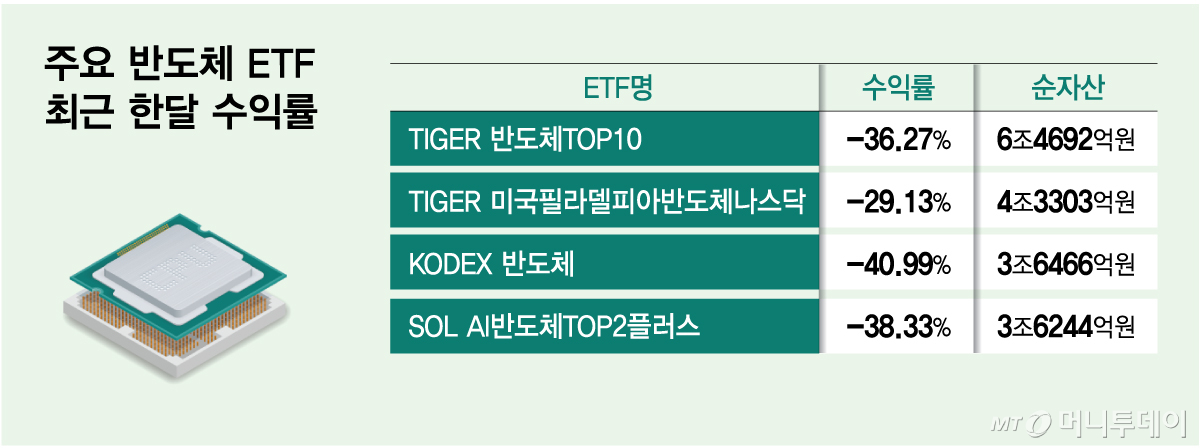
Among major ETFs, TIGER Semiconductor TOP10 posted a loss of 36.3%, and TIGER U.S. Philadelphia Semiconductor Nasdaq fell by 29.1%. KODEX Semiconductor and SOL AI Semiconductor TOP2 Plus also recorded losses of around 40%. Leveraged products suffered even larger losses. KODEX Semiconductor Leveraged and TIGER Semiconductor TOP10 Leveraged recorded -68.4% and -62.3%, respectively. Analysts attribute the heavier impact to the high concentration of semiconductor stocks in the domestic market, as well as the increased allocation to domestic and foreign semiconductor investments by local investors.
Kim Jong-min, a researcher at Samsung Securities, analyzed that "the market faced Blue Tsunami results stronger than expected and quickly reflected concerns over delayed AI investment into prices," adding that "while no substantial damage to fundamentals has been confirmed yet, potential risks were immediately front-loaded." He further stated, "In particular, the Korean stock market, which plays a core role in the global AI value chain, recorded an excessive decline as valuation, supply and demand, and technical support lines temporarily collapsed."
However, securities firms believe the substantive impact will not be significant, advising investors to look for opportunities rather than being swept up in excessive fear. Kim Jae-seung, a researcher at Hyundai Motor Securities, predicted that "while the U.S. Democratic Party's victory may lead to pace adjustments in new data center construction within the U.S., the impact will not be large," noting that "since doubts about data center demand and profitability are not high, various solutions will be sought." Researcher Kim Jong-min added, "While the tsunami's aftermath will involve aftershocks, it is more rational to prepare constructively for what comes next rather than evacuate."

 in STOCK
