

The government is reviewing a plan to convert drugs containing the common cold medicine ingredient 'pseudoephedrine' into 'prescription-only drugs.' This decision follows the arrest of a group suspected of mass-purchasing the relevant medications to manufacture narcotics. In response, some experts have expressed concern that such measures could lower patients' access to medical care.
According to MoneyToday's investigation on the 9th, the Ministry of Food and Drug Safety plans to review cold medicine sales management measures, including the conversion of over-the-counter drugs containing pseudoephedrine into prescription-only drugs, in consultation with relevant ministries such as the Ministry of Health and Welfare.
This follows the recent arrest of a group suspected of manufacturing approximately 1.36 kg of methamphetamine using medications containing pseudoephedrine and harmful chemicals.
The street value is estimated at approximately 4.2 billion won, an amount sufficient for about 40,000 people to use simultaneously. It is known that a traditional medicine practitioner, pharmacists, and pharmacy-related personnel were involved in the incident.
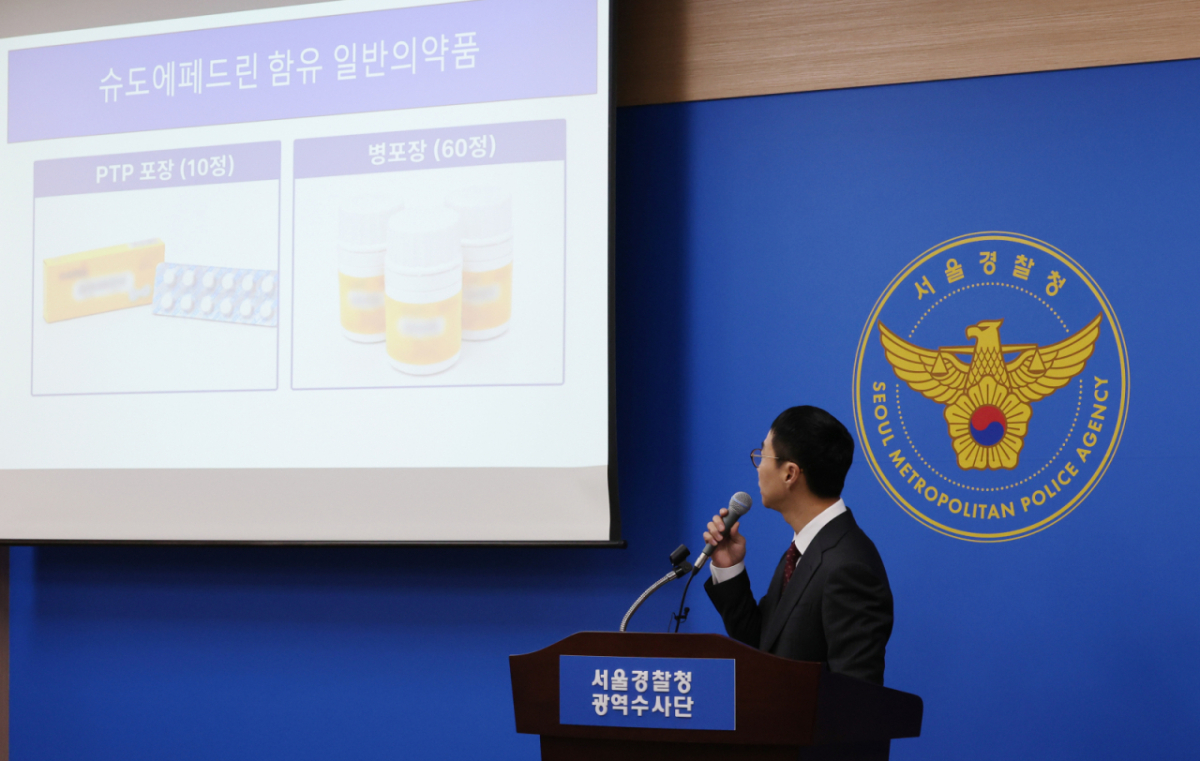
The police announced that they formally requested the Ministry of Food and Drug Safety to promptly review regulations, such as converting cold medicines containing the relevant ingredient from over-the-counter to prescription-only status.
Pseudoephedrine is an ingredient that relieves nasal congestion symptoms and is contained in a significant number of common cold medicine products available on the market.
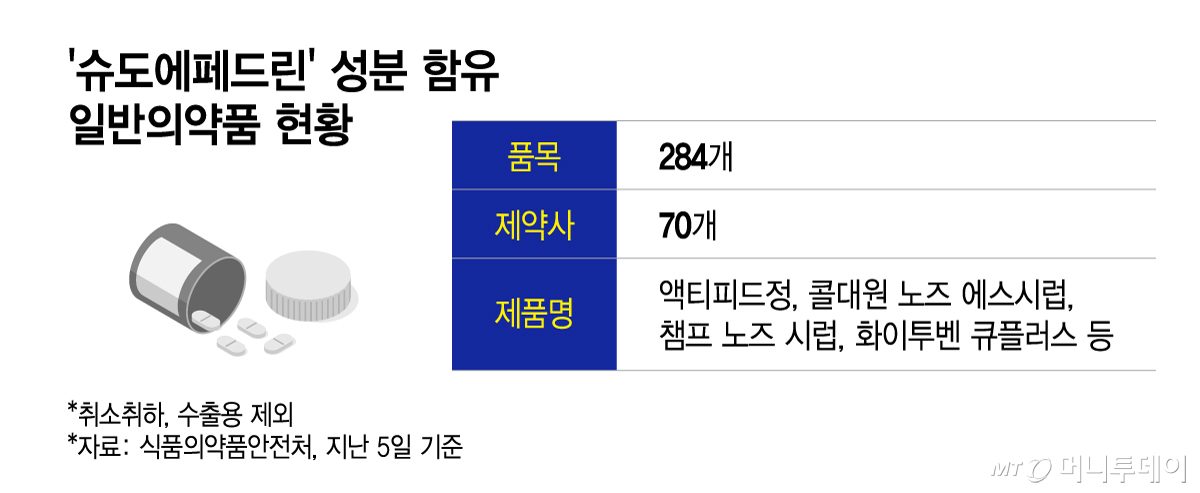
According to the Ministry of Food and Drug Safety, as of the 5th, pseudoephedrine was included in 284 over-the-counter drugs from 70 companies. 'Actifed tablets,' 'Coldwon Nose S syrup,' 'Champ Nose Syrup,' and 'Phytoven Q Plus' are examples of cold medicines containing pseudoephedrine.
Patients with hypertension or cardiovascular diseases, as well as those with benign prostatic hyperplasia, face a higher risk of side effects from pseudoephedrine and need to consult with a pharmacist before taking it.
Unrestricted duplicate dosing or high-dose intake can cause adverse reactions such as increased blood pressure, elevated heart rate, insomnia, and nervousness.
The Ministry of Food and Drug Safety is currently implementing management measures for pseudoephedrine, including recommending sales limited to a four-day supply per person and verifying the purpose of purchase.
If cold medicines containing pseudoephedrine are converted into prescription-only drugs, cold patients will henceforth be required to obtain a doctor's prescription at a medical institution without exception if they wish to take medication for nasal congestion symptoms. Currently, as these are over-the-counter drugs, they can be purchased and taken directly at pharmacies.
In response, some experts oppose the conversion of pseudoephedrine-containing cold medicines into prescription-only drugs, describing it as "burning down the house to catch a bedbug."
Lee Dong-geun, vice president of the Pharmaceutical Society for a Healthy Society (PSHS), criticized the move, stating, "Pseudoephedrine has virtually no substitute as a nasal congestion medication. Converting cold medicines containing this ingredient into prescription-only drugs means that all nasal congestion cold medicines will no longer be available for purchase as over-the-counter drugs at pharmacies."
He added, "It is like burning down the house to get rid of bedbugs. The government should formulate policies not by eliminating the drug itself, but by strengthening related regulations and pharmacy responsibilities."
Nam Eun-kyung, head of the Social Policy Team at the Citizens' League for Economic Justice, pointed out, "If cold medicines are converted into prescription-only drugs, patients must visit medical institutions to receive treatment to obtain the medication.
This will increase the financial burden on patients and the fiscal burden on the National Health Insurance system, while reducing access to healthcare."
She further noted, "The manufacture of narcotics using pseudoephedrine is an issue that the police should resolve through administrative power. Converting to prescription-only status is an administratively convenient idea that ignores public convenience and shifts all costs onto the citizens."
Pharmacist Jung Il-young suggested in a contribution that "the key to preventing crime lies in tracking mass purchases and sales and responsible sales management."
He advised, "A separate category called 'over-the-counter drugs with concerns of misuse' should be established. Items in this category should be sold only at pharmacies, pharmacists should verify and record the reason for purchase and quantity, and a system must be built to track mass or repeated purchases of pseudoephedrine-containing cold medicines in real time."

 in THEBIO

