

Although mandatory ESG (environment, social, and governance) disclosure will be required for KOSPI-listed companies with total consolidated assets of 10 trillion won or more starting in 2028, one in five listed companies meeting this criterion has not disclosed a sustainable management report.
Since information from the 2027 fiscal year must be made public, companies need to establish systems for managing carbon emissions as early as next January. In addition to assessing the impact of reduction costs on performance, companies' ability to respond to climate risks is expected to become a new criterion for investors' judgments.
First disclosure in 2028, preparation starts this year… must build emission management systems
According to the financial investment industry on the 10th, the Financial Services Commission is advancing legislation to mandate sustainability disclosures. Including 184 major subsidiaries of the 107th companies subject to mandatory disclosure, 291 entities fall within the scope of disclosure impact.
An analysis by SK Securities of 106 KOSPI-listed companies with total consolidated assets of 10 trillion won or more in 2024 found that 84 companies (79.2%) had disclosed sustainable management reports, while 22 companies had not.
Companies that have not previously published reports face the burden of newly establishing responsible organizations, internal controls, and systems for calculating and verifying emissions.
First, they must calculate 'Scope 1' greenhouse gases emitted directly from business sites and 'Scope 2' indirect emissions resulting from purchased electricity and heat use, and collect and verify data from domestic and foreign subsidiaries using the same standards. Companies that have already been publishing sustainable management reports also need to establish information management systems compliant with statutory disclosure requirements.
The government has established a plan to postpone mandatory disclosure of 'Scope 3' emissions, which refer to total supply chain emissions, by three years from the point when it becomes mandatory, and to exempt companies from liability for damages and sanctions under the Capital Markets Act regarding disclosure information for the initial three years, excluding intentional 'greenwashing' (exaggerating or distorting eco-friendly management beyond reality). Even so, systems must be prepared in advance to secure data from partner companies. Experts pointed out that initial exemptions do not eliminate the possibility of civil law lawsuits by general investors and others.
Preparing for disclosure incurs costs for measuring and verifying emissions, and equipment replacement or energy procurement costs for carbon reduction may also increase. Capital investment increases immediate cash outflows, while rising operating expenses can lower operating profit. On the other hand, improving energy efficiency can be expected to yield medium- to long-term cost savings.
Investors focus on profitability impact rather than emissions… variables in corporate valuation assessments
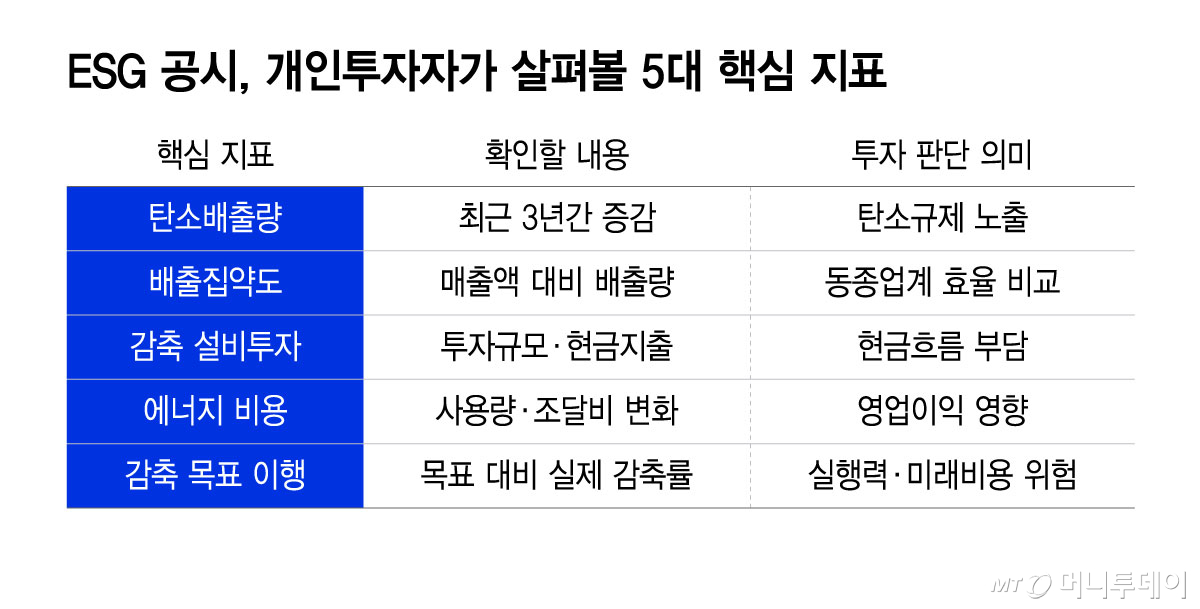
ESG disclosure provides investors with data to examine climate risks in connection with performance. Costs due to carbon regulations or production disruptions caused by heatwaves and floods can change future profit outlooks. If expected costs are large, it may burden stock prices, while improved cash flows from efficiency enhancements could be positive for corporate valuation.
Investors can check emissions over the past three years, 'emission intensity' (emissions relative to revenue), reduction targets, and implementation results in existing sustainable management reports. Experts advised comparing companies within the same industry but warned against judging a company as high-quality solely because its emissions are low. They emphasized examining whether money spent on reduction leads to actual cost savings or improved profitability by cross-referencing with capital investment amounts, operating profit, and operating cash flows in business reports.
Shin Gyeong-su, President of the Sustainable Growth Institute, said, "ESG disclosure is not simply a matter of revealing carbon emissions, but a process showing how climate risks affect a company's future profits and cash flows." He added, "Companies must be able to financially analyze reduction costs and expected effects, and investors should compare the ability to manage emissions and changes in profitability rather than the emissions themselves."

 in STOCK
