

Recommendations have emerged stating that to translate artificial intelligence (AI) into tangible new drug development results, it is essential to ensure data accuracy and connect information across each stage of the development process, from candidate molecule design to clinical trials. There are also voices emphasizing the importance of applying AI to address unmet needs in clinical settings and validating the reliability of predictive outcomes.
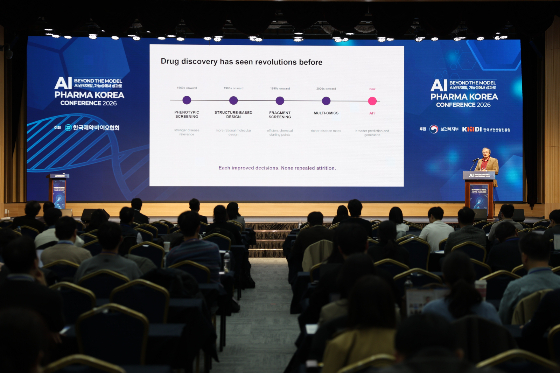
At the ‘AI Pharma Korea Conference 2026,’ hosted by the Korea Pharmaceutical Bio Association on the 10th at the ST Center in Gangnam-gu, Seoul, experts from academia, industry, and regulatory agencies presented strategies and challenges for applying AI in real-world new drug development.
The event was organized to bridge the technical potential of AI with its application in actual research settings and tangible outcomes in new drug development. The Ministry of Health and Welfare also outlined a direction to explore support measures for securing high-quality data, expanding infrastructure, and linking research outcomes with technology development and commercialization.
Edith Chan, a professor at University College London (UCL) in the United Kingdom, who delivered the keynote speech on the theme “Prioritizing New Drug Targets for CNS Disorders: More Precision with AI,” emphasized that data ‘accuracy’ is key to selecting new drug candidates and targets using AI.
Professor Chan stated, “A good AI model starts with high-quality data, but having a large amount of data does not automatically make it a good database.” She added, “To obtain predictions useful for new drug development, one must correct data where compound structures are incorrect or stereochemical information is missing.”
David Asher, a professor at the University of Queensland in Australia, emphasized that the scope of AI applications should be expanded from predicting drug-target binding to include safety, manufacturability, and patient-specific responses, and that information from each stage must be connected.
Professor Asher noted, “Binding well to a target is only the tip of the iceberg of what an effective medicine requires.” He added, “The best AI model is one that improves the next decision-making step; it should not just create more molecules, but better ones.”
He explained that even if binding affinity is increased, development can fail if other conditions such as solubility, toxicity, and manufacturability are not met. He also argued that AI should be utilized to understand patient-specific drug responses and the likelihood of resistance developing.
Park Yong-min, a leader at LG AI Research Institute, presented an approach starting from unmet needs in clinical settings under the theme “Integrated AI Strategy for New Drug Development Beyond Single Tools.” He said, “We initially tried to gather data and apply it to most cases, but there was not much data actually usable for drug development.” He added, “This led us to reflect on whether we should start from unmet needs.”
Leader Park explained that patient samples and clinical outcomes before and after treatment must be secured and analyzed together. He noted that even if precise molecular analysis data is produced, it is difficult to interpret in relation to drug responses if the timing of sample collection or treatment history is unclear. He introduced that actual research efforts are currently re-analyzing data by refining the definition of sample collection times.
He also emphasized that responding to rapid technological advancements requires cooperation beyond individual model supply, involving hospitals, research institutions, and pharmaceutical companies in jointly producing and analyzing data and validating it in clinical settings. Leader Park stated, “It is unrealistic to assume that a single technology will bring overall utility.” He added, “We must integrate various technologies and work with partners to ensure they are helpful in actual drug development.”
Kim So-hee, head of the Circulatory and Nervous System Drugs Division at the Ministry of Food and Drug Safety, announced plans to develop a ‘Guideline on Considerations for Drug Development Using Artificial Intelligence’ next month. The guideline is planned to cover data suitability, model reliability assessment, management of third-party and pre-trained models, personal information protection, post-adoption performance management, and consultation with regulatory agencies.
The core principle is determining the level of validation based on the purpose of AI use and its impact on decision-making. Division Head Kim introduced the U.S. Food and Drug Administration (FDA) evaluation system, explaining that it involves defining questions and usage contexts, establishing, executing, and documenting model risk assessments and reliability evaluation plans, and then judging suitability for the intended use. The intent is that the higher the reliance on AI results and the greater the impact of the judgment, the higher the level of validation required.
The Ministry of Food and Drug Safety will also introduce AI into its own licensing and review operations. Through a project to “Build an AI Review and Industry Support System for Pharmaceuticals,” which will invest 20 billion won over three years, applicants will be provided with a self-validation service that pre-checks for missing submission materials and formal requirements. For reviewers, the system plans to support drafting review reports, verifying data sources, summarizing and translating materials, and comparing and searching existing licensing documents.
Division Head Kim stated, “It is important to approach AI as an aid to human evaluators rather than a tool that fully automates and makes decisions alone.” She added, “Clear usage context and the representativeness and bias of data are key considerations.”

 in THEBIO
