

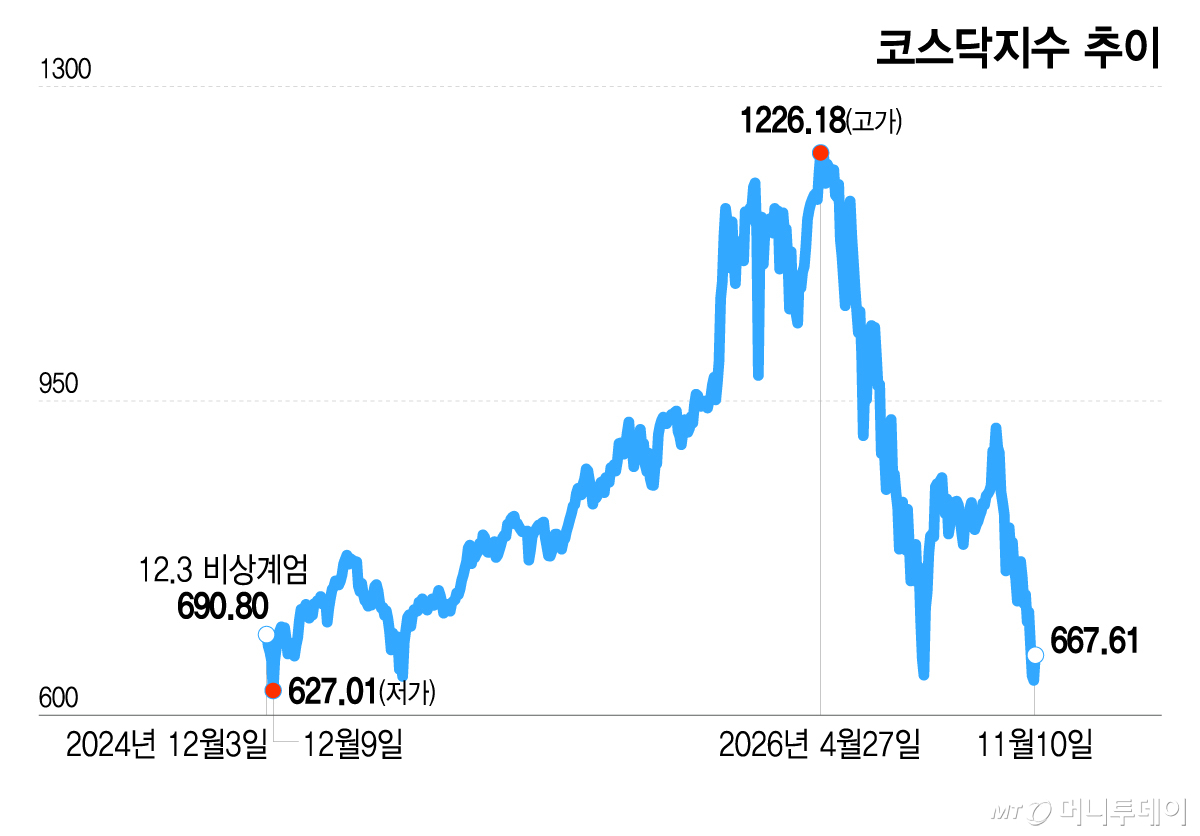
The KOSDAQ index remained in the 600s, reverting to levels seen after the the 3rd emergency martial law. Since the emergency martial law, the KOSPI has risen by 109.56%, but the KOSDAQ has actually fallen by 3.36%. The returns of KOSDAQ ETFs are also in negative territory.
On the 10th, the KOSDAQ closed at 667.61, up 28.64 points (4.48%) from the previous day. The index rose as bargain hunting poured into AI (artificial intelligence)-related stocks, which had plunged sharply following the U.S. midterm elections.
Despite the rebound on this day, the KOSDAQ index has still failed to break out of the 600s. It is even lower than the KOSDAQ index of 677.15 on December 4, 2024, the day after the the 3rd emergency martial law. It is only 40.6 points away from the post-emergency martial law low of 627.01.
Since the emergency martial law, the KOSDAQ rose to the 1,200 level in April last year on expectations for government-led KOSDAQ market improvement policies, but subsequently declined amid supply-demand concentration due to single-stock leverage, volatility issues, concerns over U.S. interest rate hikes, controversies over AI profitability, and concerns over strengthened AI regulations by the US Democratic Party.
In particular, top KOSDAQ market capitalization stocks are composed of biotech stocks, secondary battery stocks, and semiconductor materials, components, and equipment (so-bu-gang) stocks, which are disadvantaged during periods of rising interest rates, leading to greater volatility. Biotech stocks were significantly shaken by individual corporate issues, including the Samchundang Pharm incident.
Secondary battery stocks, which had been declining for a long time due to an EV "chasm" (temporary demand stagnation), revived on expectations for ESS (energy storage systems) but slid again amid concerns over delays in AI data center construction. Semiconductor materials, components, and equipment stocks also showed volatility depending on AI issues.
While the KOSPI once rose on expectations for shareholder returns, the KOSDAQ, which is dominated by growth companies, did not benefit from this effect. This is because companies in the growth stage lack surplus cash or, if they have it, must reinvest it in research and development.
As a result, passive ETFs (exchange-traded funds) tracking the KOSDAQ 150 index, as well as active ETFs managed relatively freely by fund managers, are recording negative returns.
According to KOSCOM ETF Check on this day, the one-month return (based on reinvestment of distributions) of the 'KODEX KOSDAQ150' ETF, which has the largest net asset value among KOSDAQ passive ETFs, is -28.72%, and its year-to-date return is -29.8%. The one-month return of 'KoAct KOSDAQ Active,' which has the largest net asset value among KOSDAQ active ETFs, is -32.97%, and its six-month return is -43.84%.
Experts in the financial investment industry view that while the environment surrounding the KOSDAQ is not easy, the KOSDAQ index itself is forming a bottom zone. Na Seung-du, an analyst at SK Securities, said, "Given that it is forming a bottom zone, I judge that the relative attractiveness of the KOSDAQ will be higher."
In addition, there are forecasts that interest in small- and mid-cap stocks may increase as volatility grows for Samsung Electronics and SK hynix, the leading semiconductor stocks, due to controversies over AI profitability.
Kang Hyun-gi, an analyst at DB Securities, predicted, "There is a possibility that related stocks will have a break until the AI-related situation settles down," adding, "Interest may emerge in small- and mid-cap stocks, led by the KOSDAQ." He further explained, "The fact that the KOSDAQ has proactively formed a bottom is also a factor that creates expectations for the future," noting, "In the first half of next year, a stock market where various stocks move within the KOSDAQ may appear."
It is also positive that government policies to activate the KOSDAQ market, such as the KOSDAQ segment system (promotion and demotion) which separately selects and manages high-quality companies, and strengthened criteria for delisting from the KOSDAQ, are still ongoing. Um Su-jin, an analyst at Hanwha Investment & Securities, said, "Once the KOSDAQ segment system is established, large high-quality companies may remain in the KOSDAQ market without necessarily relocating their listings to the KOSPI, thereby increasing the overall scale of the KOSDAQ market," adding, "After the introduction of the system, the total trading volume of the entire market could also continue to grow."

 in STOCK
